Construction materials, building systems, and industrial components are often too large or too complex to evaluate in a small test chamber. Doors, panels, control cabinets, battery modules, HVAC assemblies, packaged equipment, and complete subassemblies may need to be tested at full size to understand how they perform in real-world storage, transport, and installation conditions. For suppliers that serve contractors, equipment manufacturers, and infrastructure projects, this kind of testing can reduce risk before products reach the jobsite.
A climate test chamber allows teams to create controlled temperature and humidity conditions instead of waiting for natural weather exposure. This is useful because outdoor and warehouse conditions are inconsistent. A product might experience high humidity in coastal storage, heat inside a container, cold during winter transport, or condensation when moved between climates. Controlled testing helps engineering and quality teams repeat these conditions and compare results with more confidence.
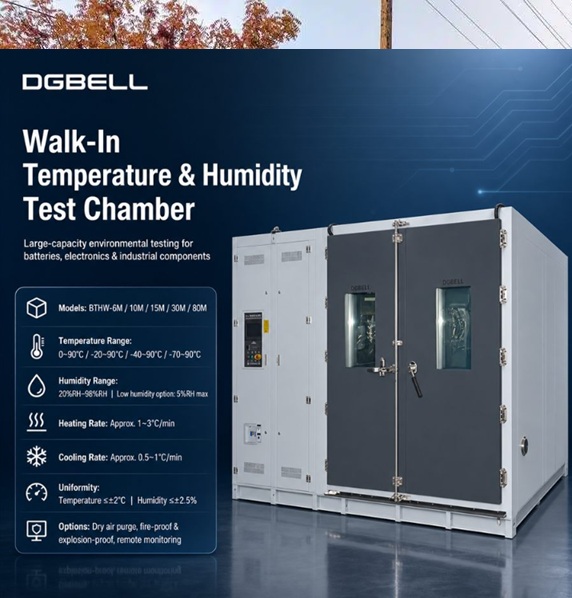
For larger products, a walk-in environmental chamber is especially practical. It gives technicians enough space to place bulky samples, test multiple units together, or evaluate products in realistic packaging. Full-size testing can reveal issues that small coupon tests may miss, including seal movement, door deformation, insulation gaps, coating changes, wiring stress, and condensation inside assemblies.
Humidity exposure is one of the biggest concerns for building products. Moisture can affect adhesives, coatings, insulation, wood-based materials, metal fasteners, electronics, and surface finishes. A product may look acceptable after production but change after days or weeks in a humid environment. Testing under controlled humidity helps suppliers understand whether packaging, material selection, drainage design, or protective coatings are strong enough for the intended market.
Temperature testing is just as important. Heat can soften materials, accelerate aging, and change dimensions. Cold can make plastics brittle, slow down moving parts, or affect seals and gaskets. When temperature and humidity are combined, the stress can be more realistic than either condition alone. Walk-in chambers allow teams to study these combined effects on finished products rather than only on small samples.
Environmental testing also supports better communication with customers. Contractors and industrial buyers often want evidence that a product can survive storage, transport, and operating conditions. Test data gives sales and technical teams a clearer way to answer questions. It can also support internal quality reviews, supplier approval, warranty analysis, and product improvement programs.
Another benefit is packaging validation. Many products are damaged before installation because packaging is not designed for long storage or difficult transport. A walk-in chamber can be used to test packaged units under heat and humidity, helping teams decide whether cartons, films, pallets, foam, desiccants, or barrier bags need improvement. Reducing this kind of damage can save money and protect brand reputation.
For manufacturers that plan to sell in multiple regions, walk-in testing can make product development more predictable. A product made for one climate may later be used in a hotter, colder, wetter, or drier market. By simulating these conditions early, suppliers can adjust designs before field problems appear. This is especially valuable for products used in commercial buildings, energy storage rooms, factories, laboratories, and outdoor infrastructure.
Choosing the right chamber depends on sample size, temperature range, humidity range, uniformity, control accuracy, ramp rate, safety features, and monitoring options. Companies should also consider whether future products may require larger capacity or additional test profiles. A well-planned chamber can support development, quality control, and customer assurance for many product lines.