
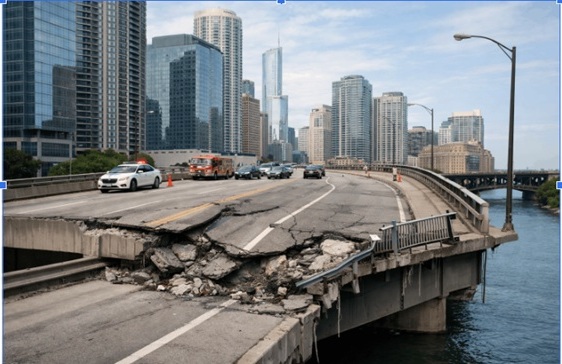
Thousands of bridges across North America are approaching or exceeding their original design life. Corrosion, fatigue, and increasing traffic loads accelerate structural degradation, often faster than periodic inspections can detect. Understanding when and how a bridge deteriorates is now a matter of public safety and budget efficiency.
This guide explores why smarter, data-driven maintenance strategies are replacing outdated approaches and what technologies make it possible.
How Does Bridge Aging Threaten Public Safety?
Detecting internal damage before it becomes visible requires continuous, sensor-based observation over time. Companies like Sixense North America offer structural health monitoring solutions that use permanently installed sensors to track a bridge’s condition around the clock. This kind of real-time oversight gives transportation agencies the data they need to intervene early, rather than discovering problems during a scheduled inspection.
Bridge aging isn’t just a maintenance inconvenience. It’s a growing safety concern that affects millions of daily commuters, freight operators, and emergency services. As bridges age beyond their intended lifespan, the risk of undetected structural failures rises sharply.
What Are the Leading Causes of Structural Deterioration?
Corrosion is the most common driver of bridge degradation. Steel reinforcement inside concrete decks and girders corrodes when moisture and chloride ions penetrate the surface. Over time, this corrosion expands the steel, causing concrete to crack and spall, which accelerates further damage.
Fatigue is another critical factor. Repeated loading from traffic creates micro-cracks in steel components that grow with each cycle. These cracks are difficult to detect visually because they often develop inside structural members or at connection points that aren’t easily accessible.
Environmental stressors compound the problem. Extreme temperature swings, high winds, seismic activity, and flooding events all impose additional forces on aging structures. Each of these stressors interacts with existing deterioration, making the overall condition harder to predict.
Why Do Traditional Visual Inspections Fall Short?
Most bridge inspection programs rely on biennial visual assessments conducted by certified inspectors. While these inspections catch visible surface defects, they miss subsurface damage that may be progressing between visits.
A visual inspection provides a snapshot of the structure at a single point in time. It can’t capture how a crack has evolved over the past 6 months or whether a load-bearing element is experiencing progressive fatigue. This limitation means that some defects only become apparent when they’ve already reached a critical stage.
Access constraints add another layer of difficulty. Inspecting the underside of a bridge deck, the interior of a box girder, or high-tension cable anchorages requires specialized equipment and often causes traffic disruptions. These logistical challenges can delay inspections or reduce their thoroughness.
What Is Structural Health Monitoring and How Does It Work?
Structural health monitoring uses permanently installed sensors to gather continuous data about a bridge’s condition and its surrounding environment. Unlike periodic inspections, this approach captures changes in real time, providing a much more complete picture of how a structure behaves under actual operating conditions.
The core principle is straightforward. Sensors measure physical parameters like strain, vibration, tilt, temperature, and displacement. This data flows to a central platform where software processes it, generates visual dashboards, and triggers alerts when values exceed predefined thresholds.
The result is a shift from reactive maintenance, where problems are addressed after they’re found, to proactive maintenance, where emerging issues are flagged before they become critical.
What Types of Sensors Are Used on Bridges?
The sensor mix depends on the structure type and the specific risks being monitored. Strain gauges measure deformation in steel and concrete elements under load. Accelerometers detect changes in vibration patterns that may indicate weakening connections or foundation shifts.
Tilt sensors track angular movement in piers and abutments. Fiber optic sensors provide distributed measurements along cables and beams, capturing temperature and strain data across long spans with a single installation.
For cable-stayed and prestressed concrete bridges, acoustic emission sensors detect wire strand failures caused by corrosion or fatigue. These sensors pick up the energy released when a strand breaks, providing immediate notification of damage that would otherwise remain hidden inside the structure.
Environmental sensors round out the system by recording temperature, humidity, wind speed, and traffic loads. This contextual data is essential for interpreting structural readings accurately, since many measurements are influenced by weather and usage patterns.
How Does Continuous Data Collection Improve Decision-Making?
Continuous monitoring transforms raw data into actionable maintenance intelligence. Instead of relying on a single inspection report every 2 years, operators receive a steady stream of indicators that track the structure’s condition over time.
Trend analysis is one of the most powerful benefits. By comparing current measurements against historical baselines, engineers can identify gradual changes that signal early-stage deterioration. A slow increase in cable tension loss or a progressive shift in vibration frequency both point to issues that warrant investigation before they escalate.
Automated alerts provide an additional safety layer. When a sensor reading crosses a critical threshold, the system notifies the engineering team immediately. This rapid response capability is especially valuable for extreme events like earthquakes, floods, or abnormal traffic loads that can cause sudden damage.
Data-driven prioritization also helps operators allocate limited maintenance budgets more effectively. Instead of applying the same inspection schedule to every bridge regardless of condition, agencies can direct resources toward the structures that need them most.
What Are the Key Benefits of Real-Time Bridge Monitoring?
Real-time monitoring delivers advantages that extend well beyond early fault detection. It fundamentally changes how bridge operators approach the entire lifecycle of their infrastructure, from daily operations to long-term capital planning.
Extending Service Life Through Early Fault Detection
Catching a defect early is significantly cheaper than repairing the damage it causes later. A small crack in a concrete deck that’s detected and sealed costs a fraction of what a full deck replacement would require if the crack is allowed to propagate unchecked.
Early detection also prevents secondary damage. When corrosion in one element goes unnoticed, the loads it was carrying transfer to adjacent components, accelerating their degradation. Continuous monitoring breaks this cycle by flagging the initial problem before it cascades.
The net effect is a meaningful extension of service life. Structures that receive timely, targeted maintenance based on monitoring data can remain safely in service well beyond their original design lifespan, delaying or even avoiding the need for costly full replacements.
How Do Automated Alerts Reduce Emergency Repair Costs?
Emergency repairs are among the most expensive maintenance activities. They require rapid mobilization, often involve traffic closures, and may demand temporary structural reinforcements while permanent fixes are engineered and installed.
Automated alert systems reduce emergency scenarios by catching developing problems during their early stages. A sudden spike in strain on a girder, for instance, triggers an immediate investigation rather than waiting for the next scheduled inspection. In many cases, the issue can be addressed through a planned repair at a fraction of the emergency cost.
Alert systems also improve safety response times during extreme events. If an earthquake or major storm impacts a monitored bridge, the system provides instant feedback on the structure’s condition. This data helps authorities make informed decisions about whether the bridge is safe for traffic without waiting for a physical inspection team to arrive.
Smart Maintenance Strategies for Aging Infrastructure
Effective bridge maintenance requires more than installing sensors. It demands an integrated strategy that combines continuous monitoring with established inspection practices, skilled engineering judgment, and modern data management tools.
Integrating Sensor Data With Periodic Inspections
Continuous monitoring doesn’t replace traditional inspections. It enhances them. Sensor data provides the context that inspectors need to focus their on-site assessments on the areas that matter most.
Before a scheduled inspection, the monitoring team can review recent data trends and flag specific locations where readings suggest potential issues. This targeted approach makes inspections more efficient and more likely to detect subtle defects that a general walkthrough might miss.
The combination also improves reporting accuracy. Inspectors can reference sensor data to support their visual observations, giving bridge owners a more complete and defensible assessment of structural condition.
How Are Digital Dashboards Transforming Asset Management?
Modern monitoring platforms display sensor data through interactive dashboards that present complex information in accessible formats. Engineers and asset managers can view real-time readings, historical trends, alert histories, and maintenance records from a single interface.
These dashboards support better collaboration between field teams and decision-makers. An engineer reviewing a trend on the dashboard can share the visualization with a project manager to justify a maintenance request, backed by clear data rather than qualitative judgment alone.
Customizable indicators allow each stakeholder to focus on the metrics most relevant to their role. An operations team might prioritize traffic load patterns, while a structural engineer focuses on strain trends and vibration frequencies. The platform consolidates everything without forcing everyone to parse raw data.
What the Future Holds for Bridge Maintenance Technology
The technologies supporting bridge maintenance are evolving rapidly. Advances in sensor design, data transmission, and analytical software are expanding what’s possible for infrastructure operators at every scale.
IoT, Satellite Measurements, and Remote Monitoring
The Internet of Things is driving down the cost and complexity of deploying large sensor networks. Wireless sensors with low power requirements can now be installed on structures that previously couldn’t justify the expense of a wired monitoring system.
Satellite-based measurements add a complementary layer of data. Interferometric synthetic aperture radar can detect millimeter-level surface movements across entire bridge corridors without any on-site instrumentation. This capability is particularly valuable for screening large inventories of structures and identifying which ones need closer attention.
Remote monitoring platforms allow engineering teams to oversee multiple bridges from a centralized location. This distributed model reduces the need for frequent site visits while maintaining continuous oversight of structural performance.
The Role of Predictive Analytics in Lifecycle Management
Predictive analytics applies statistical models and machine learning to historical monitoring data, forecasting how a structure’s condition will evolve over time. Instead of reacting to current readings, operators can anticipate future maintenance needs and budget accordingly.
These models become more accurate as more data accumulates. A bridge that has been continuously monitored for 5 years provides a rich dataset that enables reliable projections of remaining service life, optimal repair timing, and expected costs.
Predictive approaches also support better capital planning at the network level. Transportation agencies managing hundreds of bridges can use forecasted condition data to prioritize investments, schedule interventions during low-traffic periods, and demonstrate accountability to the public through transparent, data-backed maintenance programs.
Frequently Asked Questions About Aging Bridge Maintenance
What Is the Average Lifespan of a Bridge Without Continuous Monitoring?
Most highway bridges are designed for a service life of 50 to 75 years. Without continuous monitoring, deterioration often goes undetected until it becomes visible during periodic inspections. This delay can shorten effective service life because damage that accumulates between inspections may reach a point where repair is no longer cost-effective. Continuously monitored bridges, by contrast, benefit from earlier interventions that help maintain structural integrity and extend usable life well beyond the original design horizon.
How Does Weather Accelerate Bridge Structural Decay?
Freeze-thaw cycles are among the most damaging weather-related factors. Water seeps into concrete cracks, freezes, expands, and widens those cracks with each cycle. In northern climates, this process repeats dozens of times per year. Road salt used for de-icing introduces chloride ions that accelerate reinforcement corrosion. High temperatures cause thermal expansion that stresses joints and bearings, while high winds and flooding impose lateral forces the structure may not have been designed to handle repeatedly.
What Should Transportation Agencies Look for in a Monitoring Solution?
A reliable monitoring solution should offer durable, field-proven sensors suited to the specific risks of the structure. The software platform should provide real-time data visualization, automated alerts, and historical trend analysis accessible to both engineers and asset managers. Integration capability matters too.
The system should accommodate varied sensor types and environmental measurements within a single interface. Finally, look for a provider with civil engineering expertise, not just sensor hardware. Understanding the structural context behind the data is what turns raw measurements into meaningful maintenance decisions.






