
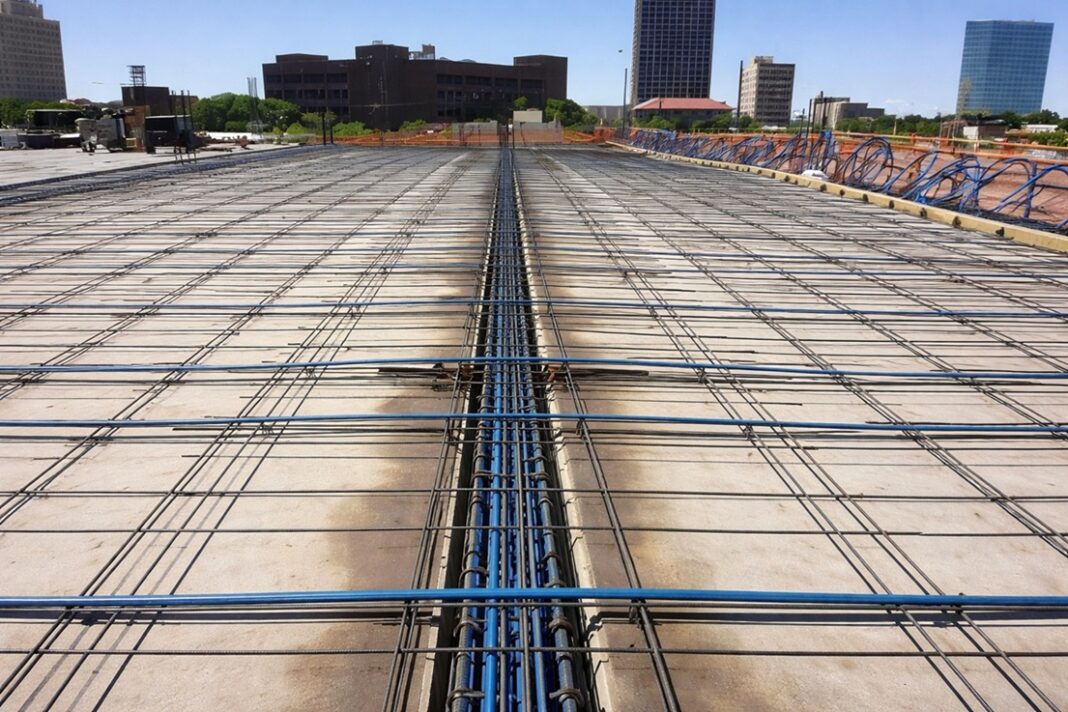
Concrete is valued for its compressive strength, yet it is inherently weak in tension. Traditional reinforced concrete addresses this to some extent, but in long-span bridges, high-rise buildings, and industrial floors, conventional reinforcement often falls short. Post-tensioning provides an effective solution by introducing compression after casting, allowing concrete to resist tensile stresses. Central to this technique are post-tensioning tendons, which carry the applied tensile forces and ensure the concrete remains in a state of beneficial compression.
Understanding Post-Tensioning Tendons
A post-tensioning tendon is a bundle of high-strength steel strands, often housed within a protective duct. Once the concrete reaches sufficient strength, these tendons are tensioned and anchored at both ends. In bonded systems, grout fills the duct, protecting the steel and creating a bond with the surrounding concrete. Tendons can follow straight or draped profiles, matching the structure’s bending moments and maximizing efficiency.
The components of a tendon system include:
- Steel Strands: Single or multi-strand wires, designed for high tensile strength. Multi-strand tendons usually consist of seven wires twisted together.
- Ducts: Plastic or metallic tubes that protect the steel and allow post-tensioning.
- Anchorage System: Transfers the force from the tendon to the concrete.
- Grouting Material: Used in bonded tendons to prevent corrosion and improve load transfer.
Types of Tendons
Post-tensioning tendons are broadly classified based on their bonding:
Bonded Tendons: Embedded in ducts and grouted after tensioning.
- Provide excellent corrosion protection.
- Offer superior crack control.
- Commonly used in bridges and high-rise slabs.
Unbonded Tendons: Coated with grease or plastic, allowing free movement within the duct.
- Easier and faster to install.
- Can be adjusted or replaced if necessary.
- Typically used in industrial floors, parking structures, and residential slabs.
Design Considerations
Designing post-tensioning tendons requires balancing structural demands with material properties:
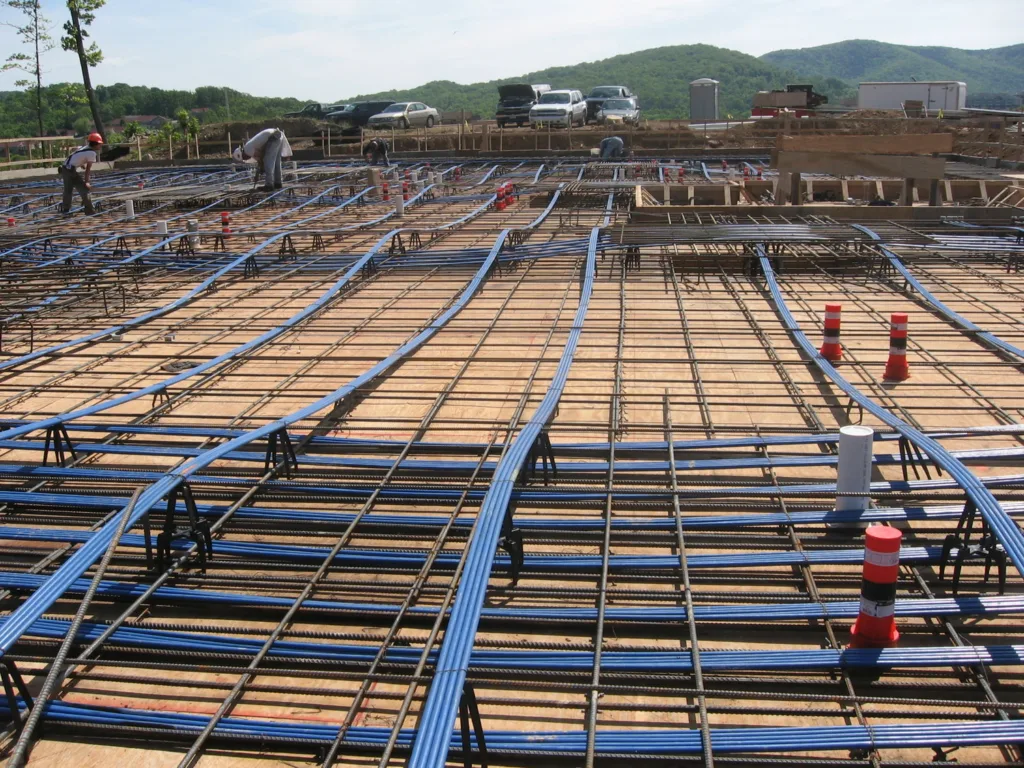
- Tendon Layout: Profiles can be straight or parabolic, following the bending moment diagram. Proper spacing ensures uniform stress distribution.
- Material Properties: High-strength steel strands typically have tensile strengths between 1860 MPa and 2700 MPa, with an elastic modulus of 195–200 GPa.
- Prestress Losses: Include immediate losses (elastic shortening, anchorage set) and time-dependent losses (creep, shrinkage, steel relaxation). Codes such as ACI 318 and IS 1343 provide guidance to account for these losses.
Installation Process
The installation of post-tensioning tendons combines precision and technique:
- Preparation: Ducts are positioned in the formwork and tendons threaded through.
- Concrete Casting: Concrete is poured and vibrated for compaction.
- Tensioning: Hydraulic jacks apply the required force once concrete reaches the target strength (typically 75%).
- Anchoring: Tendons are secured at both ends with wedges and plates.
- Grouting (Bonded Tendons): Cementitious grout is injected to bond the tendon to concrete and prevent corrosion.
Applications
Post-tensioning tendons enhance performance across diverse structures:
- Buildings: Long-span slabs, thinner floors, and reduced column sizes allow flexible, open spaces.
- Bridges: Segmental and cable-stayed bridges rely on tendons for bending resistance and minimized deflection.
- Industrial Floors: Warehouses and parking decks benefit from unbonded tendons, accommodating thermal expansion.
- Specialty Structures: Water tanks, stadiums, and airport runways use tendons for high strength-to-weight ratios and crack control.
Advantages
Post-tensioning tendons provide multiple benefits:
- Reduced slab thickness and material usage.
- Improved crack control through induced compression.
- Longer spans without intermediate supports.
- Enhanced durability, particularly with bonded tendons.
- Faster construction and economic efficiency.
Challenges
Despite their advantages, tendons demand attention:
- Risk of corrosion if grouting is inadequate.
- Installation errors can compromise structural integrity.
- Requires inspection and maintenance for exposed tendons.
- Complex design calculations for tendon profiles and prestress losses.
- High-tension strands necessitate strict safety during installation.
Quality Control & Standards
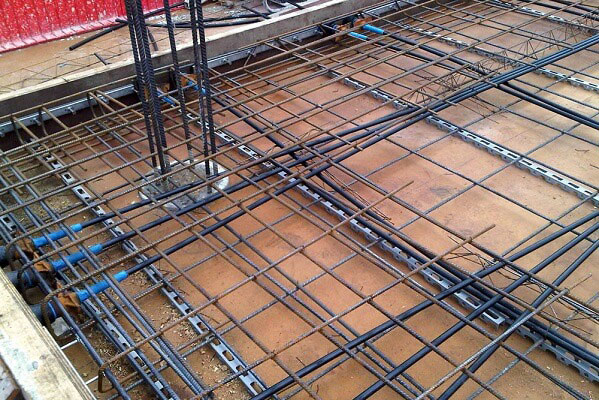
Quality assurance is crucial. Tendons must comply with ASTM A416 or IS 14268 standards. Concrete strength, duct alignment, and grouting quality must be verified. Non-destructive testing (NDT) such as load testing ensures performance, while thorough documentation and certification are essential for critical infrastructure projects.
Future Trends
Innovation in post-tensioning continues to expand its possibilities:
- Corrosion-resistant steel and galvanized tendons.
- Carbon Fiber Reinforced Polymer (CFRP) tendons for lightweight, durable alternatives.
- Embedded sensors for real-time structural monitoring.
- Eco-friendly, low-carbon grouting materials.
Conclusion
Post-tensioning tendons are essential in transforming concrete structures into high-performance systems. By integrating proper design, meticulous installation, and quality control, engineers can achieve efficient, durable, and aesthetically pleasing constructions. As urbanization grows and construction demands become more complex, post-tensioning technology will continue to play a pivotal role in shaping the infrastructure of the future.






