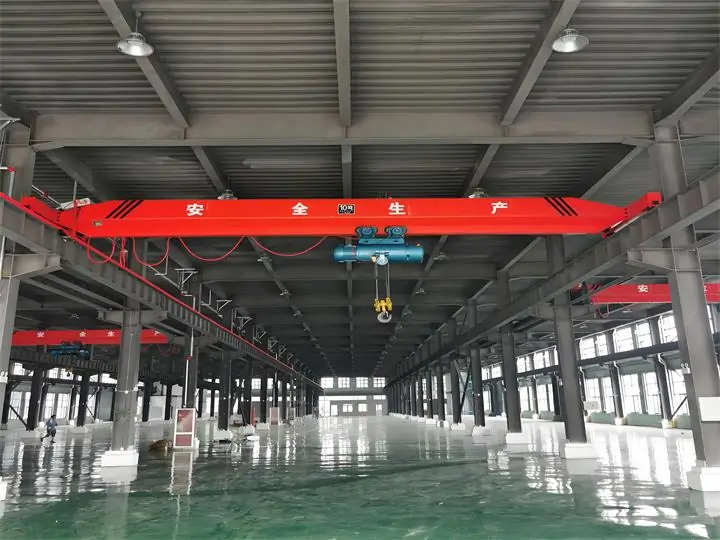
The 10 ton overhead crane sits at a critical crossroads in industrial material handling — capable enough for serious production environments, yet accessible enough for mid-sized workshops, fabrication facilities, and warehouses that don’t require the heavy infrastructure of high-capacity systems. It is, by most accounts, one of the most commonly specified crane capacities worldwide.
Yet buying the wrong configuration — or specifying the wrong duty class, span, or girder type — can result in a system that underperforms, fails prematurely, or creates safety risks. This guide walks through every key decision point for engineers, procurement managers, and facility operators considering a 10 ton overhead crane or 10 ton bridge crane purchase in 2026.
Why the 10-Ton Class Matters in 2026
The overhead crane market is in an active growth phase. The global overhead cranes market was valued at USD 5.7 billion in 2024 and is projected to reach USD 13.2 billion by 2034, growing at a CAGR of 5.5%. Insight Within that expansion, mid-capacity bridge cranes — particularly in the 5–20 ton range — represent the broadest segment by unit volume, driven by manufacturing sector growth, warehouse modernization, and increasing automation investment.
Asia-Pacific dominates the industry, accounting for nearly 45–48% of global revenue in 2026, driven by strong manufacturing output in China, India, Japan, and South Korea. But demand is rising across all major regions, with North America expected to account for approximately 20–22% of global revenue in 2026, supported by reshoring initiatives and advanced manufacturing investments.
For facilities evaluating a 10 ton bridge crane for sale, understanding the full specification picture — not just rated capacity — is essential to making a sound long-term investment.
Step 1: Single Girder vs. Double Girder — The Most Fundamental Decision
The first and most consequential decision in specifying a 10 ton overhead crane is whether to use a single girder or double girder configuration.
Single Girder 10 Ton Overhead Crane
A single girder crane uses one main bridge beam, with the hoist and trolley running beneath it on the bottom flange. Single girder overhead cranes are considered light to medium duty lifting equipment, commonly used in workshops, warehouses, and yards. Because only one beam girder is required to move the trolley and hoist, the single girder crane offers lower equipment cost, lower freight costs, and easier installation.
For 10 ton applications with moderate duty cycles (A3–A5), single girder configurations are technically valid and cost-effective. Standard spans for single girder 10 ton cranes typically run from 10.5 meters to around 22 meters, though custom spans are available.
Double Girder 10 Ton Bridge Crane
The 10 ton double girder overhead crane consists of two parallel main girders, a design that allows it to carry heavier loads and is suitable for heavy-duty work and demanding spanning applications. The trolley runs on top of the two girders rather than beneath them, which delivers several advantages: greater hook height (critical in tall facilities), better headroom for hook approach, and the ability to mount auxiliary hoists or specialized lifting attachments.
Double girder configurations are recommended when:
- Duty class exceeds A5
- Span exceeds 22–25 meters
- The facility requires maximum hook height
- Special attachments (grabs, magnets, spreader beams) are required
Step 2: Understanding Duty Class — The Spec Most Buyers Overlook
Duty class is arguably the single most important specification that buyers underestimate. It defines how intensively the crane is designed to be used, and selecting incorrectly leads to accelerated wear, structural fatigue, and shortened service life.
The most widely referenced classification systems are FEM (European) and ISO:
Duty ClassTypical Use CaseDaily Operating HoursA3 / M3Light workshop, infrequent lifts< 2 hoursA4 / M4General manufacturing, moderate use2–4 hoursA5 / M5Regular industrial production4–8 hoursA6 / M6Heavy continuous production8–16 hoursA7 / M7Intensive 24-hour operations16–24 hours
For a 10 ton crane in a standard manufacturing environment with regular material handling cycles, A5 duty class is a common and appropriate specification, supporting frequent use in demanding environments with high precision.
A facility running two shifts in steel fabrication, for example, should specify A6 rather than A5 — even if the crane appears to be handling the load comfortably on A5 in the short term. Underspecifying duty class is one of the most common causes of premature crane failure and unexpectedly high maintenance costs.
Step 3: Span and Lifting Height
The span of an overhead bridge crane is the distance between the rails on which the crane runs, measured horizontally. Overhead cranes typically have spans ranging from 10.5m to 31.5m, customized to customer requirements. A larger span is required for bigger or more spacious work areas.
For a 10 ton overhead crane, the structural implications of span are significant. As span increases:
- Beam deflection under load increases (requiring heavier section or pre-camber)
- Dead weight of the bridge increases, placing higher loads on the runway structure
- End carriage wheel loads increase, requiring heavier runway beams and column foundations
The practical recommendation: always involve a structural engineer in the building load verification before finalizing span specifications. Many projects encounter costly redesigns late in the process because runway beam and column capacity was not checked against crane wheel loads at the outset.
Lifting height — the vertical distance from the floor to the hook at maximum elevation — must account for the full load cycle: where loads are picked up, how high they need to travel, and where they are set down. Typical lifting heights for 10 ton overhead cranes range from 6 meters in low-clearance workshops to 12 meters or more in tall industrial halls. Custom lifting heights are available to fit narrow workshops or unusually wide industrial halls, with low-headroom installations at 6 meters and tall industrial setups exceeding 12 meters.
Step 4: Hoist Type and Trolley Configuration
The hoist is the heart of the crane system. For 10 ton overhead cranes, two main hoist types are in common use:
Wire Rope Hoist The standard choice for 10 ton applications. Wire rope hoists offer high load capacity, long service life, and availability in both standard and low-headroom configurations. European-standard wire rope hoists (complying with FEM or EN 14492) offer superior engineering and more precise speed control than traditional CD/MD type hoists.
Chain Hoist Electric chain hoists are available up to 10 tons but are more commonly used at lower capacities. They offer compact dimensions and lower cost at lighter capacities, but wire rope hoists are generally preferred for consistent 10 ton duty given their lower maintenance requirements and better performance under heavy cycle loads.
Low-Headroom Configurations
In facilities with limited ceiling clearance, low-headroom hoist and trolley assemblies minimize the distance between the top of the hook and the crane rail, maximizing effective hook height. This is particularly relevant in older industrial buildings where ceiling height was not originally designed for crane installation.
Step 5: Speed Selection and Variable Frequency Drives
Crane operating speeds affect both productivity and safety. Standard speed combinations for a 10 ton overhead crane are typically:
- Hoisting speed: 0.8–8 m/min (with two-speed or VFD control)
- Trolley travel speed: 20–40 m/min
- Bridge travel speed: 40–80 m/min
Variable Frequency Drive (VFD) control on all three motions has become standard on quality systems. VFDs provide smooth acceleration and deceleration, dramatically reduce structural shock loads on the crane and runway, extend motor and mechanical component life, and enable precise load positioning — critical in applications like mold handling, precision assembly, or work near personnel.
Hoisting and traveling speeds ranging from 0 to 8 m/min for hoisting, 0 to 20 m/min for trolley travel, and up to 40 m/min for bridge travel represent typical parameters for a 10 ton EOT crane with FEM-standard engineering. voittocrane For higher-productivity applications, faster speeds are available with appropriate runway and structural design.
Step 6: Safety Systems — What a Quality 10 Ton Bridge Crane Must Include
Modern 10 ton bridge cranes should incorporate the following safety systems as standard:
Overload Protection — Load limiters that prevent the crane from hoisting beyond its rated capacity. Required under most international standards including EN 13001, ASME B30.2, and FEM.
End Travel Limits — Limit switches on all three axes (hoisting, trolley travel, bridge travel) that prevent overtravel and buffer impact.
Emergency Stop — Accessible emergency stop on all control pendants and, where applicable, radio remote controls.
Anti-Collision Systems — In facilities with multiple cranes on the same runway, proximity detection prevents crane-to-crane collisions. Increasingly standard on new installations.
Slack Rope Protection — Detects abnormal rope slack conditions that could indicate hook snagging, preventing mechanical overload.
Maintenance Platform and Walkways — Required on double girder cranes for safe access to the bridge for maintenance. Single girder cranes typically use floor-level or elevated platform access.
Step 7: Control Systems
Control options for 10 ton overhead cranes range from simple corded pendants to fully automated systems:
Corded Pendant Control — The most common control method for standard workshop cranes. Robust, low-maintenance, and familiar to operators. Pendant cables require periodic inspection and replacement.
Radio Remote Control — Increasingly standard in new installations. Gives the operator freedom of movement, improving both safety (operator not directly beneath the load) and productivity. Suitable for all standard 10 ton applications.
Cabin Control — Used in large facilities where the operator needs elevated visibility of the full working area. Less common at 10 ton capacity but used in some steel fabrication and heavy manufacturing environments.
Automated and Semi-Automated Control — The growing automation of various activities within the industrial sector is fueling demand for overhead cranes with automated control capabilities, as automating labor-intensive lifting tasks enhances productivity and reduces lead times. Archive Market Research For repetitive, defined lift cycles, semi-automated positioning systems can significantly improve throughput.
Step 8: Environmental and Special-Duty Considerations
Standard 10 ton overhead cranes are designed for indoor use in ambient temperatures of approximately -20°C to +40°C. For applications outside this envelope or in hazardous conditions, specify accordingly:
- Explosion-proof cranes — required in environments with flammable gases, vapors, or dusts (ATEX or IECEx certified)
- Corrosion-resistant configurations — for food processing, chemical plants, or coastal/offshore environments
- High-temperature cranes — for foundries, steel mills, or heat treatment facilities
- Outdoor cranes — require weatherproofing to IP55 or higher on electrical components, corrosion protection on structural elements, and wind loading analysis
Step 9: Evaluating 10 Ton Overhead Crane Pricing
When comparing 10 ton overhead crane for sale options in 2026, price variance is significant. Broadly:
- Basic single girder 10 ton crane (standard span, A4 duty): USD 8,000–18,000
- Double girder 10 ton crane (moderate span, A5 duty, VFD): USD 18,000–40,000
- European-standard 10 ton crane (FEM, branded components, A6 duty): USD 35,000–70,000+
These are equipment-only ranges. Installation costs — including runway structure, electrical supply, commissioning, and load testing — can add 30–80% to total project cost depending on facility conditions.
The lowest-priced equipment is rarely the lowest total cost of ownership. Crane systems with superior materials, precision manufacturing, and branded electrical components typically deliver significantly lower maintenance costs and longer service life across a 15–25 year operational lifespan.
Step 10: Certification and Compliance
Before finalizing any purchase, confirm the following:
- Design standard compliance: FEM (Europe), ASME B30.2 (USA), GB/T 3811 (China), or relevant local standard
- Structural weld inspection: NDT (non-destructive testing) documentation for primary welds
- Load test certificate: Factory acceptance test at 125% of rated load (or as required by local regulations)
- Electrical compliance: CE marking (Europe), UL listing (USA), or equivalent
- Third-party inspection: For critical applications or international procurement, consider independent third-party inspection at the factory prior to shipment
Choosing the Right Supplier
The quality of the supplier relationship matters as much as the equipment specification. A reputable 10 ton bridge crane supplier should provide:
- Detailed engineering drawings and load calculations for runway design
- Clear documentation of component origins and specifications
- Realistic lead times with milestone-based delivery commitments
- On-site installation support or clear remote installation guidance
- Spare parts availability commitment for a minimum of 10 years
- References from comparable applications in your industry and region
For global buyers sourcing from Chinese manufacturers — which account for roughly 40% of global overhead crane manufacturing output — working with a supplier that has demonstrated export experience, understands international logistics and customs documentation, and can provide post-sale technical support in your time zone significantly reduces procurement risk.
Summary: 10-Point Checklist for Buying a 10 Ton Overhead Crane#Decision PointKey Question1Girder typeSingle or double girder based on duty and span?2Duty classA3–A7: what is the actual daily operating cycle?3SpanVerified against building column spacing and runway capacity?4Lifting heightFull lift cycle analyzed from pickup point to set-down?5Hoist typeWire rope or chain; standard or low-headroom?6Speed and drivesVFD on all three motions for smooth and safe operation?7Safety systemsOverload protection, end limits, anti-collision included?8Control methodPendant, radio remote, or automated?9Environmental specStandard, explosion-proof, corrosion-resistant, or outdoor?10CertificationDesign standard, load test, and electrical compliance confirmed?