Most quantity errors on small paving jobs trace back to two habits: treating loose and compacted volume as the same thing, and using one density for every material. On a driveway or a short access road the result is a short load, a second delivery charge and a crew waiting on a truck. The take-off below goes layer by layer, uses figures that road agencies publish, and ends with a worked example in US and metric units.
Write down the section before you measure
Each layer in a flexible pavement has its own thickness, density and allowance, so the order is built up layer by layer and not from one area figure.
- Subgrade. The prepared natural ground. There is nothing to order unless soft spots are dug out and replaced.
- Base course. Dense-graded crushed aggregate, placed and compacted in lifts.
- Surfacing. Either a gravel wearing course or hot mix asphalt.
For a residential driveway, the Colorado Asphalt Pavement Association’s driveway brief gives 3 in (75 mm) of asphalt over 4 in (100 mm) of aggregate base on good or fair subgrade, and 3 in over 6 in (150 mm) on poor subgrade. The Illinois Asphalt Pavement Association suggests 3 in over 6 to 8 in of compacted aggregate. Anything that carries regular trucks needs a designed section, not a rule of thumb.
Base course: the drawing is compacted, the truck is loose
The thickness on a drawing is the compacted thickness. The material arrives loose and loses volume under the roller, so ordering the geometric volume leaves the layer thin.
Washington State DOT’s Design Manual (Exhibit 620-1) lists crushed surfacing base course at 2,950 lb per cubic yard loose and 3,700 lb per cubic yard compacted, roughly 1,750 and 2,195 kg/m³. On those figures, every compacted cubic metre takes about 1.25 cubic metres off the truck.
There are two ways to reach tonnage, and they agree as long as they are not mixed:
- Compacted volume × compacted density.
- Compacted volume × 1.25 × loose density.
The free road base calculator at Site Measure runs the same arithmetic and lets you enter your own quarry’s weight per cubic yard, which is worth doing because stone type and moisture both move the figure. Base is normally paid by weight and delivered damp. New Jersey DOT places dense-graded aggregate at 6 ± 2 percent moisture and will not take it wetter than 8 percent when it is paid by weight. At that limit, about 148 lb of each 2,000 lb ton on the ticket is water.
Depth also decides how the layer is built. Virginia DOT allows no more than 6 in compacted per layer and Caltrans no more than 0.50 ft, so an 8 in base goes down as two 4 in lifts. Caltrans asks for at least 95 percent relative compaction in every layer.
The name changes by region for broadly the same family of material: wet mix macadam in Indian practice, Class 2 aggregate base in California, ABC in North Carolina, 21A in Virginia, 2A in Pennsylvania. Ask the quarry for the local specification name, not just “road base”.
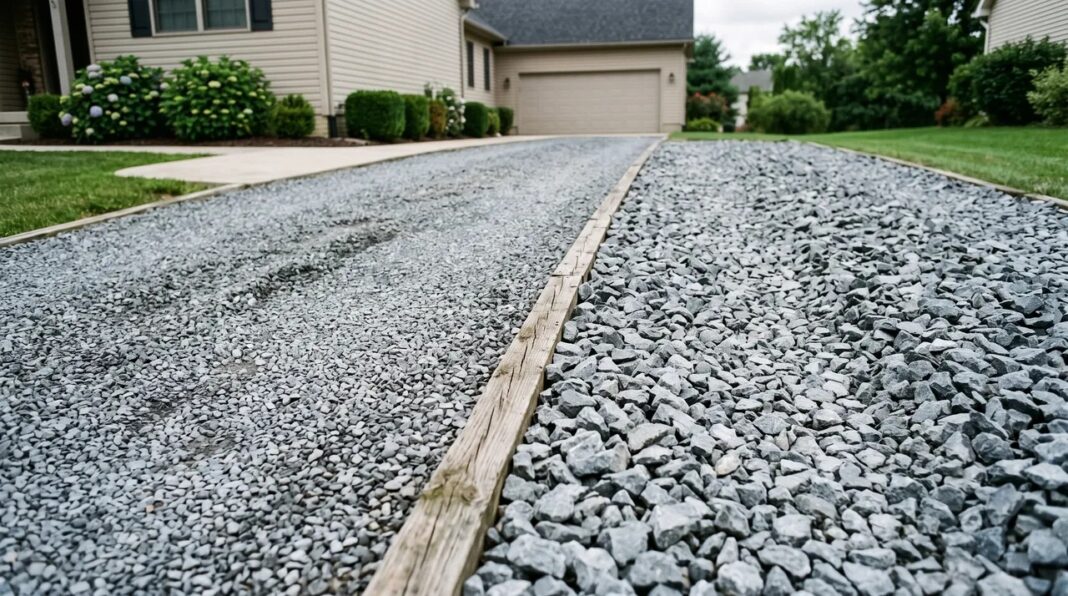
Gravel surfacing is not base left uncovered
If the road stays unsealed, the wearing course is a different product from the base. The FHWA Gravel Roads Construction and Maintenance Guide describes base gravel as having larger stone and very little clay or fine material, which gives it strength and drainage. Left on top, it does not form a crust and stays loose. Surface gravel needs enough fine material with a binding, plastic character to hold together and shed water.
The same guide puts the surface course at 3 in (75 mm) or more, so there is material left to work with a grader. For quantity, start from the supplier’s loose weight. Where none is published, 105 lb/ft³ is a workable general figure for gravel: about 1.42 US tons per cubic yard, or 1,680 kg/m³. A gravel calculator with a metric mode converts length, width and depth to cubic yards and tons, or to cubic metres and tonnes, and leaves the allowance for you to set.
Asphalt: tonnage comes from compacted thickness
Hot mix is ordered by weight for a compacted thickness. Iowa DOT uses 145 lb/ft³ (about 2,320 kg/m³) for estimating compacted hot mix asphalt. That is roughly 109 lb per square yard for each inch of thickness, or about 58 kg per square metre for a 25 mm layer.
Tonnage is area × compacted thickness × compacted density.
Do not add a loose allowance on top. The Asphalt Paving Handbook gives a rolldown of about 25 percent for dense-graded mixes, so a 3 in layer leaves the screed near 3¾ in thick. The weight is the same before and after rolling; only the thickness changes. An asphalt calculator that asks for compacted thickness keeps the two from being confused.
Worked example: a 12 × 40 ft driveway
The area is 480 ft² (44.6 m²). The section is 3 in of asphalt over 4 in of aggregate base, the CAPA design for good subgrade.
| Layer | Compacted thickness | Compacted volume | Density used | Order |
| Aggregate base | 4 in (100 mm) | 5.93 yd³ (4.53 m³) | 3,700 lb/yd³ compacted | 11.0 US tons (9.9 t), about 7.4 yd³ loose |
| Hot mix asphalt | 3 in (75 mm) | 4.44 yd³ (3.40 m³) | 145 lb/ft³ compacted | 8.7 US tons (7.9 t) |
If the driveway were surfaced with 4 in of gravel instead of asphalt, the same 5.93 yd³ compacted becomes about 7.4 yd³ loose, or roughly 10.5 US tons (9.5 t) at 105 lb/ft³.
Grade control matters as much as the arithmetic. A subgrade trimmed half an inch (12 mm) low across this driveway swallows another 0.74 yd³ of base, about 1.4 US tons, before the layer reaches its design thickness.
Four checks before placing the order
- Loose or compacted. Ask which one the quoted density is, and at what moisture.
- Which ton. A US short ton is 2,000 lb (907 kg) and a metric tonne is 1,000 kg. A quote read in the wrong unit is out by about 10 percent.
- Weight or volume. Quarries sell by the ton, and some yards sell by the cubic yard or cubic metre. Convert with the supplier’s own figure.
- Truck capacity. Round the order up to whole loads and confirm the delivery vehicle can reach the site.
Vincent Ruan maintains Site Measure, a set of free material calculators built on published agency and supplier figures.