When a contractor or asset owner evaluates structural framing for a coastal walkway, wastewater basin, cooling tower, or chemical-plant access platform, the initial bid sheet almost always tells a misleading story. On a raw ex-factory material basis, hot-dip galvanized or painted carbon steel usually prices below pultruded fiberglass-reinforced polymer (FRP). Yet over a 25- to 40-year asset horizon in aggressive environments, initial fabrication is rarely the largest cost item — scaffolding, plant shutdowns, sandblasting, recoating, and premature section replacement routinely dwarf the original purchase order.
Equally misleading is claiming that FRP always beats steel. In dry indoor warehouses or mild rural atmospheres where zinc coatings last a century, conventional galvanized steel remains the rational economic choice. Engineering-grade procurement replaces guesswork with two internationally recognized standards: ISO 9223 (paired with ISO 1461) to estimate realistic galvanizing coating life by site corrosivity, and ISO 15686-5 to discount every future maintenance, shutdown, and replacement dollar back to today’s present value.
1. Quantifying Galvanizing Life with ISO 9223 and ISO 1461
Hot-dip galvanizing protects carbon steel sacrificially: zinc corrodes slowly so the underlying steel does not. How quickly that protective layer disappears depends directly on atmospheric salinity, humidity, industrial sulfur/chloride exposure, and time of wetness. ISO 9223:2012 classifies outdoor atmospheres from C2 (low) through CX (extreme) and publishes first-year zinc corrosion rates in micrometers per year (µm/yr). Meanwhile, ISO 1461 sets minimum mean zinc coating thicknesses for non-centrifuged structural steel articles: 85 µm for steel over 6 mm thick, 70 µm for steel from 3 to 6 mm, and 55 µm for thinner 1.5–3 mm sections.
Dividing coating thickness by the ISO 9223 corrosion rate provides an objective arithmetic screening window for when first major coating maintenance enters a project budget:
Table 1. Arithmetic Hot-Dip Galvanizing Life Estimates by ISO 9223 Corrosivity Category and ISO 1461 Thickness
| ISO 9223 Corrosivity Category | First-Year Zinc Loss (µm/yr) | 85 µm Coating (>6 mm steel) | 70 µm Coating (3–6 mm steel) | 55 µm Coating (1.5–3 mm steel) |
|---|---|---|---|---|
| C2 Low — dry rural, unheated interiors | 0.1–0.7 | 100+ years | 100+ years | 79–100+ years |
| C3 Medium — urban, mild coastal | 0.7–2.1 | 40–121 years | 33–100 years | 26–79 years |
| C4 High — industrial, coastal | 2.1–4.2 | 20–40 years | 17–33 years | 13–26 years |
| C5 Very High — humid industrial, salt-laden coastal | 4.2–8.4 | 10–20 years | 8–17 years | 7–13 years |
| CX Extreme — offshore, severe chemical/splash | 8.4–25.0 | 3–10 years | 3–8 years | 2–7 years |
Basis: ISO 9223:2012 Table 2 first-year zinc rates divided into ISO 1461 minimum mean coating thicknesses. Because long-term zinc rates (ISO 9224) can slow after initial passivation while direct salt splash, immersion, or acid fumes accelerate loss, treat these windows as screening benchmarks rather than warranties.
The inflection point jumps off the table. In C2 and C3 environments, an 85 µm hot-dip galvanized girder easily clears a 30-year study period without a single recoating event. Once a construction site enters C5 (humid industrial plants, coastal marine facilities, wastewater aeration basins) or CX (offshore platforms, chemical splash zones), that same 85 µm coating can reach maintenance within 10–20 years — and thinner 3–6 mm purlins, cable-tray brackets, and handrail posts (70 µm or 55 µm) often require intervention in under a decade.
2. Running an Honest Present-Value Life-Cycle Cost Model (ISO 15686-5)
ISO 15686-5 (alongside ASTM E917 and AS/NZS 4536) standardizes how owners compare a higher-CAPEX, low-maintenance structure against a lower-CAPEX, maintenance-intensive alternative. Every cost C occurring in future year t is discounted to present value using PV = C / (1 + r)^t, where r is the organization’s real discount rate (excluding inflation). To stay objective, both competing bids must first be engineered for the identical structural function — same span, load case, deflection limit, and service period — and quoted in the same currency on the same price date.
To illustrate the arithmetic without inventing market prices, consider a 30-year cost-index model in a C5 corrosive environment at a 3 percent real discount rate, setting galvanized steel’s installed cost at index 100 and FRP’s installed cost at index 130 (+30 percent upfront premium). Under C5 zinc loss, galvanized steel requires protective recoating at Year 13 and Year 28 (cost index 40 per event). FRP still requires inspection and a planned maintenance allowance — modeled here as a surface-care event at Year 25 (cost index 10) rather than assuming an unrealistic ‘zero-maintenance’ myth.
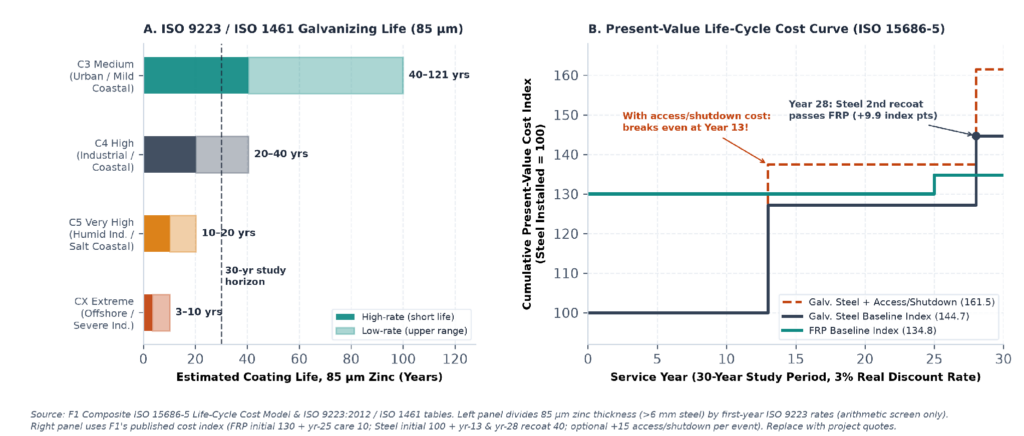
Figure 2. Left: ISO 9223 / ISO 1461 galvanizing coating-life windows for 85 µm steel against a 30-year asset horizon. Right: Cumulative ISO 15686-5 present-value cost index comparing FRP vs. galvanized steel both with zero shutdown cost and with an access/shutdown allowance (+15 per maintenance event).
Table 2. Worked 30-Year ISO 15686-5 Present-Value Cost Index (3% Real Discount Rate, Steel Installed = 100)
| Cost Component (Present Value) | FRP Option (Baseline) | Galv. Steel (Baseline) | FRP (+15 Access/Shutdown) | Galv. Steel (+15 Access/Shutdown) |
|---|---|---|---|---|
| Initial installed cost (Year 0) | 130.00 | 100.00 | 130.00 | 100.00 |
| Maintenance event #1 (PV) | Year 25: 4.78 | Year 13: 27.24 | Year 25: 4.78 | Year 13: 27.24 |
| Maintenance event #2 (PV) | None in 30 yrs | Year 28: 17.48 | None in 30 yrs | Year 28: 17.48 |
| Access, scaffolding & shutdown (PV) | 0.00 | 0.00 | Year 25: 7.16 | Yrs 13 & 28: 16.77 |
| Total 30-Year Present Value | 134.78 | 144.72 | 141.94 | 161.49 |
| Net Present-Value Advantage | FRP saves 9.95 pts (6.9%) | Baseline (+9.95) | FRP saves 19.55 pts (12.1%) | Baseline (+19.55) |
Illustrative index math matching F1 Composite’s ISO 15686-5 model (C / 1.03^t; annual inspection excluded; no full structural replacement within 30 years). Sensitivity check: raising the real discount rate to 6% shrinks future PV costs and narrows the gap; adding live-plant downtime widens FRP’s advantage dramatically.
Notice what happens when real-world jobsite access is included. Over live water basins, railway corridors, elevated pipe racks, or operating chemical units, erecting containment scaffolding and taking an operating line offline often costs more than the paint crew itself. Adding just a 15-point access/shutdown allowance per maintenance event pulls FRP’s break-even point all the way forward from Year 28 to Year 13 — the very first time steel has to be recoated.
3. Jobsite Constructability: Where Contractors Capture Day-Zero Savings
Lifecycle models frequently assume FRP always starts at a 30 percent installed premium, yet on constrained construction sites installation labor and equipment often erase much of that upfront material delta on Day Zero:
- Crane elimination and faster crew productivity: Because stiffness-matched pultruded sections typically weigh 25–60 percent less than equivalent steel members (nominal laminate density 1.9 g/cm³ vs. 7.85 g/cm³ for steel), a 6-meter FRP channel or 200 mm I-beam (5.8 kg/m, or 34.8 kg per 6-meter bar) can be carried and positioned by a two-person crew on rooftop retrofits, remote pedestrian bridges, or congested plant mezzanines without mobile cranes.
- Zero hot-work permits in hazardous zones: Field assembly relies on standard bolted connections and carbide/diamond cutting rather than arc welding or oxy-fuel torching. On operating refineries, petrochemical plants, battery-storage yards, and wastewater digesters, eliminating hot-work permits, fire watches, and gas-freeing delays shaves days off outage windows.
- Pre-cut kits and reduced substructure dead load: Factory cut-to-length bundling minimizes site waste, while lighter superstructure weight on bridge-deck replacements and rooftop enclosures frequently allows existing foundations and primary piers to be reused without costly structural strengthening.
4. Five High-ROI Construction Applications for Pultruded Structural Framing
Across industrial and civil construction, contractors see the fastest financial payback when specifying F1 Composite pultruded FRP profiles — spanning 114 catalog sizes across seven standard shapes to EN 13706 E23 alongside deck panels, gratings, and window lineals — in five recurring asset classes where corrosion, electrical safety, or installation access dominates the total budget:
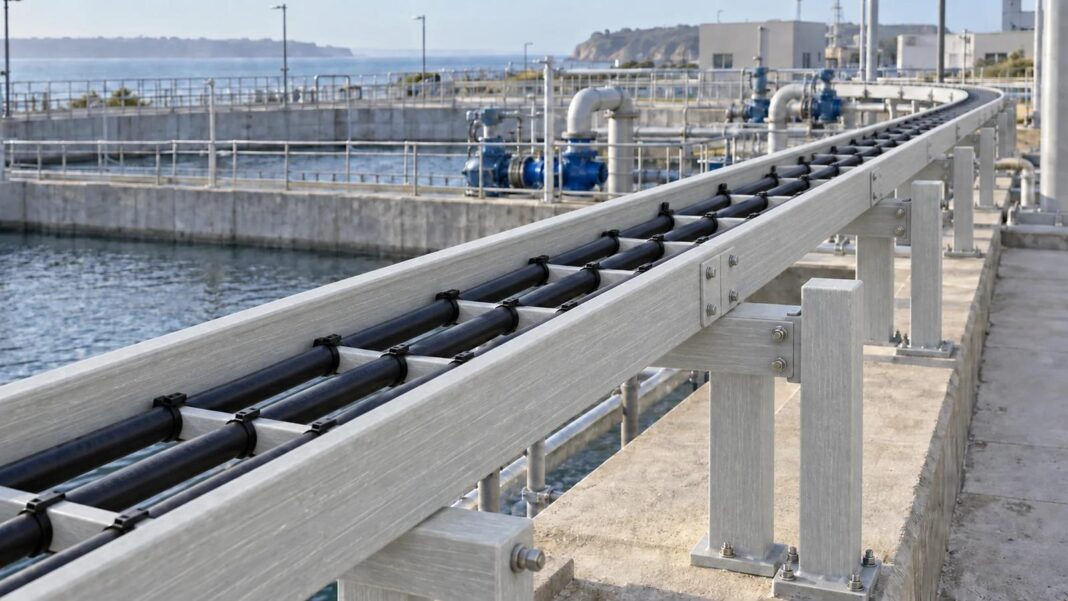
- Wastewater and water-treatment walkways & cable trays: Hydrogen sulfide gas, chlorine mist, and continuous splashing degrade painted steel handrails, grating stringers, and cable-tray brackets rapidly; vinyl ester or isophthalic polyester FRP assemblies eliminate recurring basin shutdowns.
- Cooling-tower structural frameworks: Warm, chlorinated, 100-percent-humidity plenums destroy both galvanized steel and treated timber; vinyl ester pultruded I-beams, tubes, and louvers deliver structural stability without biological decay or rust.
- Coastal, agrivoltaic, and saline solar mounting structures: In high-salinity shoreline arrays and humid agricultural zones, non-corrosive FRP beams and square-tube posts cut coating replacement while electrical non-conductivity simplifies grounding layouts.
- Pedestrian bridge decks and marine boardwalks: Combining pultruded I-beam girders with closed-top structural FRP deck panels lowers dead weight for rapid modular installation over environmentally sensitive waterways or aging abutments.
- Substation gantries, rail enclosures, and chemical-plant access platforms: Non-conductive framing paired with non-metallic FRP fasteners eliminates earthing loops around live electrical switchgear while resisting acid and alkali splash.
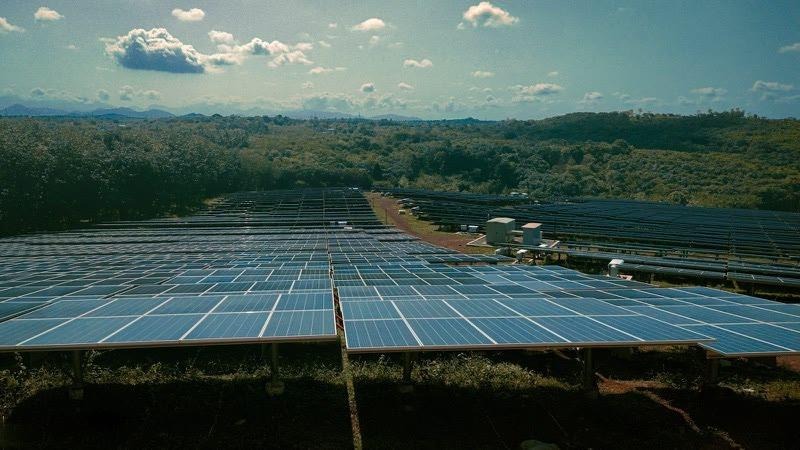
Figure 3. Utility-scale photovoltaic array. In coastal, saline-soil, and humid agricultural sites, UV-stabilized pultruded FRP framing addresses both corrosion durability and electrical isolation over 25–30 year power-purchase horizons.
5. A Practical Cost-Testing Protocol Before Tender Award
Before committing a capital project to either galvanized steel or pultruded FRP, project managers and quantity surveyors should run a four-step verification on actual vendor bids: (1) confirm structural equivalence under the same deflection limit and regional code, (2) classify the site honestly under ISO 9223 rather than guessing coating life, (3) price complete installed packages — including cranage, coatings, hot-work permits, non-metallic fasteners, and delivered Incoterms — on the same currency and date, and (4) run an ISO 15686-5 present-value sensitivity test across two discount rates and realistic plant-shutdown costs. When steel wins that test in mild indoor exposure, keep steel; when C4–CX corrosion or expensive maintenance access flips the present value decisively, pultruded FRP delivers measurable, auditable lifecycle savings.
About the Author
Yifan Liu is an Application Engineer at F1 Composite, supporting contractors, EPC teams, and asset owners with pultruded FRP structural selection, installation planning, and ISO 15686-5 life-cycle cost evaluations across industrial, marine, and infrastructure projects.