
Commercial construction projects frequently require modifications to existing concrete structures. Whether a contractor is installing new mechanical equipment, upgrading building utilities, or renovating an industrial facility, creating accurate openings in concrete is often an essential part of the work.
Unlike demolition, which generally involves removing larger sections of material, precision concrete cutting allows construction teams to make controlled modifications while preserving surrounding structures.
For general contractors, engineers, and facility managers, understanding how specialized cutting techniques fit into broader construction activities can improve project planning, reduce unnecessary disruption, and support coordination between trades.
The Role of Concrete Cutting in Modern Construction
Concrete is widely used in commercial and industrial buildings because of its strength and durability. However, these same characteristics make modifications challenging when building requirements change.
Commercial renovations often involve installing new plumbing lines, electrical conduits, ventilation systems, or mechanical equipment. These installations may require openings through concrete floors, walls, and foundations.
Commercial concrete cutting provides a controlled approach to creating these openings without removing more material than necessary.
For example, a warehouse renovation may require new floor penetrations for drainage infrastructure. Similarly, an office building undergoing mechanical upgrades may need openings through reinforced concrete walls to accommodate ventilation ductwork.
In both situations, accurate cutting helps ensure that the required modifications align with the installation specifications and surrounding construction work.
Why Precision Matters When Modifying Existing Concrete
Accuracy becomes particularly important when cutting into existing structural elements.
Concrete floors and walls may contain reinforcing steel, electrical conduits, plumbing lines, or other embedded infrastructure. Cutting without identifying these conditions can damage building systems or affect structural performance.
Before work begins, contractors should review available drawings, confirm cutting locations, and assess whether additional investigation is necessary.
Ground-penetrating radar and other appropriate scanning techniques can help identify embedded features, although their effectiveness depends on site conditions and the materials involved.
Structural considerations also require attention. Cutting through reinforced concrete can affect load paths, reinforcement continuity, and the capacity of individual building elements.
Where modifications may affect structural performance, a qualified structural engineer should evaluate the proposed openings and determine whether reinforcement or other measures are required.
Accurate dimensions also reduce unnecessary removal and help mechanical and electrical trades install their systems according to approved plans.
Common Applications and Cutting Methods
Different construction activities require different concrete removal techniques. Selecting the appropriate method depends on the structure, opening dimensions, material thickness, reinforcement, and available working space.
Concrete core drilling creates circular penetrations through floors, walls, and other concrete elements. It is commonly used for plumbing pipes, electrical conduits, mechanical services, and utility installations.
Core drilling is particularly useful when a project requires accurately sized openings without removing large surrounding sections.
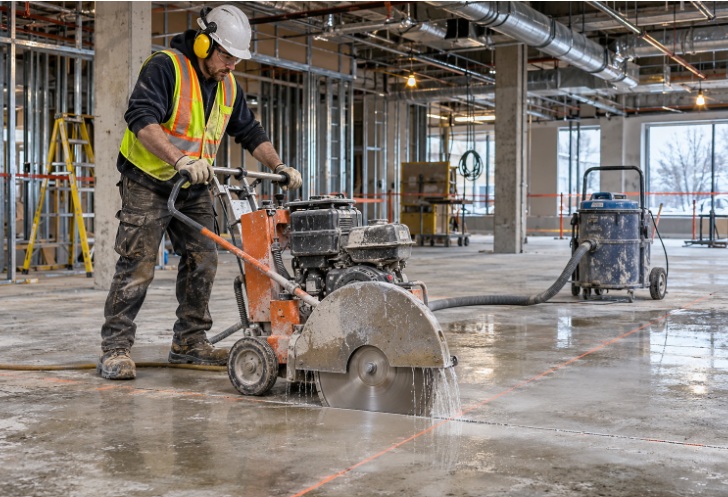
Concrete floor sawing is generally used for straight cuts in horizontal surfaces, including slabs, pavement, and industrial floors. Applications include trench openings for underground utilities, drainage modifications, and partial slab removal.
Concrete wall sawing uses specialized equipment to produce controlled cuts through vertical or inclined concrete surfaces. It is often suitable for creating doorways, equipment openings, and mechanical penetrations through reinforced walls.
Wire sawing may be appropriate for particularly thick concrete sections, irregular shapes, or locations where conventional saws have limited access.
In industrial concrete cutting, selecting equipment must also account for site-specific requirements, including restricted work areas, existing machinery, and surrounding infrastructure.
No single cutting method is appropriate for every project. The objective is to achieve the required opening while controlling material removal and protecting adjacent construction.
Managing Concrete Work in Active Commercial Facilities
Concrete renovation work becomes more complicated when construction takes place inside an occupied or operational building.
Hospitals, warehouses, manufacturing facilities, and commercial properties may need to maintain essential operations while renovations proceed.
In these environments, project teams must consider more than the cutting activity itself.
Noise, vibration, airborne dust, water use, slurry collection, and equipment access can affect nearby operations. Appropriate containment, ventilation, water management, and cleanup procedures should be established according to the cutting method and site conditions.
Concrete cutting can also create exposure to respirable crystalline silica. Contractors must assess these hazards and apply suitable engineering controls, respiratory protection where required, and applicable occupational health and safety procedures.
Water-cooled diamond cutting methods can help control dust, but the resulting slurry must be collected and managed appropriately.
Construction sequencing is equally important. Cutting operations may need to occur outside normal business hours or during scheduled equipment shutdowns.
Clear communication between facility managers and construction teams helps establish safe work zones and reduce interference with building occupants or industrial processes.
Why Specialized Subcontractor Coordination Matters
Precision cutting is most effective when it is treated as an integrated construction activity rather than an isolated task.
Mechanical contractors may determine the required penetration sizes, while electrical trades identify conduit routes and structural engineers review proposed modifications.
General contractors then coordinate these requirements with specialized cutting subcontractors.
The specific cutting technique should be selected after considering opening dimensions, concrete thickness, reinforcement, access limitations, and the installation requirements of the associated trades.
In Southern Ontario, specialized contractors such as Complete Cutting & Coring provide concrete cutting and coring services for commercial and industrial construction projects where these technical requirements must be coordinated with other building activities.
This type of subcontractor involvement is particularly relevant when multiple penetrations are needed in restricted areas or when cutting operations must be scheduled around other construction activities.
Identifying cutting requirements early also helps prevent conflicts between mechanical installations, structural elements, and existing utilities.
Planning Concrete Modifications Before Construction Begins
Effective planning starts with confirming exactly what must be removed and why.
Project managers should establish accurate opening dimensions, review the available structural information, and verify locations against mechanical, electrical, and plumbing drawings.
Existing utilities and embedded materials should be investigated using suitable methods before cutting begins. Where structural modifications are involved, the necessary engineering review and approvals should be completed beforehand.
Equipment access is another important consideration. Large cutting machines may require clear pathways, sufficient working space, suitable electrical power, and access to water or dust-control equipment.
Scheduling should account for cutting, material removal, cleanup, inspections, and the installation work that follows.
For example, completing floor penetrations before mechanical equipment arrives may reduce congestion and prevent unnecessary delays. Conversely, cutting too early without verified installation dimensions can create openings that require later modification.
Coordination meetings between the general contractor, specialized subcontractors, and affected trades can help resolve these issues before they reach the construction site.
Precision concrete cutting contributes to more predictable construction work when it is supported by accurate information, appropriate equipment, and clear responsibilities.
For commercial and industrial projects, the value extends beyond producing clean openings. Careful planning and coordinated execution help protect existing infrastructure, support efficie






