
When primary life safety systems, like sprinklers, alarms, or standpipes, are out of service for more than 4 hours in any 24 hours or during high-risk operational shifts, temporary fire protection is required by law. These temporary measures are required by Local Authorities Having Jurisdiction (AHJ) to provide 24/7 life safety monitoring until permanent systems are completely re-established.
When the system is outage, the most important life safety objective is to avoid catastrophic loss. The Fast Fire Watch Company provides specialized Fire Watch Services to meet statutory code requirements, comply with insurance policy requirements, and keep structural assets safe when they are under construction, being serviced, and experiencing unforeseen mechanical issues.
Life Safety Code Requirements
National Fire Protection Association (NFPA) standards establish strict triggers for deploying physical oversight and temporary hardware.
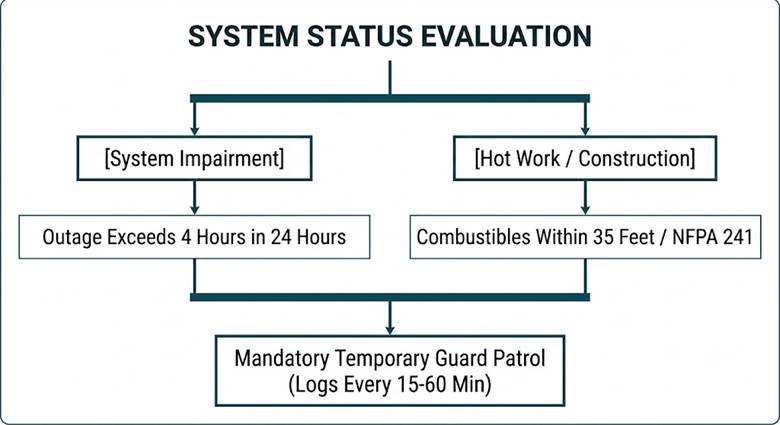
The standard requires the following three code triggers:
- System Impairments (NFPA 25 & NFPA 72): Continuous monitoring shall be provided if the sprinkler system, fire pumps or main alarm control panel are inactive for planned maintenance or emergency repairs for more than 4 hours.
- Construction and Demolition (NFPA 241): Active safety details are necessary for construction and demolition jobs with active structural framing, missing hydrants or fire barriers.
- Hot Work Operations (NFPA 51B): A security guard or a security team is required to be assigned to a hot work operation and to remain on duty for at least 60 minutes before and after the operation begins.
The National Fire Protection Association (NFPA) estimates that there were 4,300 structure fires in buildings under construction or major renovation each year, with an average of 10 million dollars of direct property damage. The Fast Fire Watch Company’s trained monitors reduce these structural weaknesses by substituting for weak automation with constant human oversight.
4 Key Triggers for Fire Watch
These temporary protection measures are put in place to fill in gaps of coverage between commercial, residential, and industrial buildings.
| Trigger Scenario | Code Reference | Mandatory Response Time | Primary Operational Duty |
| Unplanned Alarm/Sprinkler Outage | NFPA 25 § 15.5 | Rapid deployment upon discovering an incident | Round-the-clock patrols on floor-to-floor level; log updated every 15-60 mins. |
| Hot Work (Welding/Grinding) | NFPA 51B § 5.2 | Pre-work setup | Check spark zone; continue to monitor for 30 to 60 minutes after work. |
| Active Construction/Demolition | NFPA 241 § 7.2 | Project phase launch | Monitor site access, control of trash/combustibles, temporary heating. |
| Public Assembly & Event Hazards | NFPA 1 § 20.1.5.7 | Event schedule start | Maintain clear fire escape routes, announce fire zones, control crowd hazards. |
Deployment Steps During Outages
Once primary protection is not provided, systematic measures should be implemented by property owners to ensure compliance and prevent them from facing expensive municipal fines or stop-work orders.
- Report to Local Authorities: Inform the fire prevention bureau of the local fire department (AHJ) and your property insurance company of the active impairment information.
- Contract Dedicated Guards: Call in trained and certified security guards, who are trained for emergencies, to the premises.
- Create Patrol Routes: Plan for thorough walk-through routes to cover all unmonitored areas, utility rooms, stairwells, and common areas.
- Keep Written Logs: Make logs of all patrol cycles, including time of cycle, conditions observed, and structural hazards noted.
- Resolve system outages: Repair systems, get formal AHJ approval, and stop operations of temporary systems until permanent ones are back online.
Professional vs. In-House Guards
It can be very difficult to find a standard internal employee to cover watch duties and result in significant regulatory non-compliance.
- Dedicated Focus: An NFPA requirement that during an active assignment, the CERT member should not have other duties. In-house employees who are expected to perform dual jobs (for example, maintenance or construction) frequently overlook important hazards.
- Emergency Protocol Readiness: Professional Fire Watch Services offered by The Fast Fire Watch Company are completely trained in quick evacuation administration, portable extinguisher use, and direct protocols of contact with local dispatch.
- AHJ Compliance: When unqualified, untrained staff members are detected operating an informal patrol detail, they are cited by municipal fire marshals and/or ordered to evacuate the building.
Frequently Asked Questions
Is it possible for an owner to conduct their own fire watch patrol?
Yes, if the person is assigned to a monitoring role only, has no operational responsibilities, has been trained in life safety issues, and maintains formal compliance logs in accordance with local fire marshal regulations.
How often does it need to be patrolled if there’s an area that’s compromised?
Typical fire codes call for a physical examination at least every 15-30 minutes in high-occupancy or high-hazard buildings and at least once every 60 minutes in normal commercial buildings.
What happens if a property operates during an outage without temporary protection?
Lack of necessary oversight may result in stop work orders from the AHJ, high daily fines for the municipality, building evacuation, and total cancellation of property insurance during an event.
Is there a special monitor that needs to be dedicated to a minor sprinkler repair?
If the system repair is less than 4 hours in 24 hours, and the building has an operational alarm system, the temporary monitoring may not be required by law. A local fire marshal, however, still has the final say on coverage.
What equipment should temporary monitors be equipped with?
Guards should have specific communication equipment [two-way radio or mobile phone], dependable flashlights, building access keys, hazard logs, and suitable portable fire extinguishers.
Essential Safeguards for Property Risk Management
Automated infrastructure failures cause the temporary life safety measures to serve as a crucial second line of defense. By choosing a trusted partner like The Fast Fire Watch Company, you can rest easy knowing that your facilities will be compliant with the NFPA regulations, you will have minimal severe financial exposure, and lives will be saved in all facilities. Well-planned, coordinated activities with trained personnel enable property managers and general contractors to operate with full security during planned maintenance or unplanned emergency outages.






