
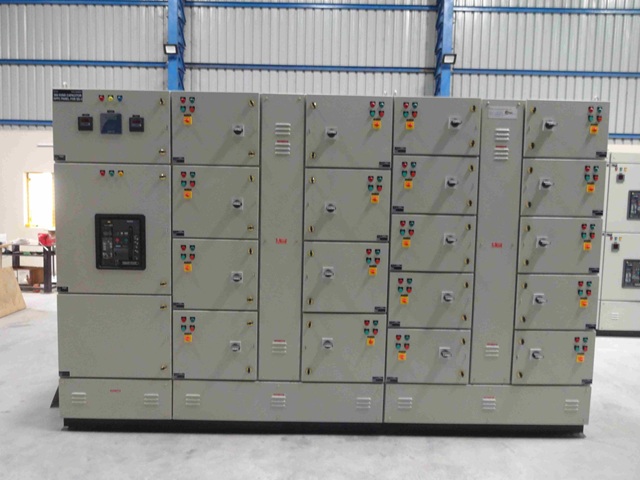
A commercial building can have a well-designed main distribution board and still be poorly served by its power factor correction panel. The problem often starts before installation: the purchase description gives a total kVAr figure but says little about operating loads, switching steps or site conditions.
For a hotel, shopping centre or office development, those details deserve attention while the electrical package is being specified. An automatic power factor correction (APFC) panel should follow the building’s electrical behaviour, including periods when occupancy and demand are low.
1. Describe how the building actually operates
Begin with the load schedule and operating timetable. Chillers, pumps, lifts, ventilation, UPS equipment and EV charging can have different duty cycles and input characteristics. A list of connected loads alone does not describe their combined demand.
For an existing building, collect representative measurements of kW, reactive power, power factor and voltage across occupied and lightly loaded periods. For a new project, identify the assumptions behind the demand estimate and leave a clear commissioning process for checking them.
Confirm the utility’s actual power factor requirement and billing method. Do not assume that a target used on another project, or a promised percentage saving, applies here. Where distortion is significant, distinguish displacement power factor from total power factor before deciding what capacitor compensation can achieve.
2. Specify usable capacity and sensible steps
Transformer kVA is useful context, but it is not enough to determine the required capacitor bank. Compensation depends on operating demand and the improvement required in power factor.
Also ask what the quoted capacity means. A capacitor’s nameplate kVAr depends on its rated voltage and frequency. A higher-voltage capacitor does not deliver its full nameplate kVAr when used at a lower voltage at the same frequency. Where reactors are included, request the net output of the complete assembly at the project’s voltage and frequency.
Then check the smallest step. A bank that performs well at daytime demand may overcompensate a lightly loaded building if its minimum step is too large. The proposal should state total net kVAr, the step sequence, the controller’s operating basis and the intended light-load behaviour.
Project-configured APFC capacitor bank panels should therefore be compared using a defined duty and configuration, rather than cabinet dimensions and total capacity alone.
3. Decide whether reactors are justified
The presence of variable-speed drives, UPS equipment or EV chargers is a reason to review power quality, not a complete specification for a reactor. Their harmonic contribution depends on equipment design and operating conditions.
Ask for available harmonic measurements or the consultant’s study. If that information is missing, record the gap and the assumptions used in the proposal. The assessment should consider interaction between the capacitor bank and the supply network, including resonance risk.
Where detuned compensation is appropriate, the reactor and capacitor must be selected together. A detuned bank helps manage the capacitor installation’s behaviour in a harmonic environment; it is not automatically a complete harmonic filtering solution. Reactor percentage should follow the design assessment, rather than being selected simply because another building used it.
4. Separate compensation technology from component packaging
There are several decisions here, and they should not be collapsed into one label such as “smart panel.”
For suitable loads, conventional capacitors with capacitor-duty contactors can be a practical option. Hybrid switching devices are another possibility where their actual switching duty suits the project. Ask the supplier to identify the device technology and operating limits; “hybrid switch” is not the same as a hybrid capacitor-plus-SVG compensation system.
An integrated smart capacitor module packages functions that would otherwise be provided through separate components. Its switching, control, protection and reactor provision depend on the exact model. Some applications use separate reactors and capacitors; others can use integrated reactor-capacitor modules. “Smart capacitor” alone does not confirm that a reactor is included.
For fast-changing reactive demand, or where leading and lagging compensation is required, evaluate a static VAR generator (SVG) or a coordinated hybrid arrangement. SVG is not a mandatory upgrade for every commercial building or charging installation. Establish the actual compensation requirement, response duty and equipment functions before paying for it.
The power factor correction panel selection guide provides a wider framework for discussing these configuration choices with the supplier.
5. Resolve the interface with the main distribution system
Define the controller’s measurement point on the single-line diagram. Current transformer location, polarity, ratio and phase association must follow the selected controller and network arrangement. Incorrect sensing can undermine an otherwise correctly sized bank.
Buildings with standby generators need an explicit operating strategy for the capacitor bank during transfer and generator operation, agreed with the equipment suppliers. Do not assume the normal utility-supply arrangement remains suitable.
The physical interface matters too: incoming cable or busbar connection, protective devices, available fault level, cable entry, enclosure protection, ventilation and maintenance access should be coordinated before manufacture. Allow for the actual electrical-room temperature and heat generated inside the panel, especially where reactors are installed.
6. Compare the component schedule, then the price
A useful quotation names the makes and models of the main components. It also distinguishes conventional capacitor compensation, detuned compensation and any SVG scope.
Brand selection can materially affect price. So can the compensation method, reactor arrangement, protective devices, cooling and documentation. An integrated module should not automatically be dismissed as more expensive: compare the complete installed arrangement, including separate switching components, wiring, assembly work and replacement access.
Ask what is included and excluded. A lower price has little meaning if one offer includes the specified reactor arrangement and inspection records while another leaves them undefined.
7. Agree the handover checks before delivery
Handover should demonstrate that the installed stages operate, not merely that the controller lights up.
In Zejiefu’s practical capacitor checks, measuring each phase current of an energized capacitor branch with a clamp meter is one useful diagnostic method. For building handover, qualified personnel can record stage-by-stage currents alongside voltage and switching status, using suitable instruments and the site’s electrical safety procedures.
Compare those readings with the actual stage configuration and expected output. A low or missing current is a reason to investigate the supply, fuse, switching device, connection and capacitor; it does not identify the failed component by itself. Intentionally unequal phase-by-phase compensation must also be assessed against its design.
Retain these readings as a maintenance baseline, together with the approved drawings, component schedule, controller settings, operating instructions and applicable inspection records. Isolation and capacitor discharge requirements must follow the equipment instructions and site procedure.
For a construction buyer, the strongest purchase specification connects three things: the building’s operating conditions, an identifiable equipment configuration and a practical method of verifying performance at handover. That gives the owner something more useful than an unexplained kVAr number on an invoice.






