
Every industry has felt the pressure to produce more video content. Marketing teams need product demos. Training departments need onboarding walkthroughs. Architecture and engineering firms need project visualizations that communicate design intent to clients who can’t read blueprints. Real estate developers need fly-through animations. And all of them needed these assets yesterday.
The traditional answer — hire a production crew, schedule shoots, wait for post-production — still works, but it no longer scales with the volume of content modern businesses require. A mid-size company might need dozens of video assets per quarter across social media, internal communications, client presentations, and advertising. At traditional production costs, that math breaks down quickly.
This is where AI video generation has moved from interesting experiment to practical business tool. The current generation of platforms can produce polished video content from text prompts, static images, or rough storyboards in a fraction of the time and cost of conventional production. The technology isn’t replacing professional videography for high-stakes work, but it’s filling the enormous gap between “we need a video” and “we can’t afford to produce one the traditional way.”
Understanding What Today’s AI Video Generators Actually Do
The term “AI video generator” covers a broad range of capabilities, and understanding the differences matters when you’re choosing a tool for a specific purpose.
Text-to-video platforms take a written description — “a modern glass office building at sunset with people walking through the lobby” — and generate a corresponding video clip. The quality of these outputs has improved dramatically over the past eighteen months, with the best models now producing footage that holds up in professional contexts.
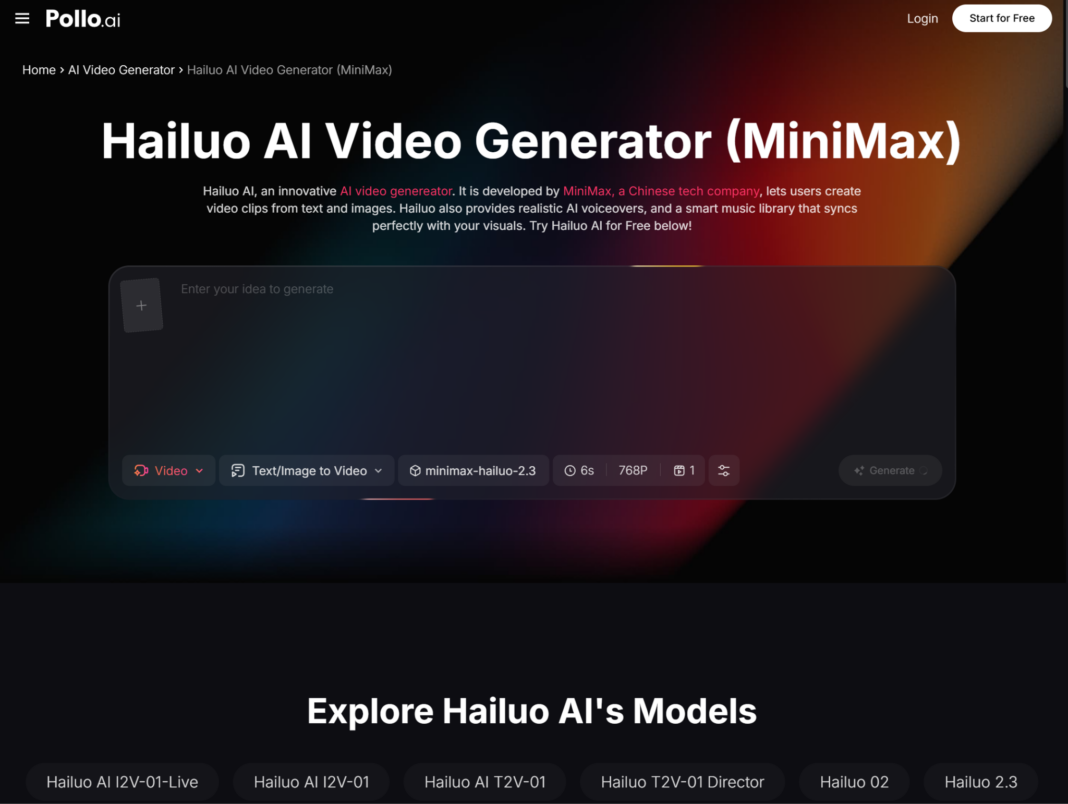
Pollo AI has become a hub for accessing several of the most capable AI video models through a single interface, which simplifies the evaluation process considerably. Among the standout options available on the platform is Hailuo AI, a video generation model developed by MiniMax that has gained significant attention for its ability to produce remarkably fluid, cinematic video from text prompts. What sets Hailuo AI apart from many competitors is its handling of motion — camera movements feel intentional rather than algorithmic, and human figures move with a naturalism that earlier models couldn’t achieve. For businesses that need video content conveying professionalism and visual sophistication, Pollo AI’s integration of Hailuo AI offers a compelling starting point.
Image-to-video tools take a different approach. You provide a static image — a product photo, an architectural rendering, a design mockup — and the AI animates it. This workflow is particularly valuable for industries like construction and real estate, where you might have detailed 3D renders that would benefit from subtle animation: clouds moving across a sky behind a building facade, water features in motion, people walking through a space. The static image becomes a living scene without requiring a full animation pipeline.
Style transfer and enhancement tools represent a third category, where existing footage is transformed — relit, recolored, or stylistically altered — using AI models trained on specific visual aesthetics.
Where These Tools Create Real Business Value
The most compelling use cases aren’t about replacing existing video production. They’re about enabling video content in situations where it previously wasn’t feasible.
Project visualization is a powerful example. An architecture firm presenting a design concept to a municipal planning board can now generate a walkthrough animation from their CAD renders in hours rather than commissioning a weeks-long animation project. The output doesn’t need to match Pixar quality — it needs to communicate spatial relationships, material choices, and environmental context clearly enough for decision-makers to evaluate the proposal. Current AI tools meet that threshold comfortably.
Marketing content at scale is another area of significant impact. A company launching a product across multiple markets can generate localized video ads — different settings, different visual contexts, different moods — from a single set of prompts. The per-asset cost drops from thousands of dollars to nearly nothing, which fundamentally changes how marketing teams think about testing and iteration. Instead of committing budget to two or three carefully produced videos, they can generate dozens of variations and let performance data determine which ones deserve further investment.
Training and safety content benefits from the speed advantage. Construction companies, for instance, need to produce site-specific safety briefing videos that reflect the actual conditions of each project. Generating these from photos of the real site, enhanced and animated with AI, creates more relevant and engaging training material than generic stock footage ever could.
Social media presence is perhaps the most straightforward application. The relentless demand for fresh video content across platforms means that even well-resourced teams struggle to keep pace. AI-generated clips — used as B-roll, background visuals, or standalone content — help fill the pipeline without proportional increases in production time or budget.
Comparing Approaches Across Leading Platforms
The AI video generation market has matured enough that meaningful differences in philosophy and capability distinguish the leading options.
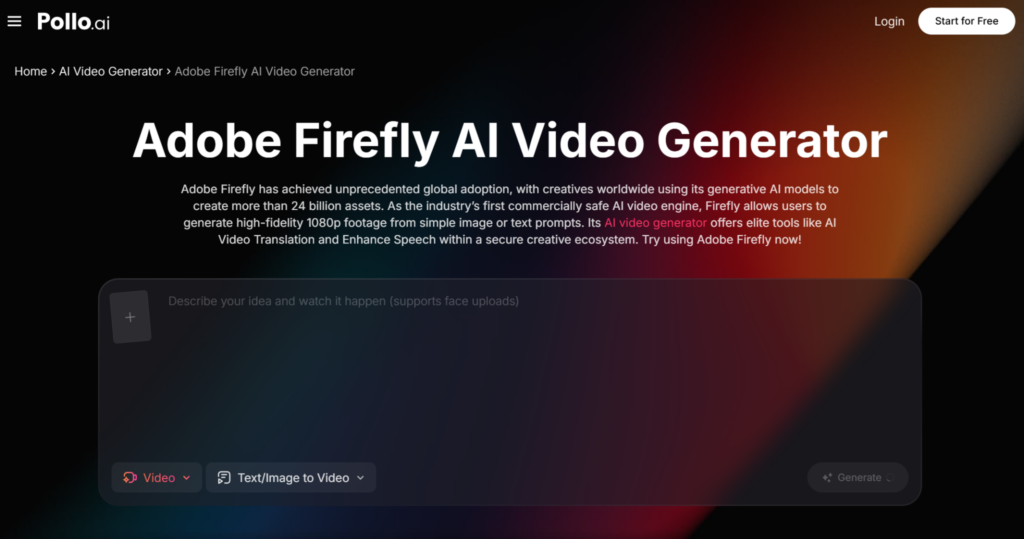
Adobe Firefly represents the enterprise-grade approach to generative AI. Adobe has built its models with a strong emphasis on commercial safety — the training data is licensed and curated to minimize intellectual property concerns, which matters significantly for businesses that need legal clarity around the content they produce. Firefly integrates deeply with Adobe’s existing creative suite, making it a natural extension of workflows that many professional teams already use. Pollo AI provides access to Adobe Firefly’s video generation capabilities, allowing users to explore its outputs alongside other models and compare results directly. For organizations already invested in Adobe’s ecosystem, this integration path reduces friction considerably.
Runway has established itself as a favorite among creative professionals who want granular control over their outputs. Its Gen-3 model produces high-quality results, and its interface is designed for users who think in terms of shots, scenes, and visual storytelling rather than simple prompts.
Pika has carved out a niche with its accessible interface and strong performance on short-form content. It’s particularly effective for social media creators who need quick, visually striking clips without a steep learning curve.
Hailuo AI, accessible through Pollo AI, occupies an interesting position by delivering cinematic quality that rivals more established players while remaining accessible to users who aren’t video production specialists. Its strength in natural motion and coherent scene composition makes it especially suitable for content that needs to feel polished and intentional.
Getting Professional Results From AI Video Tools
The gap between a mediocre AI-generated video and a professional-looking one often comes down to the input rather than the tool itself.
Prompt specificity matters enormously. “A building” produces generic results. “A contemporary three-story commercial building with floor-to-ceiling glass facades, warm interior lighting visible at dusk, surrounded by mature landscaping with a stone-paved entrance walkway” gives the model enough information to generate something that looks intentional and designed. The more precise your visual vocabulary, the closer the output matches your vision.
Understanding aspect ratios and resolution requirements before you begin saves time on the back end. A video generated in landscape format for a YouTube pre-roll won’t work as a vertical Instagram Story without significant cropping. Most platforms let you specify output dimensions upfront — use this feature rather than trying to reformat afterward.
Iterative refinement produces better results than trying to get everything right in a single generation. Treat the first output as a draft. Evaluate what works, adjust your prompt to address what doesn’t, and regenerate. Most experienced users find that their third or fourth iteration is dramatically better than their first, not because the tool improved but because their prompts did.
Post-production still matters. Even the best AI-generated video benefits from basic editing — trimming dead frames at the beginning and end, color grading to match your brand palette, adding audio that complements the visual mood. AI handles the heavy lifting of content creation, but the finishing touches that make a video feel complete and professional remain a human responsibility.
The Trajectory Ahead
The pace of improvement in AI video generation shows no signs of slowing. Models are getting better at longer-form coherence, maintaining character and scene consistency across extended clips rather than just isolated shots. Real-time generation is approaching viability, which will open up applications in live presentations, interactive media, and dynamic content personalization.
For businesses evaluating whether to adopt these tools now or wait, the pragmatic answer is that the current generation is already good enough for a wide range of professional applications. The companies gaining competitive advantage aren’t waiting for perfection — they’re learning the workflows, developing prompt expertise, and building internal capabilities that will compound as the technology continues to improve. Platforms like Pollo AI, which aggregate multiple best-in-class models into a single accessible interface, make that learning process significantly more efficient by letting teams experiment with different approaches without committing to a single vendor’s ecosystem.
The tools are ready. The question is whether your content strategy is ready to use them.






