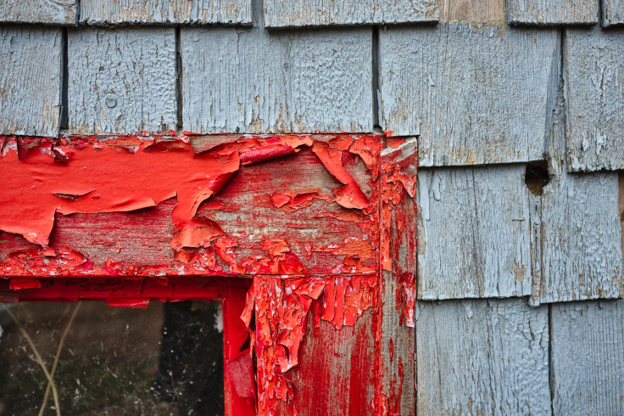
Faded paint and peeling trim are easy to rationalize. The house still looks roughly fine from the street. The repair can wait until next year. The budget has other priorities right now. These are reasonable-sounding arguments, and they are also how a $4,000 painting project quietly becomes a $15,000 structural repair. Exterior paint is not primarily a cosmetic product. It is a moisture barrier, a rot deterrent, and the first line of defense between your home’s wood framing and the weather. When that barrier begins to fail, and it does so gradually and mostly out of sight, the consequences move well beyond appearance. Most homes only require repainting every six to ten years, but hot, sunny, or significantly wet conditions can age a paint job within just a couple of years. The gap between when paint needs attention and when most homeowners address it is where the real costs accumulate.
Paint Does More Than Make a Home Look Good
A fresh exterior paint job is visible. What it is doing structurally is largely invisible, and that invisibility is part of why homeowners underestimate its importance. Exterior paint seals wood siding, trim, fascia, and soffits against moisture infiltration. It protects against UV degradation that breaks down wood fibers over time. It fills hairline cracks and surface gaps that would otherwise provide entry points for water and pests. Small cracks in exterior paint can quickly allow water to penetrate the material beneath, and once moisture reaches bare wood, the deterioration timeline shortens dramatically. A small repair that costs $150 when addressed promptly can escalate to $1,500 within a year if ignored. Once rot sets into framing, soffits, or window sills, the project is no longer a painting job. It becomes a carpentry and structural repair job with a paint job attached to the end of it.
What Happens When Paint Failure Is Left Too Long
Paint failure follows a predictable sequence. It begins with fading and minor chalking, moves to cracking and peeling as the paint bond weakens, and then exposes bare wood to direct weather contact. Moisture trapped under deteriorating paint causes blistering and bubbling, which signals that water is already working behind the surface. Left unaddressed, that moisture promotes fungal growth and wood rot. Soft, spongy boards that give under gentle pressure are the result of a process that began with peeling paint and could have been stopped at any point along the way with a fraction of the eventual cost. Replacing rotten wood siding on a full home can run between $10,000 and $20,000, depending on the extent of damage and material choice. The repainting that could have prevented it costs $3,000 to $7,000 for most single-family homes.
What Professional Painters Find on Jobs That Were Delayed
The gap between how a home looks from the street and what is actually happening at the surface is one of the most consistent realities in exterior painting. Homeowners often do not see the early warning signs because the deterioration begins in places that require close inspection: the bottoms of trim boards, window sill edges, the area around gutters, and any surface that holds moisture after rain. By the time peeling is visible from a normal viewing distance, the process has typically been underway for months.
“We show up on a lot of jobs where the homeowner thinks they just need a coat of paint,” said Robert Olivares, owner of Elite77 Painters. “When we get up close and start prepping the surface, that’s when the real picture comes out. Soft wood along the trim, failed caulk around windows that has been letting water in for two or three seasons, fascia boards that look okay from the ground but are half gone once you touch them. The painting part is the easy part. The prep and the repairs underneath are what drive the cost up. Every year that goes by without attention adds to what we have to fix before we can even open a can of paint.”
That pattern, visible throughout the industry, is the mechanism by which a straightforward maintenance project becomes a significantly more expensive one. The delay does not pause the deterioration. It funds it.
The Financial Case for Staying on Schedule
The return on investment for exterior painting makes the financial case plain. An exterior paint job can increase a home’s value by 2% to 5%, and homes with strong curb appeal sell for an average of 7% more than comparable properties with less attractive exteriors. The ROI on exterior painting has been estimated at 51% to 55%, making it one of the more cost-efficient improvements a homeowner can make. That return calculation only holds when the paint job is performed on a home in sound condition. When rot and water damage have already taken hold, the repair costs are added to the painting cost before any return is calculated, and the equation shifts considerably. Eighty percent of real estate agents believe painting a home has a positive impact on its value, but that assessment assumes the surfaces being painted are structurally intact.
Insurance and Warranty Complications Nobody Mentions
Beyond repair costs, delayed exterior maintenance creates two additional financial exposures that homeowners rarely anticipate. The first is insurance coverage. Damage claims attributed to lack of maintenance are frequently classified as neglect and denied, leaving the homeowner responsible for repairs that might otherwise have been covered had they resulted from a sudden event rather than gradual deterioration. The second is the paint warranty validity. Most paint manufacturers require homeowners to maintain surfaces as a condition of warranty coverage. If paint is applied over surfaces that were already showing signs of rot or failure, or if subsequent damage results from unmaintained surfaces, the warranty can be voided. Both exposures are avoidable with routine attention, and both become significantly harder to manage after the fact.
How to Know When the Time Has Come
The standard recommendation is to inspect the exterior of a home twice a year, once in spring and once in fall, and to paint every six to ten years, depending on climate, sun exposure, and siding material. Homes in regions with high humidity, significant temperature variation, or heavy sun exposure on certain elevations need more frequent attention on those surfaces. The practical signals that a repaint is overdue include cracking or bubbling paint along trim or siding, soft spots when light pressure is applied to wood surfaces, caulk that has pulled away from window and door edges, and any area where bare wood is visible. Maintaining paint on wooden siding and trim is especially important to avoid expensive repair or replacement work from water intrusion, and the window to address these issues affordably is always shorter than it appears.
The Year You Wait Is the Year You Pay For
Exterior painting is not a project that benefits from delay. The surface does not stabilize while waiting. Paint that is cracking continues to crack. Wood that is absorbing moisture continues to absorb it. The scope of prep work required grows with each season that passes without intervention, and the final invoice reflects every season of inaction. A professional painting job done on time, on a well-maintained surface, costs a fraction of the same job performed two or three years later on a surface that now also requires carpentry repairs, rot treatment, and structural patching before paint can be applied. The year a homeowner waits because the budget is tight or the timing is inconvenient is almost always the most expensive year of the decision.