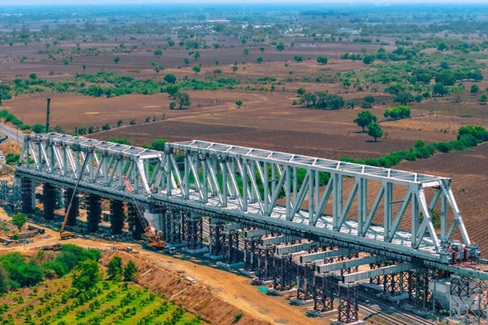
The Mumbai-Ahmedabad Bullet Train initiative reached a significant engineering achievement as workers successfully positioned a 130-metre-long steel bridge span over Indian Railway tracks close to Tralsi village in the Bharuch district of Gujarat. This newly installed section signifies the completion of 230 metres of the steel bridge, out of a total length of 330 metres.
The bridge traverses the Dedicated Freight Corridor Corporation (DFCC) tracks within the Surat and Vadodara segment of the Western Dedicated Freight Corridor. It is designed as a three-span bridge, comprising a continuous span of 100 metres and 130 metres, along with an additional simply supported span of 100 metres. The 130-metre section was relocated to its designated position on May 16, 2026. This particular span stands approximately 18 metres tall and 15.5 metres wide, with a weight of around 2,900 metric tonnes.
Previously, engineers had erected the 100-metre simply supported span, weighing 1,500 metric tonnes, in-situ at the construction site in March 2026. The remaining 100-metre continuous span, which will also be assembled on-site, weighs approximately 1,600 metric tonnes. Upon completion of the final section, the total weight of the entire bridge structure is expected to be around 6,100 metric tonnes.
According to the press release, the steel bridges were manufactured at a workshop located in the Karbon Factory in Umergaon, Gujarat. These structures were designed to have a lifespan of 100 years. Construction teams assembled the 130-metre span on temporary trestles, positioned 14 metres above the ground.
Approximately 1,21,373 Tor-Shear Type High Strength (TTHS) bolts, a C5 painting system, and metallic bearings were utilized in the construction of this section. An automatic mechanism, equipped with two semi-automatic jacks, facilitated the movement of the massive structure into place, with each jack capable of exerting a pushing force of 250 tons using mac-alloy bars.
The launch process was conducted with meticulously organized traffic management on the active freight tracks. These temporary traffic modifications guaranteed the safety and accuracy of the bridge launch. The staged implementation of the engineering tasks also reduced interruptions to the continuous freight operations along the corridor.
The project entails the construction of several steel structures along its path. Of the 17 steel bridges proposed for the Gujarat segment of the project, 14 have been completed. Project designs indicate that a total of 28 steel bridges are planned for the entire Mumbai-Ahmedabad Bullet Train corridor.