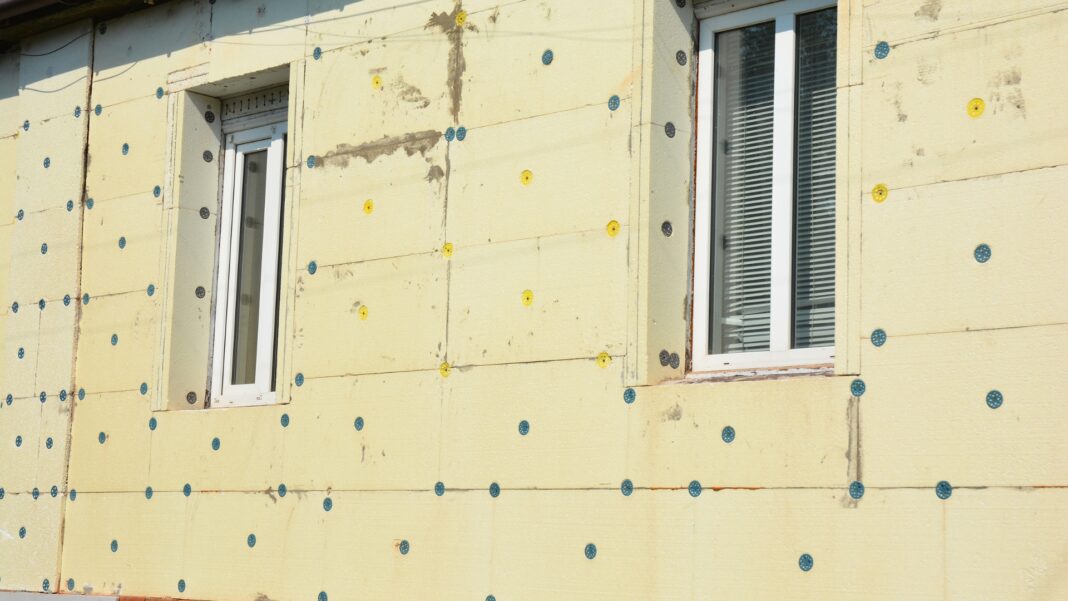
Choosing the right external wall insulation for a project is rarely straightforward. The market offers a wide range of boards, systems, fixings, and finishes – and the wrong combination can lead to costly failures, regulatory non-compliance, or poor thermal performance. This guide is written for contractors, developers, and property owners who want a clear, practical framework for making the right purchasing decisions the first time.
Why External Wall Insulation Is the Right Solution for So Many UK Properties
The UK housing stock is one of the oldest in Europe. A significant proportion of homes – particularly those built before 1930 and those constructed using non-traditional methods between the 1950s and 1980s – have solid walls or non-standard cavity constructions that cannot be insulated internally or via cavity fill without major disruption or structural risk.
For these buildings, external wall insulation is the primary retrofit solution available. It adds a continuous layer of insulation to the outside of the building fabric, eliminating cold bridging, protecting the structure from moisture and frost damage, and significantly reducing heat loss without affecting internal floor area.
Beyond retrofit, EWI is also widely used in new-build construction where architects want to achieve very low U-values, particularly in Passivhaus or near-zero-energy building projects. In these contexts, thick EPS or mineral wool boards are combined with high-performance renders to create building envelopes that far exceed standard regulatory requirements.
The market for EWI in the UK has grown substantially over the past decade, driven partly by government energy efficiency schemes and partly by rising energy costs that have made the payback period on insulation investment considerably shorter than it once was.
The Main Types of External Wall Insulation Board
The starting point for any EWI specification is the insulation board. The two dominant materials are expanded polystyrene and mineral wool, and the choice between them is driven by a combination of performance requirements, fire regulations, and budget.
Expanded polystyrene (EPS) is the most widely used board type in residential EWI projects across the UK. It is lightweight, easy to handle and cut on site, and offers good thermal performance at a competitive price. Standard white EPS boards are available in a range of thicknesses, typically from 50mm to 200mm. Grey or graphite EPS boards use a modified bead structure that improves thermal conductivity – allowing the same U-value to be achieved with a thinner board, which is useful where projection from the wall face is constrained by shallow window reveals or planning conditions.
EPS is suitable for the vast majority of residential retrofit projects below 11 metres in height. Above that threshold, regulations in England require the use of non-combustible materials in the external wall construction of residential buildings, which effectively rules out standard EPS.
Mineral wool boards – made from rock wool or stone wool – are non-combustible and are therefore the required choice for buildings above 11 metres in height under Approved Document B. They offer slightly lower thermal conductivity than grey EPS, meaning boards need to be somewhat thicker to achieve equivalent U-values, but the fire safety advantage is significant. Mineral wool is also vapour-permeable, which makes it the correct choice for use with breathable render systems on older masonry buildings where managing moisture movement through the wall is important.
The decision between EPS and mineral wool is one of the most important specification choices in any EWI project. Getting it wrong – particularly on a higher-risk building – can have serious regulatory and liability consequences.
[obraz_1]
What Makes a Complete EWI System
Buying insulation boards alone does not constitute a complete EWI system. A properly specified and installed system consists of multiple components, each of which must be compatible with the others and appropriate for the specific project conditions.
A complete system includes adhesive for bonding the boards to the substrate, mechanical fixings for additional security, alkali-resistant fibreglass reinforcement mesh embedded in a basecoat render, a range of profiles and beads for junctions and edges, and a topcoat render or decorative finish.
Sourcing all of these components from a supplier that stocks complete, compatible systems – rather than piecing together products from multiple sources – significantly reduces the risk of compatibility failures and simplifies the procurement process. Penguin Building Materials supplies a comprehensive range of external wall insulation products including complete EWI systems, boards, fixings, mesh, profiles, and render finishes, available online with fast UK delivery and trade pricing on bulk orders.
Render Finishes: Matching Performance to the Project
The render finish is the most visible element of any EWI installation and the primary line of defence against weather. Choosing the right finish requires balancing aesthetic requirements, performance characteristics, and compatibility with the insulation system beneath.
Silicone render is the market-leading choice for most EWI applications in the UK. It is hydrophobic and vapour-permeable, meaning it resists water absorption while allowing the wall to breathe. It stays cleaner for longer than acrylic alternatives, is flexible enough to resist hairline cracking, and is available in a very wide range of colours and grain sizes. For most residential and commercial EWI projects, silicone render is the default specification.
Acrylic render is a polymer-modified alternative that offers good adhesion and durability at a slightly lower price point than silicone. It is less breathable, which limits its suitability on older masonry construction, but for newer substrates or projects where budget is a primary consideration, it remains a practical choice.
Mineral render is a cement-based product mixed on site and used where a fully breathable, vapour-open finish is required. It is the traditional choice for use over mineral wool insulation boards on historic or traditionally-built properties. Mineral render is typically overcoated with a compatible masonry paint to achieve the desired colour.
Texture is another variable. Renders are available in grain sizes from around 1mm to 3mm and can be applied in scraped, rolled, or roughcast finishes. Finer textures tend to suit contemporary aesthetics; coarser finishes work better on properties where surface irregularities need to be disguised or where a traditional appearance is required.
Profiles, Fixings, and Mesh: The Details That Determine Quality
In EWI installation, the quality of the finished job is often determined less by the choice of insulation board or render than by the care taken with the smaller components and the detailing at junctions.
Starter tracks fix to the wall at the base of the system and support the first course of insulation boards level. They also protect the bottom edge of the insulation from ground moisture and mechanical damage. The correct starter track profile depends on the board thickness and the base detail – whether the system terminates above a damp-proof course, at a plinth render, or at ground level.
Corner beads and mesh provide reinforcement and a clean edge at external corners, which are among the most vulnerable points in any render system. Inadequate corner reinforcement is a leading cause of cracking and impact damage in the years following installation.
Window reveal profiles and drip trims manage the transition between the EWI system and window and door frames – and ensure that water is directed away from these junctions rather than allowed to track behind the system. Correct detailing here is critical to preventing water ingress, which is the most common cause of EWI failure in otherwise well-installed systems.
Mechanical fixings must be specified based on the substrate type, board thickness, and building height. The embedment depth into the substrate – not just the overall length of the fixing – is the key variable. On substrates where pullout values are uncertain, testing should be carried out before installation to confirm fixing performance.
Reinforcement mesh should be alkali-resistant fibreglass with a weight appropriate to the basecoat render being used. Heavier mesh provides greater crack resistance; in impact-vulnerable areas such as ground-floor zones, a heavier impact mesh is often specified in addition to standard mesh.
Regulatory Considerations: What You Need to Know Before You Buy
Before specifying and purchasing EWI materials, it is important to understand the regulatory framework that applies to the project. Getting this wrong – particularly on a higher-risk building – can result in enforcement action, insurance issues, or the need to strip out and redo work.
For existing residential buildings in England and Wales, Part L of the Building Regulations sets minimum U-value targets for walls being upgraded. The notional target for an existing wall is 0.30 W/m²K, though this may vary depending on the extent of the works and whether the project triggers a full compliance assessment.
For buildings above 11 metres in height, Approved Document B requires that external wall systems – including EWI – use non-combustible materials. This means mineral wool boards and compatible non-combustible render systems are mandatory. The complete system must have a valid European Technical Assessment or equivalent third-party certification as a system assembly.
Buildings above 18 metres that fall within the scope of the Building Safety Act 2022 are subject to the Higher-Risk Buildings regime, which imposes additional procedural and documentation requirements on Principal Designers and Principal Contractors.
Planning permission is also relevant in certain cases. In conservation areas or on listed buildings, the addition of external wall insulation may require prior approval or listed building consent. The increase in wall thickness – typically between 80mm and 150mm depending on board specification – can also affect compliance with permitted development rules in relation to boundary distances.
[obraz_2]
Practical Buying Advice for Contractors
For contractors purchasing EWI materials regularly, a few practical principles make the procurement process more efficient and reduce the risk of costly errors.
Always buy materials as a complete, compatible system rather than mixing products from different manufacturers without checking compatibility. EWI system failures most commonly occur at the interface between products – between adhesive and board, between basecoat and topcoat, or between profile and render – and are much less common when a single system is specified and used throughout.
Calculate quantities carefully and include a waste allowance. On a typical residential project, a 10% overage on boards and mesh is a reasonable starting point. Under-ordering and waiting for additional materials to be delivered causes programme delays that are more costly than the materials themselves.
Order profiles and accessories at the same time as boards and render. These smaller components are often overlooked in initial estimates and can cause delays if they need to be sourced separately after installation has begun.
Check that the supplier you use can deliver to your site within a timeframe that fits your programme. For contractors working across multiple projects simultaneously, a supplier with reliable stock availability and consistent lead times is worth paying a modest premium for.
Complete external wall insulation systems are available to buy online at Penguin Building Materials, with stock ready for fast delivery across the UK.
Conclusion
External wall insulation is a technically demanding but commercially important area of the UK construction market. Specifying and purchasing the right system requires a clear understanding of the building being treated, the regulatory framework that applies, and the performance characteristics of the products available.
Whether you are working on a straightforward residential retrofit or a larger, more complex project involving higher-risk buildings or demanding fire performance requirements, taking the time to specify correctly and source materials from a reliable, specialist supplier is the most effective way to deliver durable, compliant, and high-performing results.