The rapid expansion of road networks, expressways, airports, urban transit corridors, and industrial pavements has significantly increased the demand for high-speed, high-quality concrete paving solutions. Among the most transformative technologies in modern concrete construction is the slipform paver laying machine. These machines have revolutionized the way concrete pavements are constructed by enabling continuous and highly accurate concrete placement without the use of fixed side forms.
What Is a Slipform Paver Laying Machine?
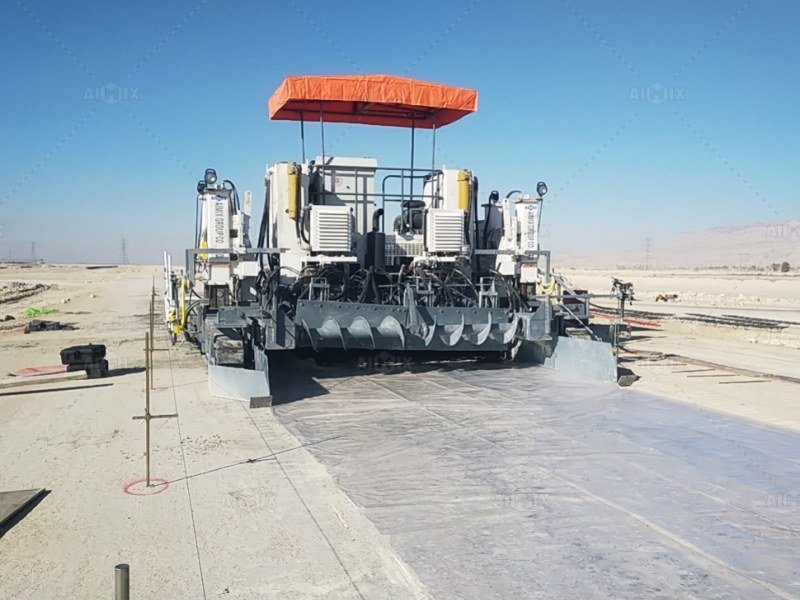
A slipform paver is a self-propelled concrete paving machine that places, spreads, consolidates, and finishes concrete in a continuous process while moving forward. Unlike traditional paving methods that rely on fixed side forms, slipform machines use movable side shutters (forms) that shape the concrete as the machine advances, allowing the freshly placed concrete to retain its shape immediately after extrusion.
The term slipform refers to the continuous movement of the formwork along the alignment, eliminating the need for repeated installation and removal of conventional forms.
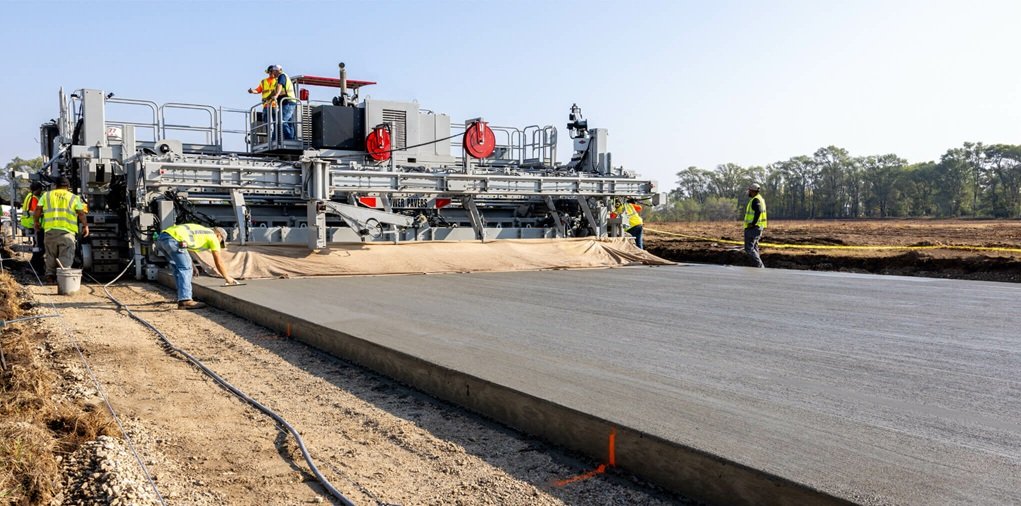
Working Principle of Slipform Paving
The slipform paving process is a synchronized operation involving concrete supply, distribution, vibration, shaping, and surface finishing.
Step-by-Step Process:
- Concrete Supply
Concrete is delivered to the paver using transit mixers, dumpers, or belt placers. The concrete mix must meet strict workability and consistency requirements. - Spreading and Distribution
An auger or spreader system distributes concrete evenly across the paving width. - Consolidation
High-frequency internal vibrators mounted within the machine compact the concrete, removing entrapped air and ensuring uniform density. - Shaping by Slipform Mould
Adjustable side forms shape the pavement edges and profile as the machine moves forward. - Surface Finishing
Finishing beams, oscillating screeds, or pan floats smooth the surface to the desired texture and level. - Texturing and Curing
Surface texturing (such as broom or tine finish) improves skid resistance, followed by curing compound application to control moisture loss.
The entire operation occurs continuously, producing long stretches of uniform pavement with minimal interruptions.
Key Components of a Slipform Paver
1. Main Frame and Chassis
The rigid steel frame supports all functional components and ensures structural stability during paving operations.
2. Track or Wheel System
Slipform pavers typically use crawler tracks for superior traction and stability on uneven subgrades.
3. Concrete Hopper and Augers
The hopper receives concrete and feeds it to transverse augers that distribute material evenly across the paving width.
4. Vibration System
High-frequency vibrators compact the concrete internally. The number and spacing of vibrators depend on pavement thickness and width.
5. Slipform Mould (Side Forms)
These adjustable moulds define the pavement width, thickness, edge shape, and cross slope.
6. Grade and Steering Control System
Modern slipform pavers use stringline sensors, laser guidance, GPS, or 3D control systems to maintain precise alignment and elevation.
7. Finishing and Texturing Units
Includes finishing beams, oscillating screeds, burlap drags, and texturing brushes.

Types of Slipform Paver Laying Machines
Highway and Mainline Slipform Pavers
Highway and mainline slipform pavers are large, high-capacity machines used for constructing wide cement concrete pavements on highways, expressways, and rigid road corridors. These machines are capable of paving widths ranging from about 4 metres to more than 16 metres in a single pass and can place thick concrete slabs designed to withstand heavy traffic loads. They are equipped with multiple internal vibrators to ensure deep and uniform compaction, along with advanced grade and steering control systems such as stringline sensors, laser guidance, or 3D GPS technology. Highway slipform pavers are best suited for long, straight stretches where high productivity and consistent pavement quality are important.
Curb, Gutter, and Barrier Slipform Pavers
Curb, gutter, and barrier slipform pavers are compact and highly maneuverable machines designed for shaping smaller concrete elements along roadways. These machines use specially designed moulds to extrude kerbs, medians, parapets, crash barriers, and drainage channels without the need for conventional shuttering. Their ability to work efficiently in confined urban spaces makes them ideal for city roads, flyovers, and bridge approaches. By eliminating manual formwork, curb and barrier slipform pavers significantly reduce labour requirements while delivering uniform profiles and smooth finishes.
Canal and Drain Slipform Pavers
Canal and drain slipform pavers are specialized machines used for constructing concrete-lined irrigation canals, stormwater drains, and sewer channels. They are capable of paving trapezoidal, U-shaped, or rectangular cross-sections and can operate on sloped embankments and varying gradients. These machines ensure uniform lining thickness and smooth hydraulic surfaces, which improve water flow efficiency and reduce seepage losses. Canal slipform pavers are particularly valuable in large irrigation and flood control projects where speed, consistency, and durability are essential.
Airport Runway and Heavy-Duty Pavement Slipform Pavers
Airport runway and heavy-duty pavement slipform pavers are designed for projects that demand extremely high structural performance and precision. These machines are built with robust frames and powerful vibration systems capable of placing very thick concrete slabs required for runways, taxiways, aprons, and industrial yards. Tight tolerance control is achieved through advanced guidance systems, ensuring compliance with stringent aviation and industrial standards. Their use results in pavements with exceptional load-bearing capacity, surface smoothness, and long service life.
Fixed-Width Slipform Pavers
Fixed-width slipform pavers are designed for projects where the pavement width and thickness remain constant throughout the alignment. These machines have pre-set configurations that require minimal adjustment during operation, making them simple to operate and maintain. Fixed-width pavers are commonly used on long stretches of highways or industrial roads with uniform design standards. While they offer high stability and consistent output quality, their lack of flexibility makes them less suitable for projects involving variable cross-sections.
Variable-Width (Telescopic) Slipform Pavers
Variable-width or telescopic slipform pavers provide greater flexibility by allowing the paving width to be adjusted during operation. These machines are equipped with extendable frames and advanced hydraulic systems that enable on-the-fly width changes. They are particularly useful for expressways, urban arterial roads, and projects where the pavement geometry varies along the alignment. Although mechanically more complex than fixed-width machines, variable-width slipform pavers reduce the need for multiple machines and improve overall project adaptability.
Modular Slipform Pavers
Modular slipform pavers are designed with interchangeable components and moulds, allowing a single machine to perform multiple functions. Depending on the configuration, these machines can be used for paving roads, constructing kerbs, forming barriers, or lining canals. This versatility makes modular slipform pavers attractive to contractors handling diverse infrastructure projects. While their productivity may be slightly lower than that of dedicated machines, their adaptability and cost efficiency make them a practical choice for multi-purpose use.
3D GPS and Laser-Guided Slipform Pavers
3D GPS and laser-guided slipform pavers represent the most advanced generation of concrete paving equipment. These machines use digital terrain models, GPS, GNSS, or laser systems to control paving accuracy without the need for physical stringlines. The technology enables faster setup, improved precision, and reduced material wastage, particularly on large and complex projects. Although the initial investment and skill requirements are higher, 3D-guided slipform pavers are increasingly preferred for modern, high-precision infrastructure development.
Applications of Slipform Paving Machines
Slipform pavers are used across a wide range of infrastructure projects:
- National highways and expressways
- Rigid pavements and concrete roads
- Airport runways, taxiways, and aprons
- Metro rail depots and stations
- Industrial yards and container terminals
- Irrigation canals and drainage systems
- Concrete barriers, kerbs, and parapets
In countries like India, slipform paving has gained prominence in projects such as cement concrete highways, Bharatmala corridors, and airport expansions.
Advantages of Slipform Paver Laying Machines
1. High Construction Speed
Slipform paving significantly reduces project timelines by enabling continuous concrete placement.
2. Superior Surface Quality
Automated control systems ensure uniform thickness, smooth finish, and consistent alignment.
3. Reduced Labor Requirement
Automation minimizes dependency on skilled manual labor, improving productivity and safety.
4. Cost Efficiency for Large Projects
Although capital-intensive, slipform pavers reduce overall lifecycle costs for large-scale projects.
5. Improved Structural Performance
Better compaction and joint quality enhance pavement durability and load-bearing capacity.
6. Flexibility in Design
Slipform moulds can be adjusted to produce various profiles, widths, and edge shapes.
Concrete Mix Requirements for Slipform Paving
The success of slipform paving depends heavily on the concrete mix:
- Low slump (typically 25–50 mm) to maintain shape after extrusion
- Well-graded aggregates for stability and finish
- Adequate cement content for early strength gain
- Use of admixtures like superplasticizers and retarders
- Consistent batching and delivery
Poor mix control can lead to edge slump, surface tearing, or inadequate compaction.
Automation and Technological Advancements
Modern slipform pavers are increasingly integrated with advanced technologies:
- 3D machine control systems
- GPS and GNSS-based guidance
- Laser leveling
- Real-time monitoring of paving parameters
- Telematics and remote diagnostics
These innovations improve accuracy, reduce material wastage, and enhance overall project control.
Future Outlook of Slipform Paving Technology
The future of slipform paver laying machines is aligned with broader trends in construction automation and sustainability:
- Increased use of AI-based machine control
- Integration with BIM and digital project management
- Energy-efficient hydraulic systems
- Use of low-carbon and alternative concrete mixes
- Autonomous or semi-autonomous paving operations
As infrastructure investments continue to grow globally, slipform paving will remain a cornerstone technology for durable and high-performance concrete construction.
Conclusion
Slipform paver laying machines have fundamentally transformed concrete pavement construction by combining speed, precision, and durability. Their ability to deliver high-quality pavements with minimal manual intervention makes them indispensable for modern infrastructure projects. While the technology requires significant investment and planning, the long-term benefits in terms of performance, lifecycle cost, and construction efficiency far outweigh the challenges. As automation, digital control, and sustainable construction practices continue to evolve, slipform paving machines are set to play an even more pivotall role in shaping the future of roads, airports, and urban infrastructure worldwide.
Image Credit: gomaco.com, powercurbers.com, wirtgen-group.com, aimixgroup.com