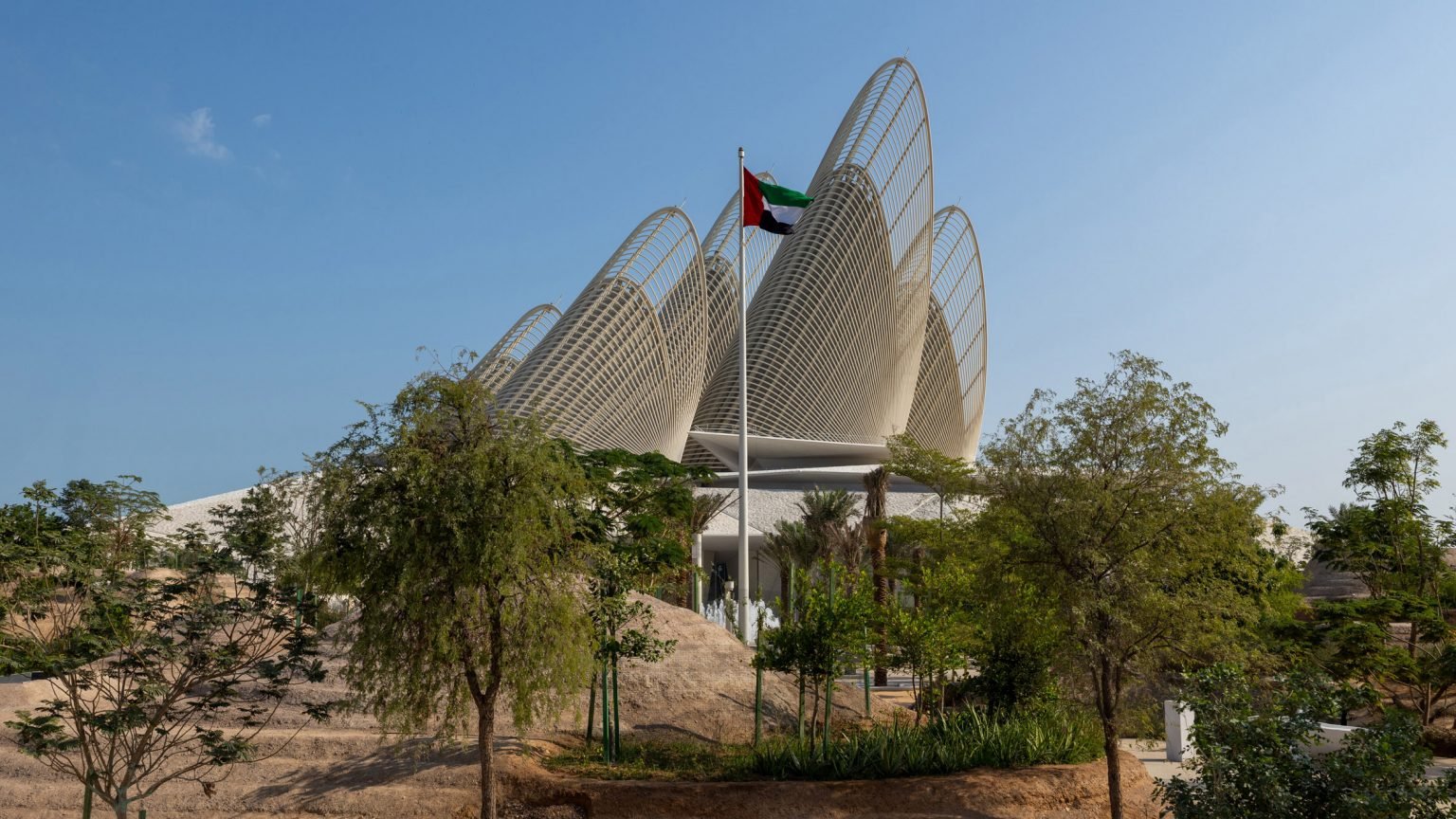
The Zayed National Museum, whose design was done by Foster + Partners, has been delayed quite a while but it finally is available for visitors. It arises as the leading institution of the emirate’s rapidly-developing cultural district on Saadiyat Island, Abu Dhabi. Comprising a trio of impressive museums, the Zayed National Museum is positioned in the company of the Louvre Abu Dhabi and the Guggenheim Abu Dhabi (opening soon). The museum is dedicated to the founder of the UAE, Sheikh Zayed bin Sultan Al Nahyan, and tells the story of the country through seven massive galleries.
A Monumental Architectural Statement
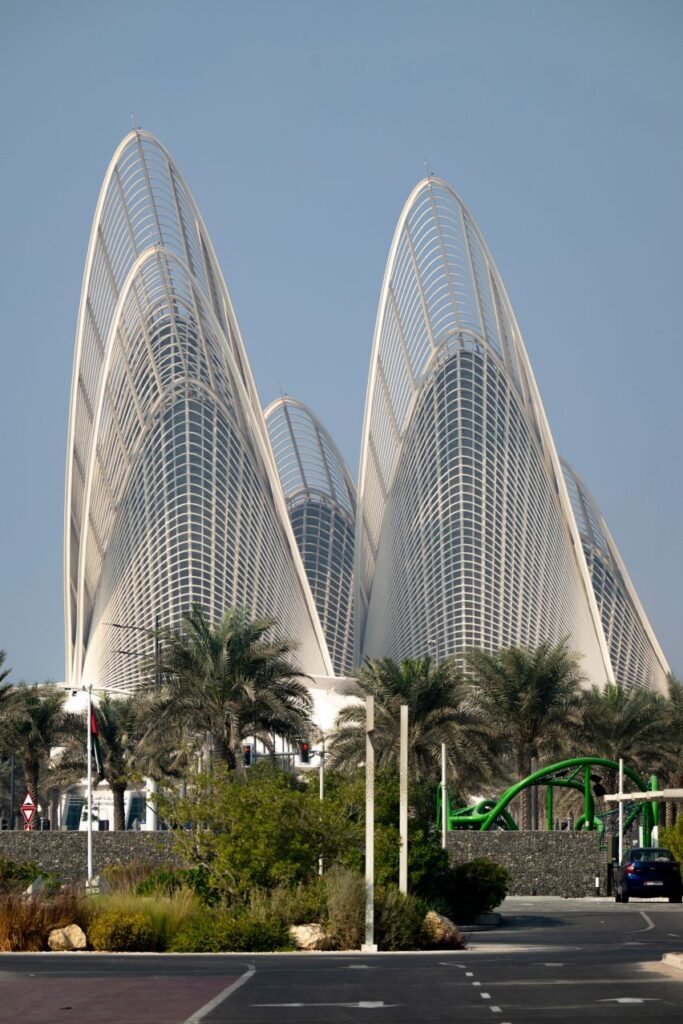
The five metal masts of the museum, shaped after the feathers of a falcon – a highly symbolic animal for Sheikh Zayed – and stretching up to 123 meters, are the main elements of the building, which can be seen from far. The towers also serve as thermal chimneys which absorb cool air from underground and ventilate the building naturally. Their shapes and orientations are such that they do not overshadow each other, thus a lot of natural light comes to the inside of the building.
The towers rely on negative air pressure to draw out hot air from the central area
- The heated wing tips generate rising thermal air currents
- Nice cool air is drawn from underneath the desert surface, thus less mechanical cooling is needed
- This passive design move is at the heart of the building’s environmental objectives and it ties the whole project to the desert of the UAE.
Design Inspired by the Landscape
The museum occupies 88,870 square meters and is surrounded by a highly molded and faceted hill which imitates the desert landscape of the region. The outside of the building is largely made up of white concrete blended with local crushed marble thus the final product has all the features of the sandy palette of Saadiyat Island. A little bronze at doorways and wayfinding points give off some warmth while the towers have used a mix of painted steel and aluminium for their final touch.
Norman Foster revealed that the design was influenced by the site which was undeveloped at that time: the architect took the ground’s texture and form directly as the major elements that helped to create the building’s modern yet regionally grounded look.
A Dramatic Interior Experience
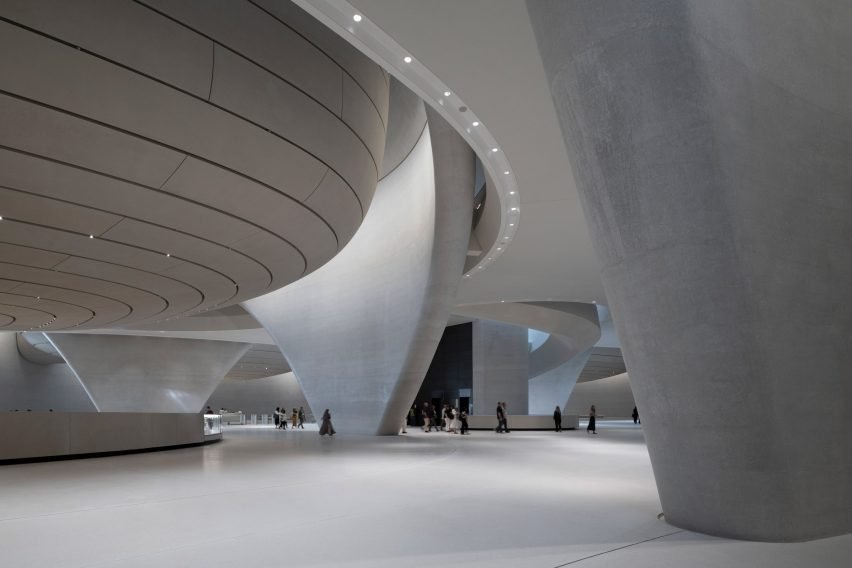
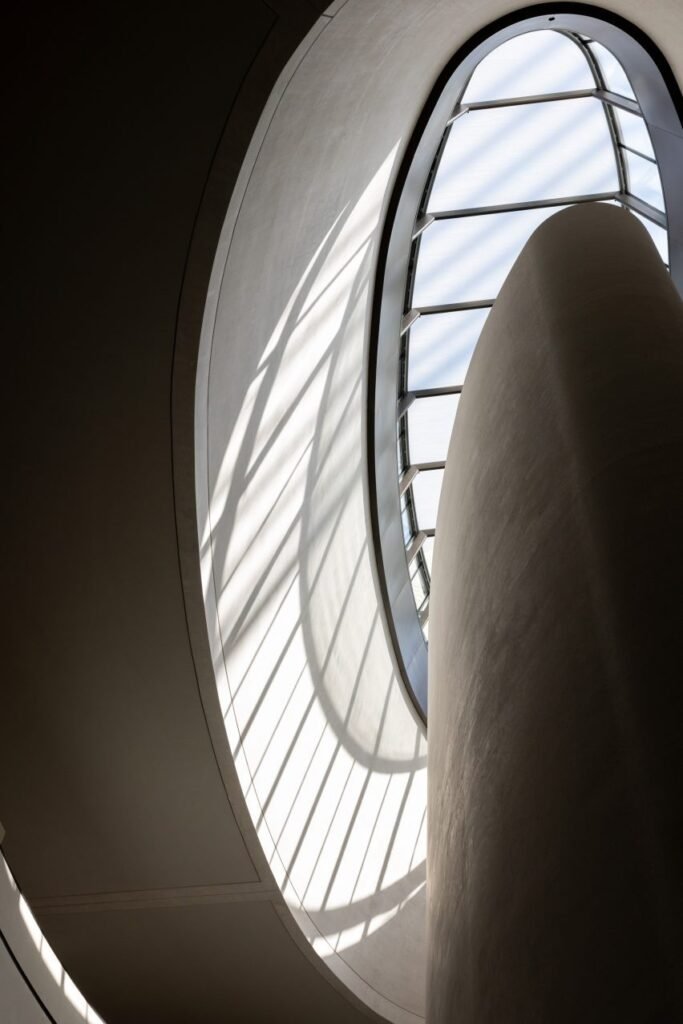
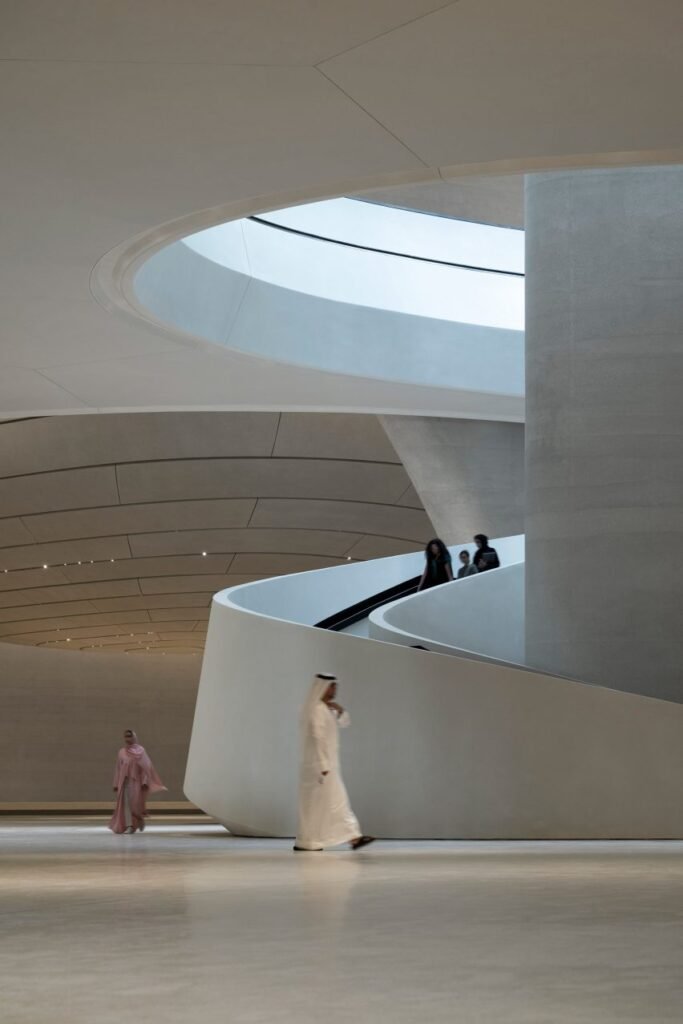
The central part of the museum is Al Liwan, an extremely large lobby which is architecturally characterized by several layers of locally cast concrete drum walls. This area accommodates a museum shop, an auditorium, as well as the entrances to two ground-floor galleries.
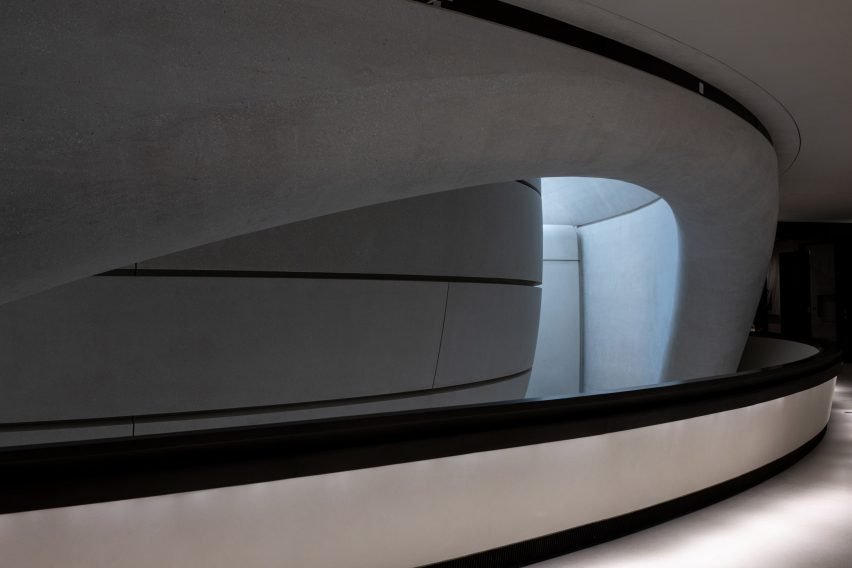
There are also four more galleries on the upper floor in enclosed pods that look like suspended structures and are covered with glass-reinforced concrete. By lifting these pods, Foster + Partners made the building full of light which comes into the public areas from the recesses between the towers.
Six gallery pods of different dimensions
- Hanging architecture offers floating visual appearance
- Sunlight helps to bring the pods and concrete walls to life
- The deliberate change of size when visitors move from the grand lobby to the smaller gallery pods is an enhancement of the museum experience.
Exhibitions and Cultural Significance
The museum with 1,500 plus artifacts is a human historical journey of the UAE dating back to 300,000 years ago and going up to the present era. Some of the important pieces are:
- The full-size Bronze Age boat reassembled in the atrium
- The highly detailed model of Hili Grand Tomb
- Galleries exploring archaeology, natural landscapes, falconry, governance and the life of Sheikh Zayed
Al Masar Garden: A 600-Metre Cultural Spine
The building is accompanied by the Al Masar Garden, a straight 600-meter public area that extends from the museum to the seashore. The four thematic zones into which the garden is divided feature tree-lined walkways, an entrance plaza with a grand fountain, and a landscape made up of:
- more than 900 trees and plant species
- sculptures of native animals
- an irrigation system based on the ancient falaj water channels
The garden not only strengthens the museum’s civic role but also links it with the neighboring residential and retail areas thus making what Foster calls “a city within the city” on a small scale.
A Project Nearly Two Decades in the Making
Foster + Partners was the winner of the design competition in 2007, and the ground-breaking took place in 2008. According to Mohamed Khalifa Al Mubarak, Chairman of Culture Department, Abu Dhabi, the main reason why the proposal of Foster was chosen is that it was able to integrate the values, the environment, and the symbols of Emirati into one architectural language of global significance. By the opening of Zayed National Museum following Mechanical’s Natural History Museum and Adjaye Associates’ Abrahamic Family House, Saadiyat Island is turning into a cultural hub of one of the most ambitious districts in the world.
Images- Zayed National Museum