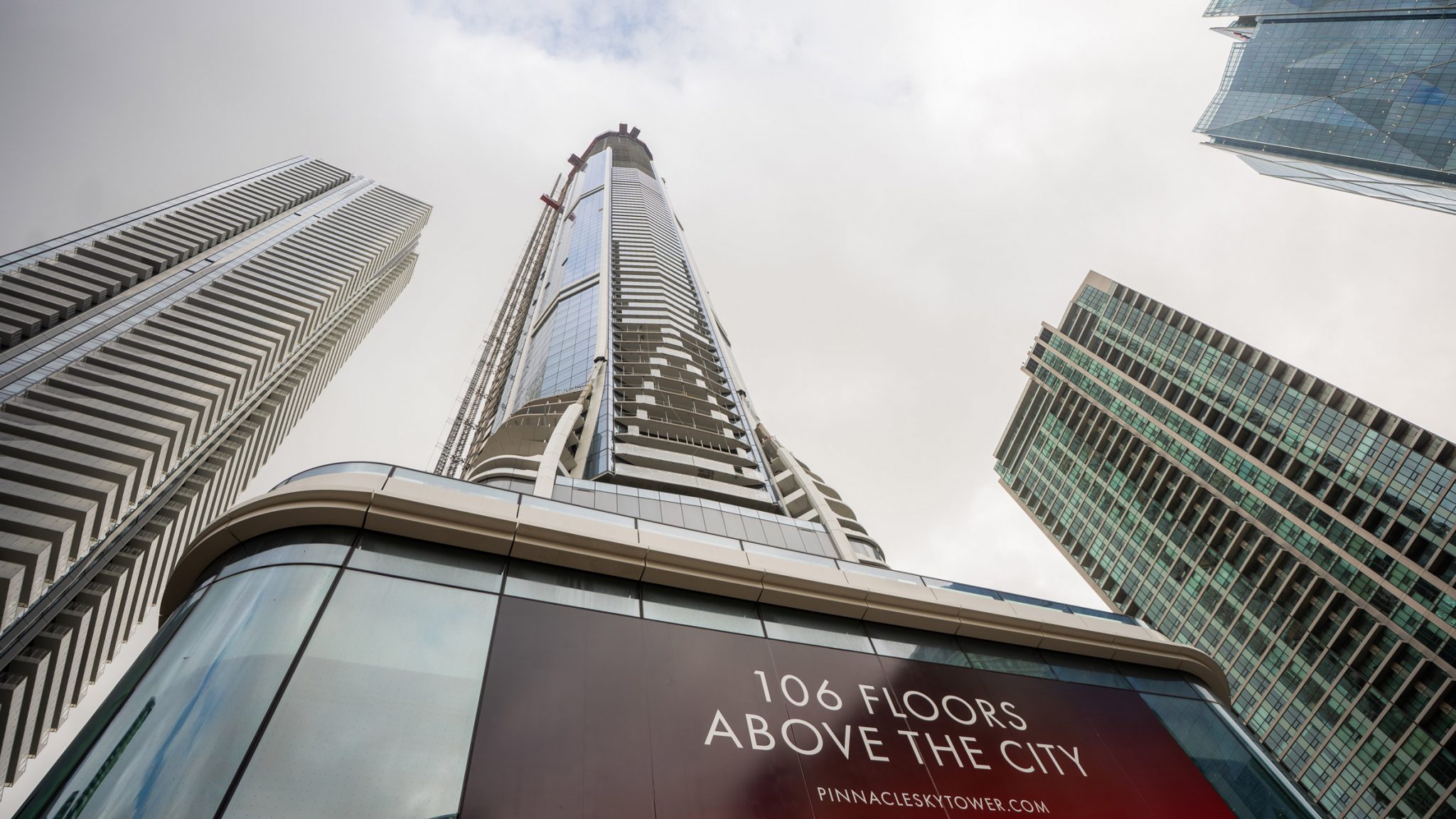
Toronto has a new record with Skytower being the main tower of the Pinnacle One Yonge development that has officially surpassed hundred storeys. Once finished, the tower designed by Hariri Pontarini Architects will be the tallest building in Canada. As the tower ascends, it tells the story of Toronto’s expanding skyline, which is most visible along the waterfront where new high-rise clusters are continually changing the urban landscape.
The height of Skytower is anticipated to be 351.85 meters. The very first photos of construction that were made public in the middle of 2025 depicted the building around 71 storeys and there was a partial cladding presence. Since that time, the work has been unceasing, with most of the mid-level exterior being closed and the core going beyond the 100-storey mark. They are planning to move the façade work on the upper levels as well as the installation of mechanical systems and the interior completion for the next stages.
Pinnacle International president and CEO Michael De Cotiis described the event of reaching the milestone as the defining moment of Canada’s architectural growth. The developer sees this tower as a future anchor for the rapidly changing concentration of mixed-use density in the Harbourfront district which is increasing at a brisk pace.

Project Overview
- Architect: Hariri Pontarini Architects
- Developer: Pinnacle International
- Height: 351.85 meters
- Storeys: 106 approved; construction is currently beyond 100
- Uses: Residential units, hotel, amenities
- Key Feature: Restaurant on the 106th floor
- Location: Pinnacle One Yonge, Toronto Harbourfront
Hariri Pontarini Architects conceived SkyTower with a geometrical shape that was tapered and had 12 sides. The surface of the building truncates and even the sloping form makes the building reflect light differently depending on the view angle. Though the visual effect is one of the designer’s intents, the shape also performs structural function. The building’s faceted areas enable the wind forces coming from Lake Ontario with less intensity to be dispersed. That is to say that the strong winds caused by the lake are one of the main problems for the high-rise buildings situated on the waterfront but SkyTower is designed to minimize the effect of the wind.
According to the architects, the elevation of the upper facilities is broadly in line with the main observation level of the CN Tower. Even though the CN Tower is still much taller, the connection between the two can be visually established as both of the most significant vertical elements of the city.
Key Design Features
- 12-sided floor plate that tapers as it moves upward.
- Chamfered corners to reduce wind pressure.
- Balkon on one side that forms a vent-like pattern.
- Progression of cladding now is at an advanced stage for the lower and middle sections.
- A place for amusement was positioned to offer the vista of the whole lake and city.
Height Revision and Development Strategy
Initially, SkyTower had a plan approved for a 95-storey building. A request for a variance made in March 2025 led to the consent of the present 106-storey design. A few meters shy of 309, the tower at One Bloor by Foster + Partners was the first supertall that got completed in Canada at the beginning of 2025. SkyTower at the same location will be longer than that by over 40 meters.
The skyscraper is a part of a multi-building scheme, which consists of the another high-rise build that is projected to be 95 storeys tall. These towers will, therefore, be the core of the residential and mixed-use neighborhood of the city, closest to the transit lines, the financial district, and the waterfront corridor.

Development Context
Toronto is still very active in the vertical game of planning and building and, as a result, we are witnessing the birth of a vast number of tall towers yearly.
Harbourfront has been an industrial land and now it is a high-density neighborhoods area in transition. The city’s planning framework is very favorable to vertical growth especially near transit and waterfront infrastructure.
Among the recent projects is the 84-storey Forma tower designed by Gehry that is contributing to the rising skyline.
Toronto’s Vertical Expansion
Toronto has been transforming its skyline rapidly within the last ten years. Quite often new towers are erected next to low-rise commercial streets, which results in a layered visual condition that combines the old urban fabric with the new high-rise construction. Different urban studies and the photo series that are released throughout the year have all been demonstrating how significant these developments are in reshaping the character of the most important neighborhoods.
The development of SkyTower along with several other large-scale projects is telling us that the city is getting more and more characterized by tall, mixed-use buildings that are located close to transit and have high-density. In such a way as residential living in high-rises will be more and more popular, developers are still committed to the creation of vertical communities that have integrated amenities and public spaces.
Next Steps and Completion Timeline
- The structural topping-out will probably be done very soon.
- Installation of cladding is going on and the workers are moving upward.
- Mechanical and interior work are scheduled to be done in 2025–2026.
- Resident occupancy is planned for 2026.
When it is finished, SkyTower will be the tallest residential building in Canada and one of the tallest on the continent. Its rise tells a story of Toronto architectural evolution and also puts the city among the key global talks about tall urban living.
Reference- dezeen.com