1. Introduction
Road infrastructure is a key component of economic development and connectivity. With rapid urbanization and a continuous rise in traffic volume, many existing roads are no longer capable of handling present-day demands. This leads to congestion, pavement deterioration, and safety concerns. To overcome these issues, engineers adopt road widening and strengthening techniques to upgrade existing roads efficiently.
Road widening involves increasing the width of the carriageway to accommodate more traffic lanes or shoulders. Strengthening, on the other hand, improves the load-carrying capacity of the pavement to withstand heavier traffic loads and extend its service life. Together, these methods help in improving both functional and structural performance of roads.
2. Need for Road Widening and Strengthening
Over time, roads experience both functional and structural deficiencies. Functional issues arise due to increased traffic volume, while structural problems occur due to repeated loading and environmental effects.
The major reasons for adopting these methods include:
- Increase in traffic volume and axle loads
- Urban expansion and industrial growth
- Deterioration of pavement over time
- Need for improved safety and riding quality
Upgrading existing roads is often more economical and practical than constructing new ones, especially in developed areas.
3. Road Widening Methods
Road widening is carried out to increase the capacity of the roadway while maintaining proper alignment and structural continuity with the existing pavement.
3.1 Symmetrical and Asymmetrical Widening
In symmetrical widening, additional width is provided equally on both sides of the centerline. This ensures uniform load distribution and maintains geometric balance, making it suitable for highways and rural roads.
In asymmetrical widening, the road is expanded only on one side. This method is commonly used in urban areas where constraints such as buildings, utilities, or land availability restrict expansion on both sides.
- Symmetrical widening provides better structural uniformity
- Asymmetrical widening is suitable for space-constrained areas
3.2 Full-Depth and Partial Widening
Full-depth widening involves constructing new pavement layers from the subgrade level, including sub-base, base, and surface layers. This ensures uniform strength and durability across the entire width.
Partial widening involves extending the pavement by adding layers adjacent to the existing structure. Although faster and more economical, it requires careful treatment of joints to avoid cracking and differential settlement.
- Full-depth widening ensures long-term durability
- Partial widening reduces cost and construction time
3.3 Shoulder Widening and Use of Geosynthetics
Shoulder widening is often included to enhance safety and provide additional space for emergency stopping. It also improves drainage and reduces edge failures.
Geosynthetics such as geotextiles and geogrids are increasingly used in widening projects to improve soil stability and prevent differential settlement between old and new pavement.
- Shoulders improve safety and drainage
- Geosynthetics enhance stability and performance
4. Road Strengthening Methods
Road strengthening is carried out when the existing pavement is unable to carry traffic loads effectively. Instead of complete reconstruction, strengthening techniques improve structural capacity and extend service life.
4.1 Pavement Overlay
Overlay is the most commonly used method for strengthening. It involves placing an additional layer over the existing pavement to improve both strength and riding quality.
Depending on the requirement, overlays can be classified as:
- Bituminous overlays for flexible pavements
- Cement concrete overlays (white topping) for higher durability
Overlays are effective in restoring structural integrity and improving surface conditions.
4.2 Profile Corrective Course and Surface Treatment
Before applying an overlay, it is essential to correct surface irregularities. A profile corrective course is used to fill depressions and level uneven surfaces.
For minor defects, surface treatments such as crack sealing and micro-surfacing are applied to prevent further deterioration.
- Ensures proper bonding of overlay layers
- Improves smoothness and riding comfort
4.3 Recycling and Full-Depth Reclamation
Recycling methods are widely used to improve sustainability and reduce construction costs. In cold and hot in-place recycling, the existing pavement material is reused after processing.
In cases of severe pavement damage, full-depth reclamation is adopted. This involves pulverizing the entire pavement structure, mixing it with stabilizers such as cement or lime, and reconstructing the base layer.
- Recycling reduces material usage and cost
- Full-depth reclamation restores structural strength
4.4 Use of Geosynthetics in Strengthening
Geosynthetics are used in strengthening works to enhance pavement performance. They help in reducing reflective cracking, improving load distribution, and increasing the overall life of the pavement.
- Prevents crack propagation
- Improves structural efficiency
5. Equipments Used in Road Widening and Strengthening
The execution of road widening and strengthening projects requires the use of specialized construction equipment at different stages. Each machine plays a specific role in ensuring quality, efficiency, and durability of the pavement.
5.1 Earthwork Equipment
These machines are used for excavation, clearing, and initial ground preparation:
- Excavator – used for digging, trenching, and removal of soil
- Bulldozer – used for clearing land and rough leveling
- Backhoe Loader – used for small-scale excavation and utility work
5.2 Material Handling Equipment
These are used for transporting and loading construction materials:
- Dump Trucks – transport soil, aggregates, and asphalt mix
- Wheel Loaders – load materials into trucks or hoppers
- Tippers – used for short-distance material movement
5.3 Surface Preparation Equipment
These machines prepare the base for widening and strengthening:
- Motor Grader – used for leveling and shaping the road surface
- Cold Milling Machine – removes damaged pavement layers
- Scarifier – loosens compacted soil or old pavement
5.4 Paving Equipment
These are used for laying new pavement layers:
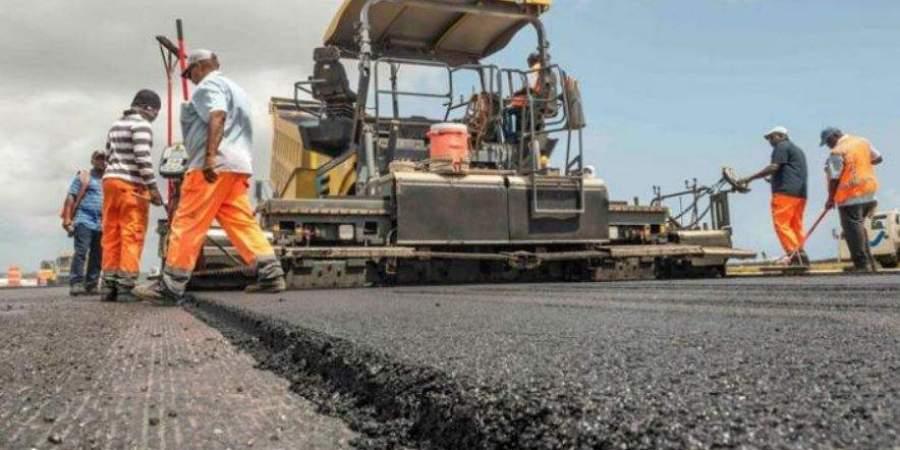
- Asphalt Paver – lays hot mix asphalt uniformly
- Concrete Paver – used for rigid pavement construction
- Sensor Paver – ensures accurate thickness and smooth finish
5.5 Compaction Equipment
Compaction is essential to achieve strength and durability:
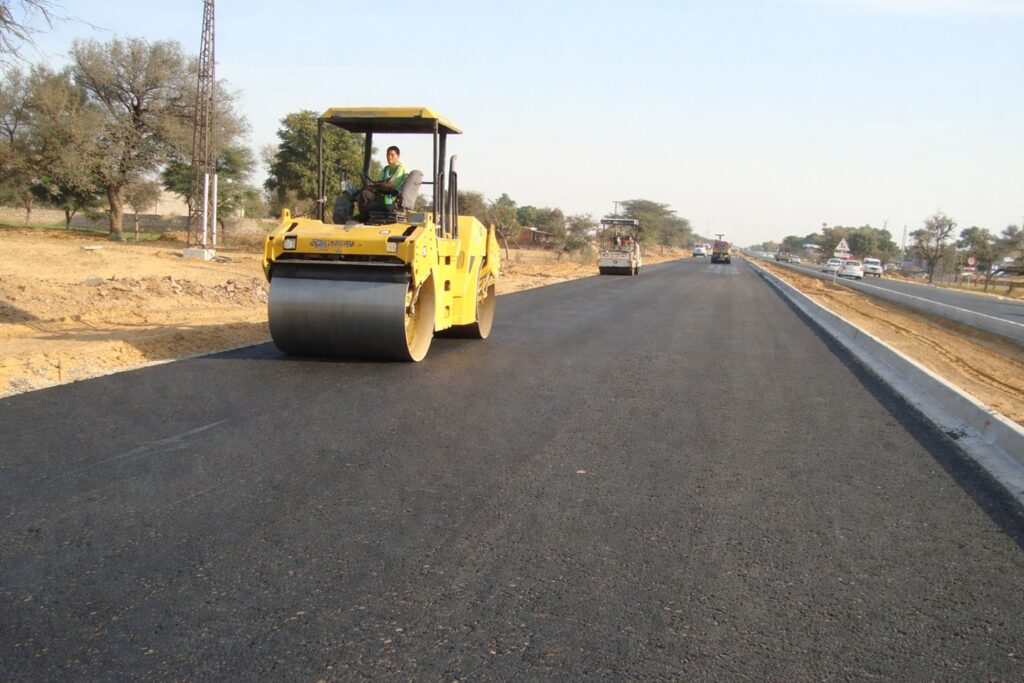
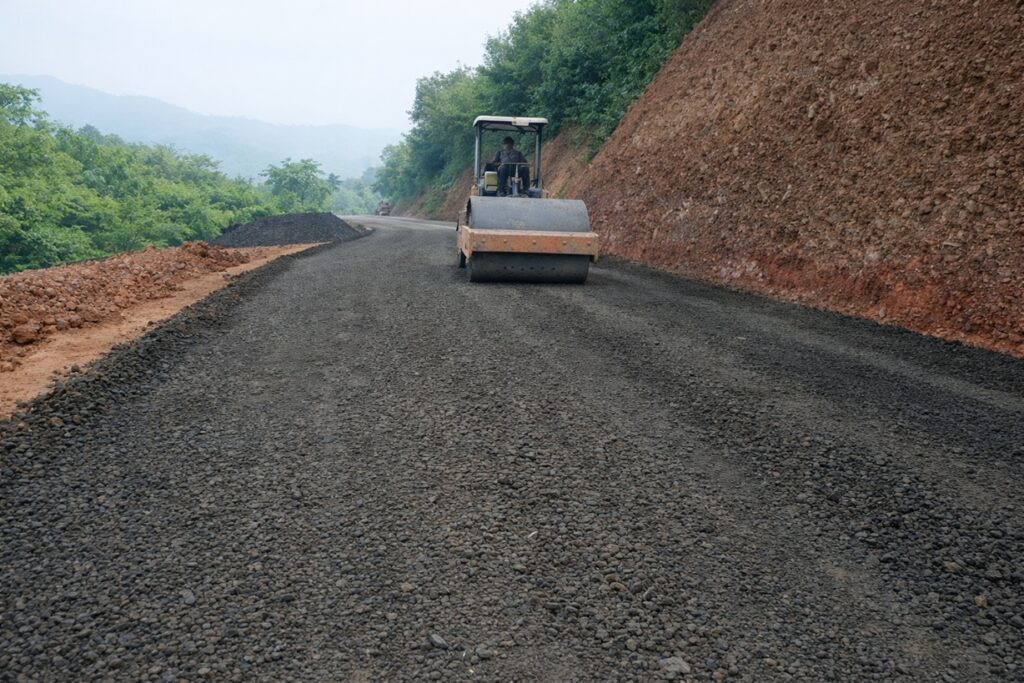
- Vibratory Roller – compacts asphalt and granular layers
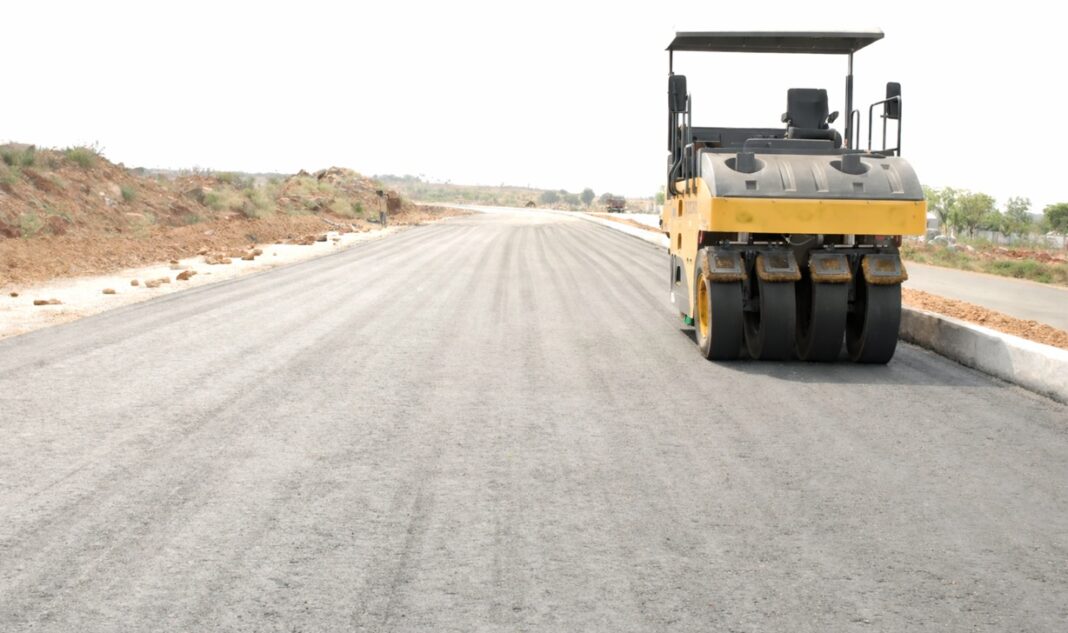
- Pneumatic Tyre Roller – provides uniform compaction
- Tandem Roller – used for finishing and surface smoothness
5.6 Bitumen Application Equipment
Used for applying bonding layers between pavement courses:
- Bitumen Sprayer – applies tack coat and prime coat
- Pressure Distributor – ensures uniform spraying
5.7 Finishing and Miscellaneous Equipment
These machines are used for final touches and quality improvement:
- Road Marking Machine – applies lane markings
- Shoulder Finishing Equipment – shapes and compacts shoulders
- Water Tanker – used for dust control and moisture conditioning
6. Challenges in Execution
Road widening and strengthening projects often face practical challenges during execution. Traffic management is one of the most critical issues, especially in busy urban areas where construction activities disrupt normal flow.
Other challenges include:
- Land acquisition constraints
- Drainage and water infiltration problems
- Poor bonding between old and new pavement
- Environmental and sustainability concerns
Proper planning, design, and supervision are necessary to overcome these challenges.
7. Conclusion
Road widening and strengthening are essential techniques for upgrading existing road infrastructure to meet modern traffic demands. While widening increases the capacity of the road, strengthening enhances its structural performance and durability.
With the use of modern construction methods, advanced materials, and efficient equipment, these techniques have become more effective and sustainable. Proper implementation ensures improved safety, longer pavement life, and better serviceability, making them important for road infrastructure development.
Image credit: globalhighways.com, projectsmonitor.com, x.com, constructionweekonline.in