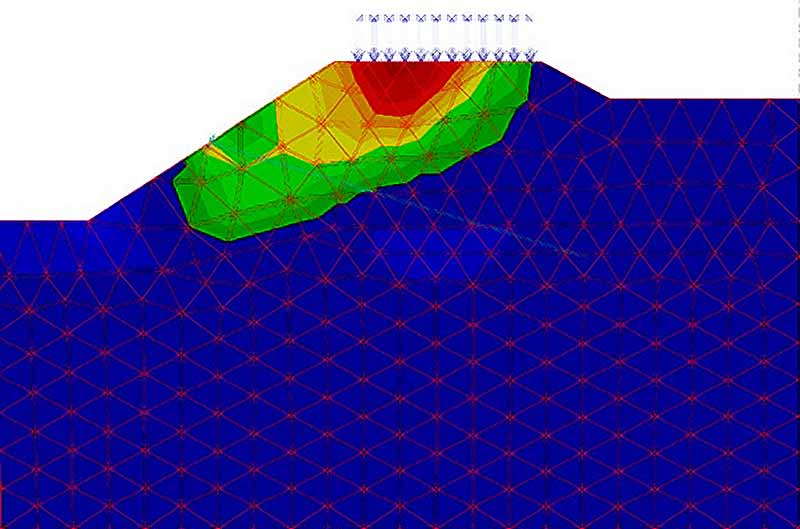
Ground engineering relies heavily on understanding soil–structure interaction, stress–strain behavior, and the performance of earth systems under loading. Traditional analytical solutions often simplify soil behavior, making them insufficient for modern infrastructure projects that demand higher precision and risk management. Numerical modeling has therefore become an essential part of geotechnical engineering, enabling detailed simulation of soil response, deformation patterns, and failure mechanisms.
Software platforms such as PLAXIS, FLAC, and GeoStudio represent three widely adopted tools for numerical analysis in geotechnical practice. These platforms employ advanced numerical methods, primarily the finite element method (FEM) and finite difference method (FDM), to model complex soil–structure systems. Each tool is suited to specific applications, ranging from slope stability and foundation analysis to tunnel design and soil–fluid interaction problems.
Numerical Modeling in Ground Engineering
Numerical modeling refers to the process of representing soil behavior and engineering systems using computational algorithms. Unlike analytical methods that rely on closed-form equations, numerical models approximate solutions through discretization and iterative calculation.
Key Principles
- Discretization – The soil mass or structure is divided into smaller elements or zones (finite elements in FEM, zones in FDM).
- Constitutive Models – Soil behavior is represented using models ranging from linear elasticity to advanced elastoplastic models (Mohr-Coulomb, Hardening Soil, Cam-Clay, etc.).
- Boundary Conditions – Constraints and loads are applied to replicate in-situ stresses, external forces, and interaction effects.
- Solution Procedure – Iterative algorithms solve the governing equations of equilibrium, compatibility, and constitutive relationships.
- Output Interpretation – Results include displacements, stresses, strains, pore pressures, and stability indicators such as factors of safety.

Advantages of Numerical Modeling
- Captures nonlinear, time-dependent soil behavior.
- Allows simulation of staged construction, critical for embankments, excavations, and tunneling.
- Handles complex geometries and boundary conditions.
- Facilitates coupled analyses (e.g., seepage–stress, thermal–mechanical, dynamic response).
PLAXIS in Soil Analysis
PLAXIS is a finite element software specialized for geotechnical applications. Developed initially at Delft University of Technology, it has evolved into a comprehensive tool widely used in both research and practice.
Core Features
- Finite Element Method (FEM) – Models 2D and 3D soil–structure interaction problems.
- Constitutive Soil Models – Includes Mohr-Coulomb, Soft Soil, Hardening Soil, HS-Small, and user-defined models for advanced projects.
- Staged Construction – Enables modeling of sequential excavation, loading, or construction stages.
- Coupled Analyses – Provides soil–water interaction modeling through fully coupled flow–deformation analyses.
- Dynamic Capabilities – Allows earthquake loading, machine vibrations, and other dynamic effects.
Applications
- Excavation Design: PLAXIS simulates wall deflections, ground settlements, and strut forces in deep excavation support systems.
- Foundation Analysis: Settlement prediction for shallow and deep foundations, including pile–soil interaction.
- Tunneling: Ground loss, lining stresses, and settlement troughs can be analyzed in 2D or 3D.
- Slope Stability: FEM-based stability evaluation with shear strength reduction techniques.
- Dams and Embankments: Consolidation, pore pressure dissipation, and staged loading are analyzed.
FLAC in Soil Analysis
FLAC (Fast Lagrangian Analysis of Continua), developed by Itasca Consulting Group, is based on the finite difference method (FDM). It is particularly strong in handling large strain, dynamic, and non-linear soil behavior problems.
Core Features
- Finite Difference Method (FDM) – Uses explicit time-marching schemes, suitable for both static and dynamic problems.
- Large Deformation Modeling – Can capture large-strain plastic behavior and failure propagation.
- Built-in Constitutive Models – Includes Mohr-Coulomb, Hoek–Brown (for rock), strain-softening, and user-defined models.
- Dynamic Analysis – Well-suited for earthquake engineering, blast loading, and vibration problems.
- Coupled Processes – Allows thermal, hydraulic, and mechanical coupling.
Applications
- Seismic Analysis: Simulation of soil–structure response to earthquake ground motions, including liquefaction analysis.
- Underground Excavations: Tunnels, caverns, and mining operations involving stress redistribution.
- Slope Stability and Rock Mechanics: Analysis of progressive failure in slopes and rock masses.
- Soil–Structure Interaction: Dynamic loading on foundations, retaining walls, and underground structures.
- Barrier Systems: Seepage and contaminant transport coupled with mechanical deformation.
GeoStudio in Soil Analysis
GeoStudio is a suite of geotechnical modeling software developed by Geo-Slope International (now part of Seequent). It provides modular solutions for different aspects of soil and rock engineering.
Core Features
- Modular Structure – Includes SLOPE/W (stability), SEEP/W (seepage), SIGMA/W (stress–strain), TEMP/W (thermal), and QUAKE/W (dynamic).
- Finite Element and Limit Equilibrium Methods – Combines FEM for stress and flow analysis with limit equilibrium for stability assessments.
- Integrated Analysis – Modules can be linked, allowing stress–seepage–thermal–stability coupling.
- Graphical Interface – Widely recognized for ease of use and intuitive problem setup.
Applications
- Slope Stability (SLOPE/W): Factor of safety determination under static and seismic loading.
- Seepage and Groundwater (SEEP/W): Flow net development, pore pressure distribution, and seepage control measures.
- Stress–Strain (SIGMA/W): Stress redistribution under foundations, embankments, and excavations.
- Thermal Analysis (TEMP/W): Frozen ground, ground heat exchangers, and seasonal effects.
- Earthquake Loading (QUAKE/W): Seismic displacement and stability assessment.
Challenges and Limitations
Despite their advantages, numerical models have limitations:
- Input Data Quality: Soil parameters are difficult to obtain accurately; poor data reduces reliability.
- Model Complexity: Advanced constitutive models require calibration, often based on laboratory or field tests.
- Computation Cost: Large 3D models and coupled analyses demand significant computational resources.
- User Expertise: Misinterpretation of results due to inexperience can lead to unsafe design assumptions.
Future Outlook
Advancements in numerical modeling are moving towards:
- Integration with Digital Twins: Real-time monitoring data integrated with numerical models for predictive asset management.
- Probabilistic Approaches: Incorporating uncertainty and variability of soil parameters in design reliability.
- Machine Learning Coupling: Using AI techniques to calibrate soil models and improve prediction accuracy.
- Cloud-Based Simulation: Enhancing collaboration, speed, and accessibility for large-scale infrastructure projects.
Conclusion
Numerical modeling has become indispensable in modern ground engineering, allowing engineers to simulate soil behavior under complex conditions that analytical methods cannot adequately address. PLAXIS, FLAC, and GeoStudio each bring unique strengths—whether it is PLAXIS for staged construction and soil–structure interaction, FLAC for dynamic and large-deformation analysis, or GeoStudio for integrated modular solutions in seepage, stress, and stability studies. Their appropriate selection and application, combined with high-quality geotechnical data, enhance both the safety and efficiency of infrastructure projects.
Image Source: geotechdata.info, geoengineer.org