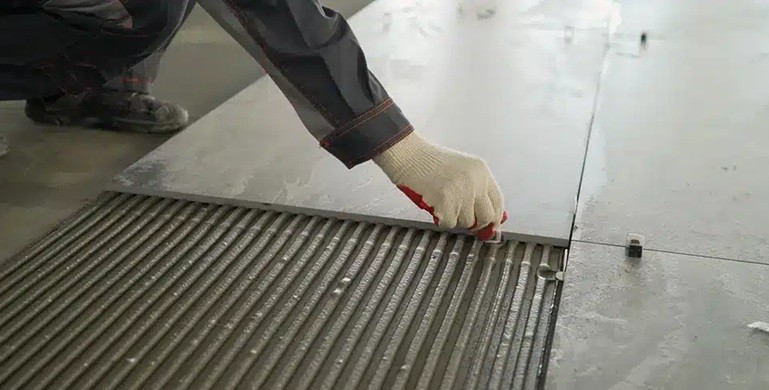
The evolution of tile design has influenced modern architecture. One of the key trends is the increasing use of large format tiles (LFTs). These tiles create a uniform surface with fewer grout lines and a more continuous finish. They are widely used in residential, commercial, retail etc. where a consistent appearance is preferred.
However, large format tiles also bring installation challenges. Their size, weight, and material properties require greater care during fixing compared to traditional tiles. The tile adhesive system plays an important role in this process, as it supports proper bonding and helps maintain long-term performance.
Adhesives for large format tiles are not just bonding agents; they are engineered materials designed to manage stress, movement, and environmental factors. Choosing the wrong adhesive or using improper installation techniques can result in failures such as debonding, cracking, lippage, and long-term durability issues.
Understanding Large Format Tiles
Large format tiles are generally defined as tiles where at least one side exceeds 600 mm, although many modern applications involve slabs that are much larger. These tiles are typically made from materials such as vitrified ceramic, porcelain, or natural stone, all of which have low porosity and high density.
While these properties contribute to durability and aesthetics, they also reduce the tile’s ability to bond with traditional cement-based mortars. Additionally, their size means that even minor installation errors can lead to visible defects.
As a result, large format tiles require:
- High-performance adhesives with superior bonding strength
- Uniform and near-complete adhesive coverage
- Proper substrate preparation
- Skilled installation techniques
Key Challenges in Adhesives for Large Format Tiles
1. Weight and Gravity-Induced Stress
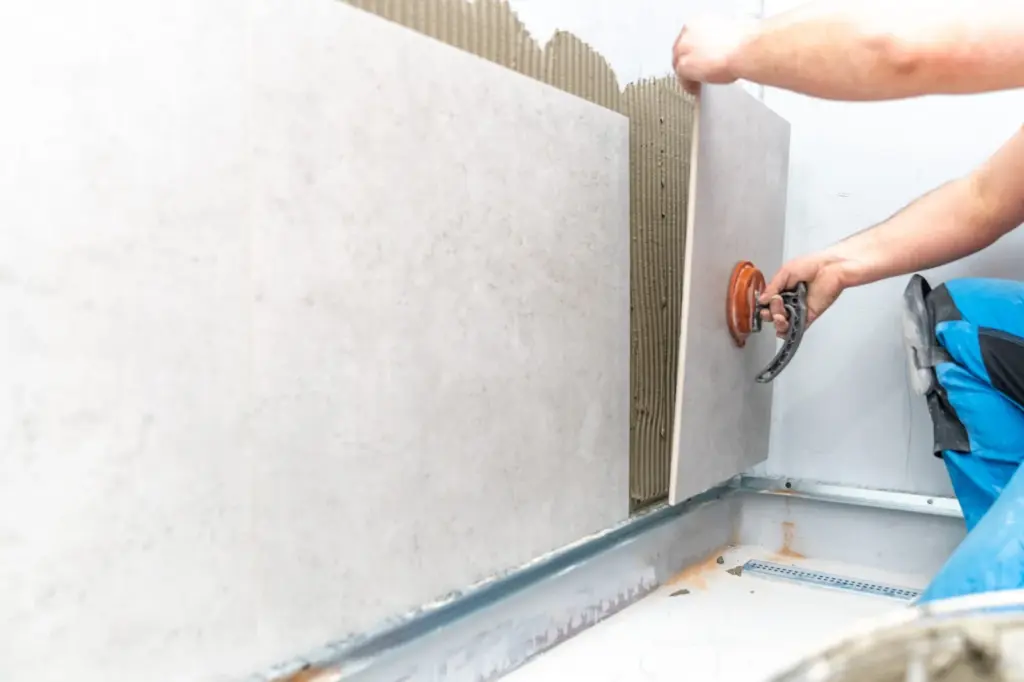
One of the most immediate challenges with large format tiles is their significant weight. When installed vertically, such as on walls or façades, the adhesive must support this weight without allowing slippage during installation or detachment over time.
Conventional adhesives often lack the required non-sag properties, leading to tile movement before the adhesive sets. Over time, this can result in bond failure, posing both aesthetic and safety concerns.
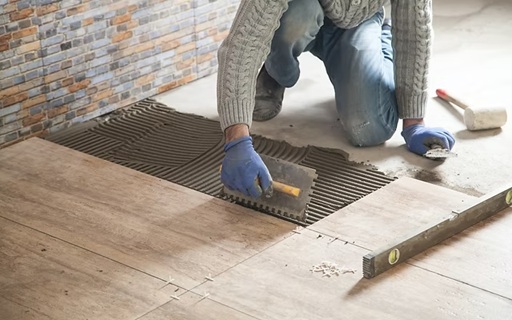
2. Achieving Full Adhesive Coverage
Ensuring adequate adhesive coverage beneath large format tiles is far more difficult than with smaller tiles. Due to their size, any inconsistency in adhesive application can create air voids or hollow pockets.
These voids weaken the bond and can lead to:
- Cracking under load
- Hollow sounds when tapped
- Reduced load distribution
- Water ingress in wet areas
For large format tiles, achieving at least 95% adhesive coverage is essential to ensure structural stability and durability.
3. Substrate Flatness and Surface Preparation
Large tiles do not tolerate uneven surfaces well. Even slight irregularities in the substrate can result in:
- Uneven tile alignment (lippage)
- Stress concentrations
- Poor adhesion
Unlike smaller tiles, which can adjust to minor surface imperfections, large format tiles amplify these flaws, making proper surface preparation and levelling important.
4. Reduced Grout Joints and Movement Stress
Traditional tile installations rely on grout joints to absorb movement caused by temperature changes, structural shifts, or vibrations. Large format tiles, however, have fewer grout lines, which limits their ability to accommodate movement.
This places additional stress on the adhesive layer, which must now act as a flexible buffer to absorb these forces. Without adequate flexibility, the system becomes prone to cracking and debonding.
5. Low Porosity and Bonding Difficulty
Most large format tiles, especially porcelain and vitrified varieties, have very low water absorption rates. While this improves durability, it also reduces the effectiveness of traditional bonding methods that rely on mechanical interlocking.
As a result, adhesives must provide chemical bonding properties to ensure a strong and lasting connection between the tile and substrate.
6. Lippage and Installation Accuracy
Lippage refers to the uneven alignment of tile edges, which is more noticeable with large format tiles due to their size and flat surface. Even slight variations in adhesive thickness or substrate level can result in visible misalignment.
This not only affects aesthetics but can also create functional issues, especially in flooring applications.
7. Environmental and Moisture Exposure
In areas exposed to moisture—such as bathrooms, kitchens, and outdoor spaces—the adhesive must resist water penetration and maintain its bonding strength. Poor adhesive performance can lead to:
- Tile staining
- Efflorescence
- Mold growth
- Structural degradation
Types of Adhesives for Large Format Tiles
Polymer-Modified Cementitious Adhesives
Polymer-modified cementitious adhesives are among the most commonly used solutions for large format tiles due to their balanced performance characteristics. These adhesives are essentially cement-based formulations enhanced with polymer additives that significantly improve bonding strength and flexibility. The inclusion of polymers allows the adhesive to develop a stronger grip on low-porosity surfaces such as porcelain and vitrified tiles, which are otherwise difficult to bond.
In large format tile installations, these adhesives perform well because they can accommodate minor substrate movements while maintaining a strong bond. They also provide better resistance to environmental factors such as moisture and temperature variations. Their versatility makes them suitable for both wall and floor applications across residential and commercial projects, making them a reliable choice for most standard large tile installations.
High-Performance Adhesives (C2TE, S1, S2)
High-performance adhesives, often classified under standards such as C2TE, S1, or S2, are specifically engineered for demanding applications where superior performance is required. These adhesives offer enhanced tensile adhesion strength, reduced slip properties, extended open time, and increased deformability. Such characteristics make them particularly suitable for large format tiles, which place greater stress on the bonding layer.
These adhesives are capable of handling structural movement, thermal expansion, and heavy loads without compromising the bond. Their extended open time allows installers to position large tiles accurately without the risk of premature drying. As a result, they are widely used in high-rise buildings, façades, and commercial environments where durability and precision are important.
Non-Sag Adhesives
Non-sag adhesives are designed to address one of the most common challenges in vertical tile installations—tile slippage. Due to the weight of large format tiles, maintaining their position on walls during installation can be difficult. Non-sag adhesives provide high initial grab, ensuring that tiles remain in place immediately after fixing.
This property not only improves installation accuracy but also enhances safety by reducing the risk of tiles slipping before the adhesive sets. Non-sag adhesives are particularly useful in applications such as wall cladding, bathroom installations, and vertical surfaces where precise alignment is essential. Their ability to hold heavy tiles in position makes them indispensable for large format tile installations on walls.
Extended Open Time Adhesives
Extended open time adhesives are formulated to remain workable for a longer duration after application, which is especially important when dealing with large format tiles. The installation of these tiles requires careful handling, alignment, and adjustment, all of which take more time compared to smaller tiles.
With extended open time adhesives, installers have greater flexibility to position tiles accurately without the risk of the adhesive drying too quickly. This ensures proper bonding and reduces the likelihood of errors such as misalignment or inadequate adhesion. These adhesives are particularly beneficial in large-scale projects, façade applications, and complex layouts where precision is crucial.
Flexible Adhesives
Flexible adhesives are specifically designed to accommodate movement within the tile system. Large format tiles, due to their size and reduced grout joints, are less capable of absorbing stress caused by thermal expansion, structural shifts, or vibrations. Flexible adhesives compensate for this limitation by acting as a buffer that absorbs and distributes these forces.
Their elasticity helps prevent cracks, debonding, and tile failure, especially in environments subject to temperature fluctuations or heavy usage. Flexible adhesives are commonly used in exterior applications, high-traffic areas, and spaces exposed to dynamic conditions. Their ability to maintain bond integrity under stress makes them essential for ensuring long-term durability.
Lightweight Adhesives
Lightweight adhesives are formulated to improve workability and ease of application, particularly when handling large format tiles. These adhesives have a lower density compared to conventional products, making them easier to spread and reducing the physical effort required during installation.
Their improved consistency allows for better coverage and more uniform application, which is important for large tiles. Additionally, their reduced weight can be advantageous in vertical applications, as it minimizes the overall load on the substrate. Lightweight adhesives are especially useful in interior projects where efficiency and ease of use are important considerations.
Rapid-Setting Adhesives
Rapid-setting adhesives are designed for projects where time is a important factor. These adhesives cure quickly, allowing tiles to be fixed and put into service in a shorter period. Despite their fast-setting nature, they are formulated to provide the necessary strength and durability required for large format tile installations.
They are commonly used in commercial spaces, renovation projects, and high-traffic areas where downtime must be minimized. However, their quick setting time requires careful handling and skilled application to ensure proper alignment and bonding. When used correctly, rapid-setting adhesives can significantly improve project efficiency without compromising performance.

Best Installation Practices
Even the most advanced adhesive will not perform effectively without proper installation techniques.
1. Back-Buttering
This technique involves applying adhesive both on the substrate and the back of the tile. It ensures full coverage and eliminates air voids, significantly improving bond strength.
2. Proper Trowel Selection
Using the correct trowel size is essential to achieve uniform adhesive thickness. Larger notch trowels are typically required for large format tiles.
3. Surface Preparation
The substrate must be:
- Clean and free of dust
- Structurally sound
- Level and even
Proper preparation is important for achieving a durable bond.
4. Tile Levelling Systems
Levelling systems help maintain uniform tile height and alignment during installation, reducing the risk of lippage.
5. Movement Joints
Incorporating movement joints in the design allows the system to accommodate expansion and contraction, reducing stress on the adhesive layer.
Common Mistakes to Avoid
- Using traditional cement mortar instead of adhesive
- Inadequate adhesive coverage
- Ignoring substrate preparation
- Selecting the wrong adhesive type
- Rushing installation without proper alignment
- Skipping back-buttering
Avoiding these mistakes is essential for ensuring a successful installation.
Future Trends in Tile Adhesives
The tile adhesive industry continues to evolve in response to changing design trends and performance requirements. Emerging developments include:
- High-flexibility adhesives for ultra-large slabs
- Eco-friendly and low-VOC formulations
- Ready-to-use adhesives for faster application
- Smart materials with enhanced bonding technologies
These innovations are expected to further improve installation efficiency and long-term performance.
Conclusion
Large format tiles represent the future of modern design, offering unmatched visual appeal and versatility. However, their successful application depends on more than just design—it requires a deep understanding of materials, adhesives, and installation techniques.
Adhesives play a central role in addressing the unique challenges posed by large format tiles, from supporting their weight to accommodating movement and ensuring long-term durability. By selecting the right adhesive system and following best practices, professionals can achieve installations that are not only visually stunning but also structurally sound and long-lasting.