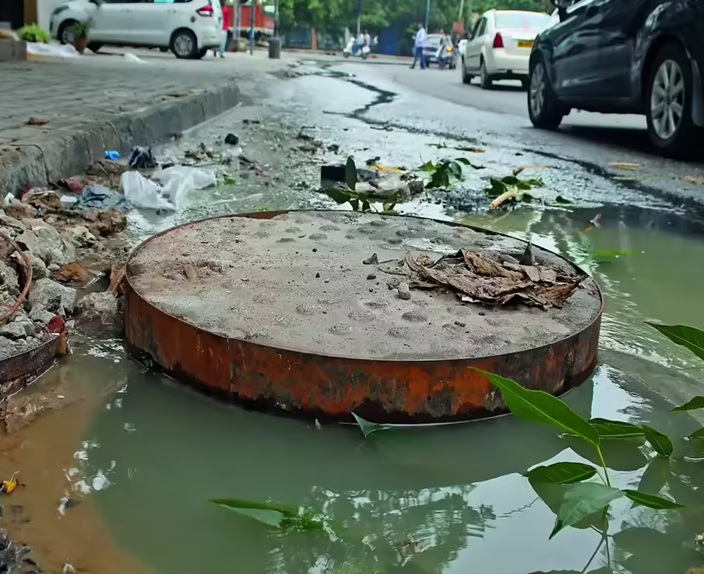
The Bangalore Water Supply and Sewerage Board (BWSSB) has introduced robotic cleaners and artificial intelligence (AI) monitoring to tackle the persistent issue of overflowing manholes in the city.
This initiative is aimed at ensuring safer and more efficient cleaning processes, while also reducing dependence on manual labor and fostering a more sustainable sanitation system. The magnitude of the task is significant. BWSSB oversees more than 1.1 million sewer connections through a network that spans nearly 11,900 kilometers, encompassing over 300,000 manholes throughout the city. With the rapid urban growth of Bengaluru and the prevalence of illegal connections, the sewer network is under continuous strain.
The system is particularly susceptible during the monsoon season, as overflowing manholes lead to inconveniences, public health risks, and environmental hazards. Conventional cleaning methods, which utilize jetting and suction machines, have struggled to keep up, often proving inadequate in narrow streets or congested areas. To address these challenges, BWSSB is implementing robotic technology that is equipped with cameras and AI-guided navigation systems.
These robots will be capable of traversing dark and confined spaces, transmitting live images to operators above ground, which will facilitate precise and effective cleaning in locations that are inaccessible to human workers or traditional machinery. Officials have indicated that this new system is anticipated to significantly reduce the time taken to resolve complaints, with a goal of addressing manhole-related issues within a 12-hour timeframe.
The initial rollout will be conducted through short-term service contracts instead of outright purchases, allowing the board to evaluate efficiency and cost-effectiveness prior to broader implementation. A pilot project valued at 500,000 rupees over a period of 15 days has already been proposed, with tenders being issued to invite service providers to showcase their capabilities.
In conjunction with advancements in robotics, the Bangalore Water Supply and Sewerage Board (BWSSB) intends to enhance physical infrastructure by installing Double Iron (DI) pressure manhole covers in areas that are particularly vulnerable.
Approximately 1,500 of these covers are anticipated to be installed throughout the low-lying regions of the city. These reinforced covers are designed to endure heavy traffic, thereby minimizing risks for pedestrians, while also providing long-term cost savings due to their durability and reusability. Urban planners and sanitation specialists regard this initiative as a pivotal step towards modernizing Bengaluru’s sewer management system.
By integrating robotics, AI oversight, and upgraded hardware, the city is not only improving operational efficiency but also mitigating health risks for sanitation workers, who frequently encounter hazardous conditions during manual cleaning.
For a city that accommodates millions, the incorporation of smart technologies into vital civic services embodies a larger vision of sustainable, equitable, and environmentally friendly urban living. Although the expense associated with new technology remains substantial, experts assert that the advantages—such as quicker complaint resolution, safer operations, and long-term maintenance savings—warrant the investment.
As Bengaluru gears up to implement these innovations, its trial of AI and robotics in sanitation could potentially establish a standard for other Indian cities aiming to merge technological advancement with inclusive urban development.