Bjarke Ingels Group (BIG) has revealed the final winning concept for the Hamburg State Opera new home, a 45,000 m2 music and performing arts hall planned for the Baakenhöft peninsula in HafenCity. The project is a combination of the Hamburg State Opera and the Hamburg Ballet in one building, and a new building that will replace the old one of the company on Dammtorstraße, which has been there for the last 50 years.
A jury composed of members in agreement selected the scheme as it was able to fulfill the functional requirements of a large-scale performing arts institution and at the same time, acknowledge the site’s character as a part of HafenCity’s further urban development.
The proposal is to transform the opera house into a production facility and a civic landscape. Performance, rehearsal, and backstage areas are merged with a city park that links the city directly to the riverbank. In this way, Hamburg continues its tradition of cultural institutions located along the waterfront, and the building is allowed to serve as a highly visible landmark in the city’s growing harbor district.
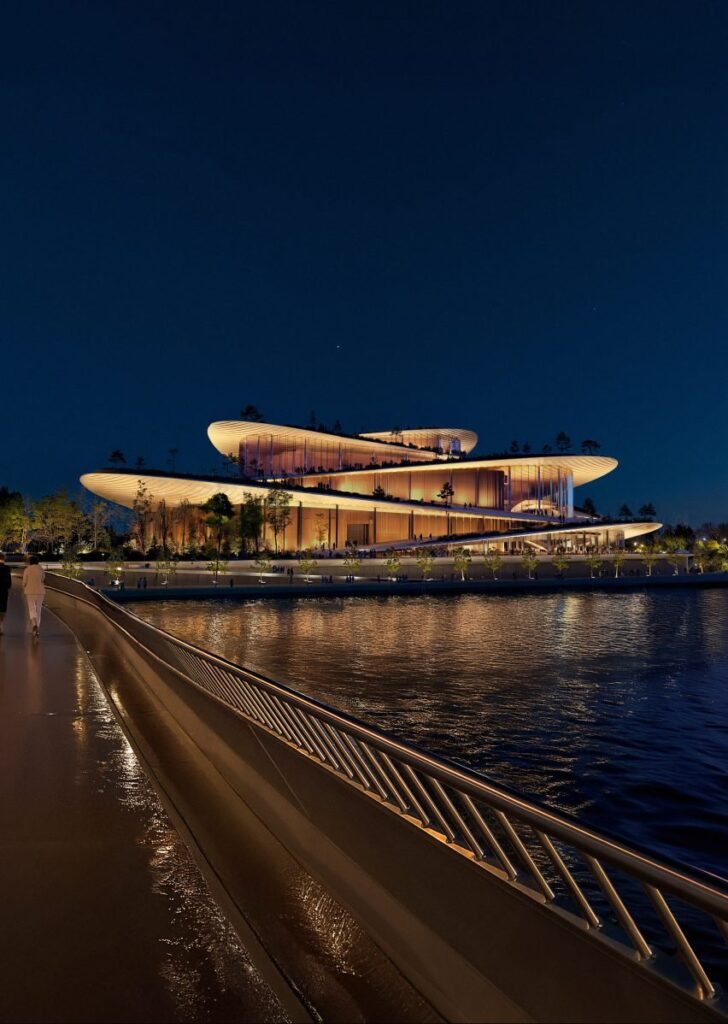
Concentric Terraces Connecting City and Water
Bjarke Ingels describes the proposal as “a landscape of concentric terraces,” expanding outward from the main hall in a circular pattern. The building’s continuous roofline forms a walkable terrain accessible from several directions. These terraces provide routes that link the urban side of HafenCity with the harborfront, creating a public path network across the entire structure.
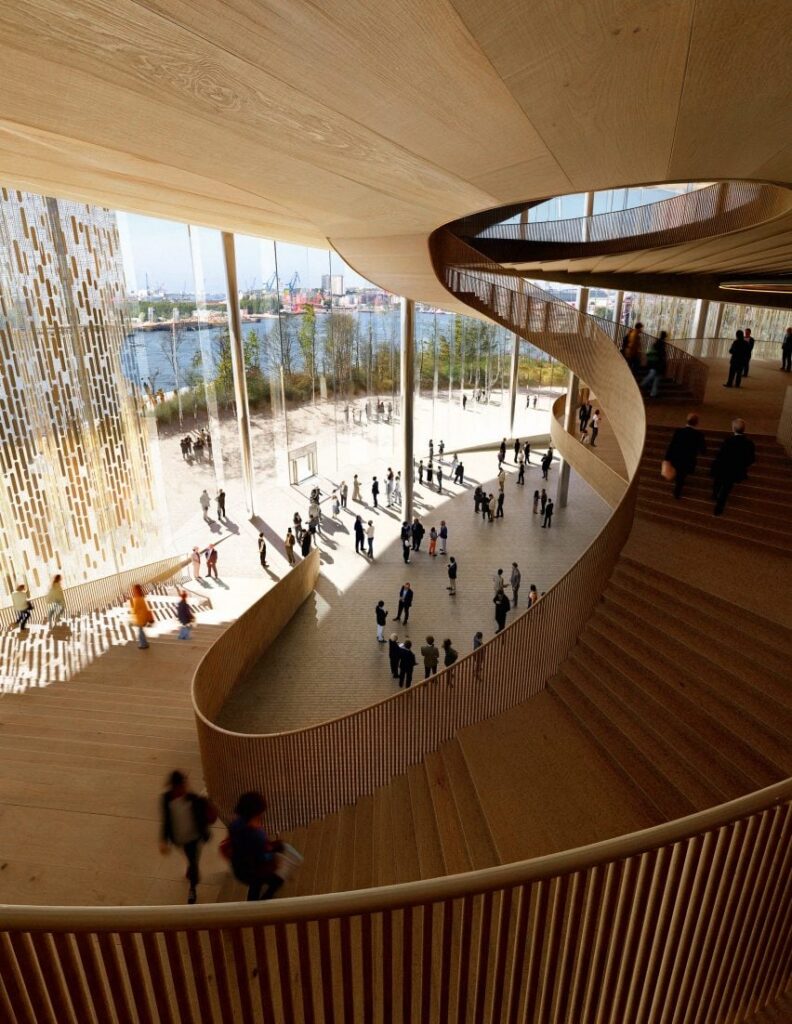
Inside, the transition from exterior to interior is intentionally direct. Stone paving from the park continues into the foyer, creating a single ground surface. A large timber-lined hall forms the primary gathering space, with two central staircases rising toward upper levels and leading visitors to exterior terraces.
Key elements shaping the terrace system include:
- A circular roofline that functions as a fully accessible walkway
- Terraces designed for circulation, seating, and public use
- Lookout points oriented toward the harbor, Elbe, and city skyline
- Entry paths from multiple sides that converge at the main foyer
Auditorium Formed by Layered Timber
At the center of the building, the main auditorium is composed of horizontal timber bands that shape acoustics and guide sightlines. The material wraps around balconies, walls, and the hall’s upper perimeter to form a single continuous environment. BIG partner Jakob Sand notes, “The main hall is the heart of the project — a space with state-of-the-art acoustics and perfect sightlines to the stage.”
The timber rings serve both functional and visual purposes: they support the acoustic performance of the hall, define movement patterns inside the space, and reduce the separation between audience and stage.
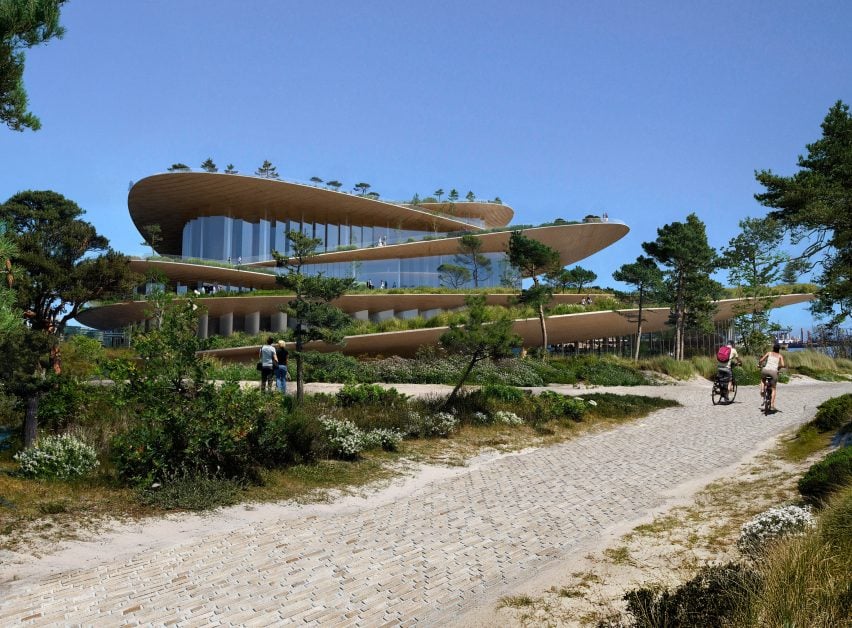
A Building That Reveals Its Working Process
The operational areas of the opera, which comprise a studio stage, rehearsal rooms, dressing areas, and technical workshops, are located compactly behind the main hall. This enables the direct movement of production and performance zones. Besides that, it facilitates the technical staff to carry out their activities that are necessary for the opera house, such as changing the stage setting, handling costumes, and the logistics of musicians.
Partner David Zahle emphasizes the transparency of the layout: “Visitors can walk along the facades and have a look at the foyer, rehearsal rooms, backstage areas, and offices, which are all open to each other.” The exterior routes and glass facades not only create visual links but also render visible the production components of the opera that are usually concealed. This openness is meant to serve as a medium through which the public gets to see the scale and complexity of an opera house.
Landscape as Ecological Infrastructure
The landscape around, which was designed by BIG Landscape, is an exemplary model of how ecology and flood management features can be merged into the public space. Terraces, planted dunes, wetlands, and rain basins operate as one system that accommodates the fluctuating water levels of the Elbe. These methods absorb the water that runs off the land, bind the soil, and make homes for the species that originate from the area.
Environmentally friendly measures that have been taken on the site:
- Terraced surfaces designed to slow and direct stormwater
- Planted dunes that absorb water and manage soil conditions
- Wetlands that filter runoff and support biodiversity
- Rain basins planned to adapt to tidal movements
- Public park areas that function as both recreational spaces and flood-response zones

Conclusion
The new Hamburg State Opera with its terraced form, transparent production spaces, and climate-resilient landscape is a redefinition of how a major cultural institution can be both architecture and public infrastructure. By integrating civic space, world-class acoustics, and ecological design, BIG’s scheme makes the opera house not only a top-tier performing arts venue but also an easily reachable cultural landmark that deepens the relationship between HafenCity, its waterfront, and its expanding community.
Project Information
The Hamburg State Opera project is a collaboration between the Kühne Foundation, the Free and Hanseatic City of Hamburg via its Ministry of Culture and Media, and Hamburgische Staatsoper GmbH. The new opera complex, with a total built area of 45,000 square meters, is situated on the Baakenhöft peninsula of HafenCity. The pictures are done by Yanis Amasri. Besides the visual and design expertise of Theatre Projects, Bollinger + Grohmann, Transsolar, K+H, and Duschl are also involved.
Core Team
The BIG partners-in-charge Bjarke Ingels, Jakob Sand, and David Zahle head the project. Sarkis Sarkisyan and Michael Leef are the main leaders of the design department and receive support from the interdisciplinary group which includes Mariia Nakonechnaia, Carlos Ramos Tenorio, David Benjamin Wilden, Jianuo Xuan, Jacob Engelbrecht Ødum, Celia de la Osa Muñoz, Gilana Antonova, Giovanni Vergantini, Mathis Paul Gebauer, Hou Ming Ng, Martino Hutz, and Veronica Hamilton. The landscape part is the responsibility of BIG Landscape’s Giulia Frittoli, Ulla Hornsyld, Gaspard Del Marmol, and Lucia Ayala.
Image The renders are by Yanis Amasri