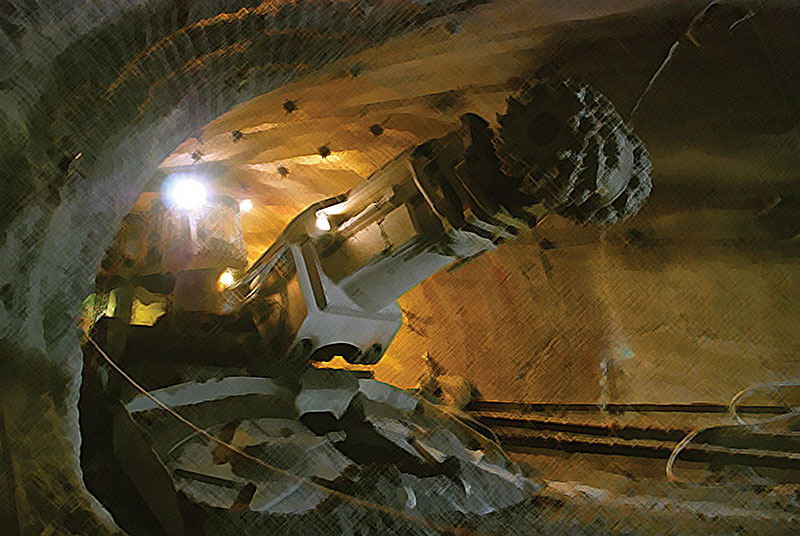
Tunnel roadheaders are mechanized machines specifically designed for excavating tunnels in rock and soil. They operate by using a rotating cutter head to remove material continuously, allowing precise shaping of the tunnel profile. These machines are particularly effective in confined underground spaces where blasting is impractical or restricted due to safety or environmental constraints. Roadheaders enable controlled excavation, reducing overbreak, improving alignment, and maintaining consistent tunnel dimensions.
Key Components of Tunnel Roadheaders
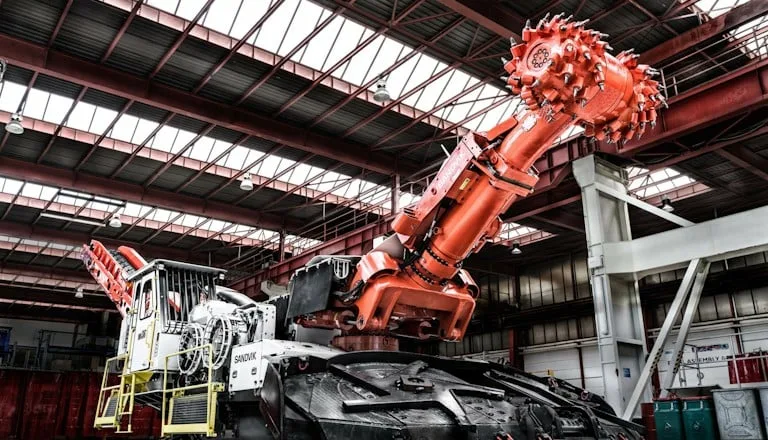
- Cutter Head – Rotating drum with picks or cutting tools for rock excavation.
- Boom System – Articulated boom for vertical and horizontal cutter positioning.
- Crawler Carrier/Chassis – Tracked base housing engine, hydraulics, and operator cabin.
- Conveyor System – Transports excavated material to muck cars or conveyors.
- Operator Cabin – Enclosed cabin with controls, monitoring, and remote operation.
- Hydraulic & Electrical Systems – Controls boom, cutter rotation, conveyors, and power distribution.

Applications of Tunnel Roadheaders
Metro and Railway Tunneling – Roadheaders are widely deployed in urban tunneling projects for metro and suburban railway systems. Their ability to excavate without blasting reduces disruption in urban environments and allows precise tunnel lining placement.
Mining Operations – Roadheaders are applied in underground mining to develop access tunnels, ventilation drifts, and ore extraction galleries. Machines can operate in hard and medium rock conditions, providing consistent excavation for production and infrastructure development.
Civil Engineering Works – Roadheaders are used in underground storage facilities, utility tunnels, and defense installations. Their mechanized excavation ensures precise alignment and minimal disturbance to surrounding structures.
Shaft Sinking and Cross-Cuts – Specialized configurations allow roadheaders to operate in inclined or vertical shafts, facilitating excavation in restricted or hard-to-reach areas.
Advantages of Tunnel Roadheaders
- Continuous excavation reduces downtime compared to drilling and blasting.
- Precise cutting limits overbreak, reducing lining and support costs.
- Operator-controlled or remote operation improves safety at the tunnel face.
- Suitable for varying rock conditions and tunnel geometries.
- Integrated conveyors enable efficient removal of excavated material.
- Mechanized operation reduces manual labor in confined spaces.
- Modern systems record operational data for maintenance and planning.
- Adaptable to shafts, cross-cuts, and complex underground profiles.
Types of Tunnel Roadheaders
1. Single Cutter Head Roadheaders – Compact machines with one rotating drum, suitable for smaller tunnels and confined spaces. Commonly used in mining and small urban tunnels, they offer precise excavation with limited footprint.
2. Dual Cutter Head Roadheaders – Equipped with two cutter heads for simultaneous excavation of multiple tunnel sections or larger profiles. These machines improve cycle efficiency and are often deployed in metro and railway tunneling projects.
3. Multi-Drum or Continuous Miner Roadheaders – Designed for extensive tunnel profiles, these machines have multiple rotating drums, enabling high-volume excavation in long tunnels and large civil engineering projects.
4. Electro-Hydraulic Roadheaders – Combine electrical power for cutting systems with hydraulic boom control. These machines offer higher energy efficiency, precise boom articulation, and reduced environmental impact compared to pneumatic models.
5. Pneumatic Roadheaders – Operate using compressed air to drive cutter heads. Still used in mines or remote areas where electrical supply is limited. Pneumatic machines are simpler but less automated.
Key Factors for Selecting Tunnel Roadheaders
- Tunnel Profile and Project Size – Match machine size, cutter head type, and boom configuration to tunnel diameter and project length.
- Rock Conditions – Select cutter type, drum speed, and power system based on rock hardness, abrasiveness, and fracture patterns.
- Energy Source – Consider electro-hydraulic or pneumatic systems depending on site electricity availability and operational efficiency.
- Mobility Requirements – Compact carriers for narrow tunnels; tracked or heavy-duty chassis for large-scale projects.
- Automation and Guidance – Advanced laser alignment, computerized control systems, and data logging enhance precision and reduce overbreak.
- Safety Features – Dust suppression, cabin protection, and remote control options are pivotal for underground operations.
- Maintenance and Service Support – Ensure availability of spare parts, service personnel, and diagnostic systems for continuous operations.
- Budget and Lifecycle Cost – Consider upfront cost, productivity, maintenance, and operational efficiency over the machine’s lifecycle.
- Operator Skill Level – Match machine complexity with available trained workforce and training provisions.
- Environmental Compliance – Evaluate emissions, dust control, and noise reduction systems, especially in urban projects.
Conclusion
Tunnel roadheaders are central to modern mechanized excavation in tunneling, mining, hydropower, and civil engineering projects. They provide continuous, controlled excavation while reducing overbreak, improving safety, and integrating with material transport systems. As automation and monitoring technologies advance, roadheaders are increasingly integrated with intelligent tunneling systems, enhancing efficiency, safety, and project predictability in underground works.