A new classroom constructed at Panchsheel Balak Inter College in Noida, Uttar Pradesh, marks the first built application of Sugarcrete, a low-carbon interlocking block made from sugarcane waste. The project, developed through a collaboration between the University of East London (UEL), Indian manufacturer Chemical Systems Technologies, and local partners, is being positioned as a prototype for environmentally sustainable and community-driven school infrastructure in India.
Background: Origin of Sugarcrete and Its Composition
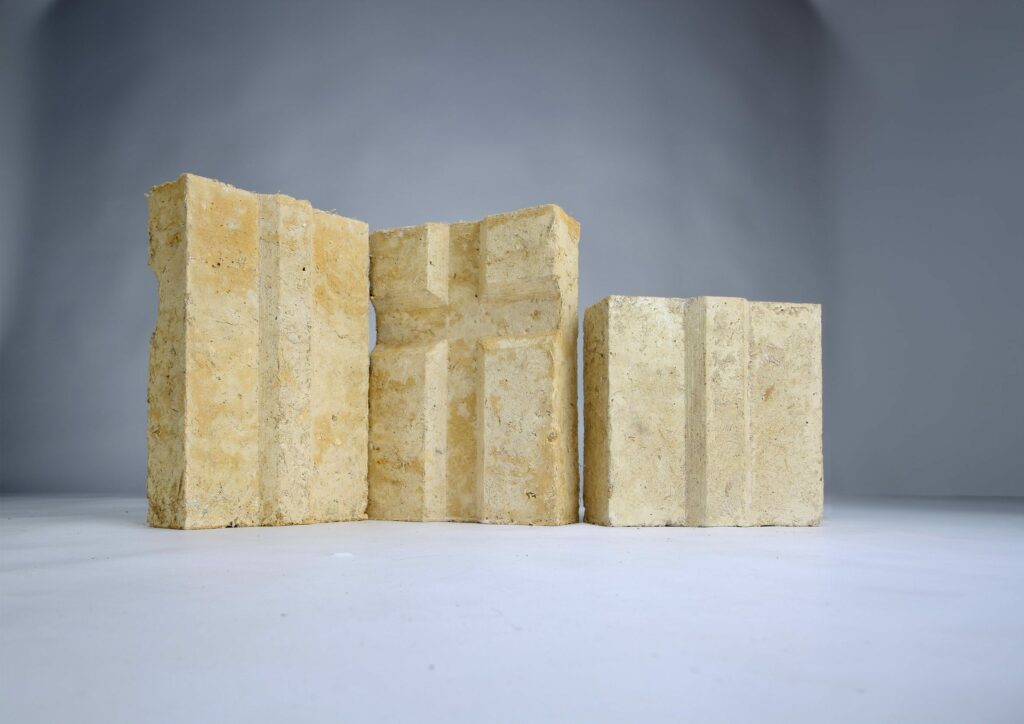
Sugarcrete is a bio-based building block formulated in 2023 by UEL researchers. The material uses bagasse, the fibrous byproduct remaining after sugarcane is processed. Rather than incinerate or dispose of this byproduct, it is combined with mineral binders to form durable, interlocking masonry units.
Each block is:
- Produced using low-energy processes compared to fired clay bricks
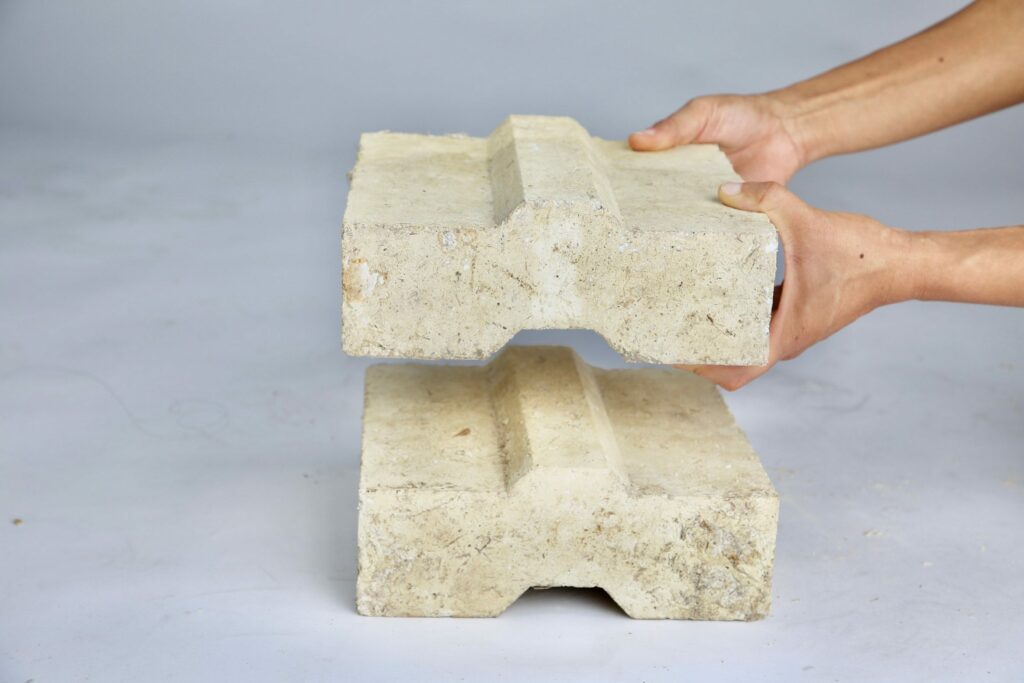
- Shaped into interlocking geometries that allow dry stacking or lime mortar jointing
- Estimated to have a carbon footprint up to six times lower than conventional clay bricks
- Designed to meet basic thermal comfort and acoustic insulation needs in tropical climates
The development was led by Alan Chandler, associate at UEL’s Sustainability Research Institute, and Armor Gutierrez Rivas, senior lecturer in architecture. Both played key roles in material research, prototyping, and project delivery in India, with support from UEL’s postgraduate architecture students.
Construction Approach: Site Execution and Detailing
For the Noida classroom, the Sugarcrete blocks were manufactured locally by Chemical Systems Technologies. The blocks were assembled atop a cast-in-situ concrete slab, using lime-based mortar for bonding—chosen for its lower environmental impact and compatibility with breathable wall systems.
Key construction elements included:
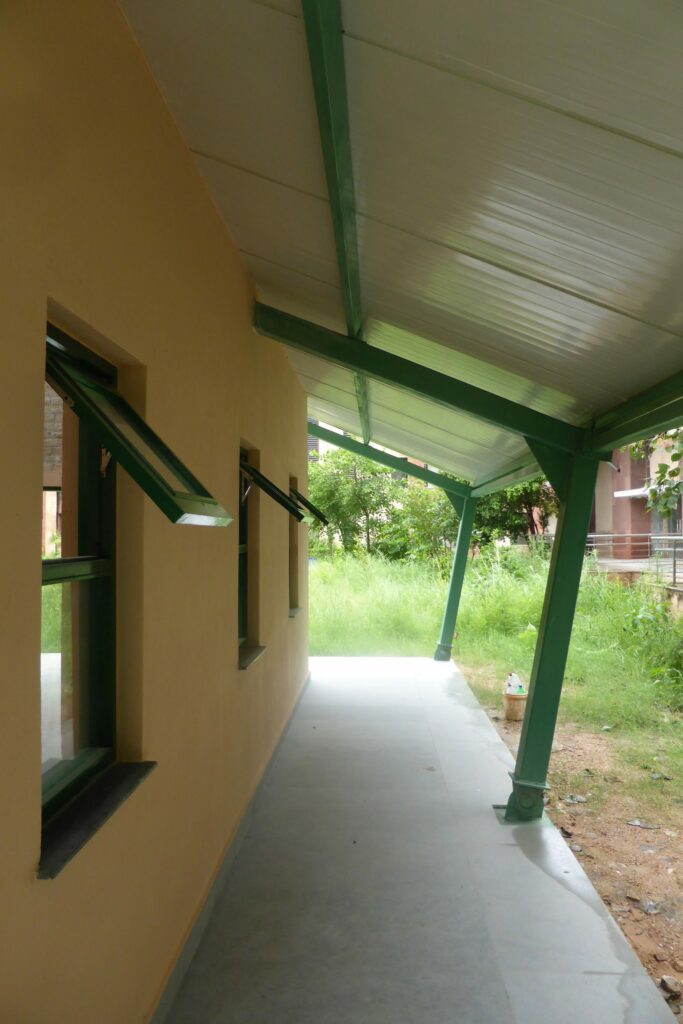
- Exterior finish: Cement render for weather protection
- Interior walls: Lower wall zones finished in clay plaster
- Roof structure: Green-painted steel frame supporting an angular profile
- Clerestory opening: Incorporated for natural light and high-level cross-ventilation
- Veranda design: Provided through roof overhangs to protect walls during monsoon rains
The structural and envelope design emphasizes passive cooling, daylighting, and rain protection while minimizing embedded energy.

Learning Space and Skill Development Centre
More than a functional classroom, the structure serves as a local learning hub designed to promote both formal education and vocational skills training. It was conceived as a demonstration unit to:
- Assess Sugarcrete’s real-world performance in India’s climate and usage conditions
- Provide technical exposure to local craftsmen and students on low-carbon materials
- Act as a reference site for future projects using bio-based alternatives
“Sugarcrete is more than a material—it’s a system for low-carbon, inclusive development,” said Armor Gutierrez Rivas. “This school acts as a platform to test real-world performance and demonstrates how community-oriented design can deliver both environmental and social value.”
Insights and Implementation Challenges
While Sugarcrete demonstrated ease of block assembly, some practical challenges emerged during construction:
- Availability of lime render materials was inconsistent in some areas
- Skill gaps existed around lime plastering techniques and tool handling
- Durability testing under high humidity and intense rainfall conditions is still ongoing
These challenges are now being addressed by incorporating capacity-building components in the project’s outreach, including training modules for local workers and contractors.
Alan Chandler commented that while the block system itself is intuitive to use, it is the availability of compatible local materials and skills that will determine broader adoption. Early-stage results suggest the construction time and labour intensity can be kept low, making it viable for replicable rural infrastructure.
Ongoing Work and Future Roadmap
Following the Noida project, UEL has partnered with the Paryatan Foundation, an education-focused NGO, to build another Sugarcrete-based school building in Hisar, Haryana. This second project aims to test:
- Replicability of Sugarcrete production using locally sourced bagasse
- Feasibility of decentralized block manufacturing near sugar mills
- Viability of scaling in peri-urban and rural markets
- Long-term weathering resistance and material maintenance cycles
The research team is also studying how the system can be adapted for broader construction categories such as primary health centres, training pavilions, and community shelters.
Relevance to Indian Construction
India, as one of the top global producers of sugarcane, generates significant quantities of bagasse annually. Redirecting this waste stream into construction through products like Sugarcrete presents a viable alternative to fired brick manufacturing, which remains resource- and energy-intensive.
Potential benefits include:
- Reduction in embodied carbon across small-scale rural projects
- Job creation in semi-skilled sectors through decentralized production
- Local ownership of material cycles and maintenance practices
- Reduced demand for river sand and topsoil used in conventional bricks
Additionally, the interlocking design simplifies assembly and may reduce the need for skilled masonry labour in future deployments.

Contextual Comparison
Sugarcrete joins a growing catalogue of alternative construction materials. Notable global innovations include:
- Cob bricks developed by the University of the West of England
- Bioplastic-wood composite floor panels for modular interiors
- Bamboo panel structures in Indonesia and Vietnam for educational buildings
- Compressed earth blocks used across South India and Africa in low-rise housing
In India, practices such as mud construction, limecrete, and stabilized soil blocks have seen renewed interest, though adoption varies based on policy and market incentives.
Conclusion
The Sugarcrete classroom in Noida represents an early-stage but tangible attempt to validate bio-based construction at a community scale. As India explores strategies for decarbonising its building sector, such locally rooted innovations may help establish viable pathways for sustainable public infrastructure. If further research validates its performance across climate zones and lifecycle benchmarks, Sugarcrete could emerge as a scalable alternative for India’s rural education infrastructure and beyond.
Images- dezeen.com