
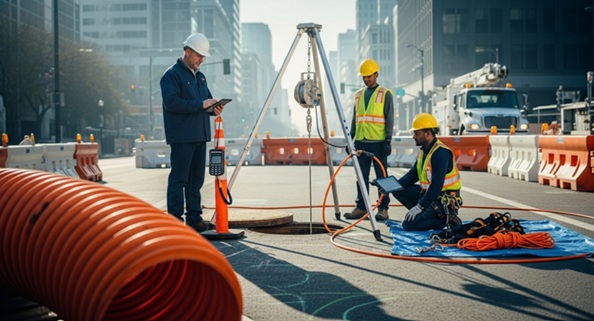
Confined spaces—ranging from municipal manholes to deep utility trenches—present severe, persistent threats to construction and maintenance crews. Data from 2024 indicates the total recordable incident rate for solid waste collection employees increased to 5.0 per 100 full-time equivalent workers, highlighting the escalating dangers in these environments. Despite significant advancements in monitoring equipment, human error and inadequate preparation continually result in preventable fatalities.
Project managers and site supervisors must adopt rigorous confined-space safety protocols to ensure worker survival in high-risk areas. OSHA mandates that employers keep workplaces clean and free from hazards, but subterranean infrastructure requires far more stringent safeguards. Implementing a comprehensive, proactive strategy serves as the ultimate operational standard for 2026 infrastructure safety mandates.
Critical Hazards and the Mandate for Atmospheric Evaluation
Hazardous atmospheres account for the majority of confined space casualties, making continuous gas monitoring an essential requirement. Municipal infrastructure maintenance remains exceptionally dangerous, with waste and recycling collection ranking as the fifth deadliest U.S. occupation in 2024 at 37.4 deaths per 100,000 workers. Invisible threats like hydrogen sulfide, carbon monoxide, and oxygen deficiency can incapacitate an entrant within seconds.
Regulatory bodies heavily penalize contractors who bypass strict environmental testing procedures. Recently, the United States Department of Public Safety proposed penalties of $60,000 for an employer who permitted employees to enter a confined space without an atmospheric evaluation or a written respiratory program. Executing a comprehensive atmospheric evaluation before breaking the plane of entry protects the crew from unseen, lethal gases.
The Critical Roles of the Entry Supervisor and Attendant
A compliant entry operation relies entirely on the distinct, non-overlapping duties of the designated entry supervisor and the outside attendant. The employer cited for the $60,000 fine lacked a required entry permit, a document the entry supervisor must personally verify and authorize. The supervisor is responsible for confirming that all acceptable entry conditions are in place before signing the operational permit.
Conversely, the attendant monitors conditions from the outside and maintains constant communication with the entrants. The Bureau of Labor Statistics reported 32 fatal injuries in solid waste collection in 2024, underscoring the need for vigilant external monitoring. The attendant never enters the space but retains the authority to order an immediate evacuation and to initiate emergency protocols.
Developing a Compliant Non-Entry Rescue Plan
Industry standards designate the non-entry rescue plan as the primary and mandated hierarchy of rescue to prevent secondary fatalities. Historical incident data shows transportation incidents caused 23 of the 32 fatal injuries in the solid waste collection subcategory, proving that extraction environments are inherently chaotic. Deploying mechanical retrieval systems eliminates the need for additional personnel to enter a hazardous atmosphere.
| Rescue Type | Primary Method | Risk to Rescuers | Required Equipment | Ideal Use Case |
| Non-Entry Rescue | Mechanical extraction from outside | Zero exposure to hazardous atmosphere | Winch, tripod, full-body harness, retrieval line | Unresponsive entrant in a vertical drop or unobstructed shaft |
| Entry Rescue | Physical entry by trained responders | Extreme exposure to hazardous atmosphere | SCBA, life-support systems, atmospheric monitors | Entrant trapped behind physical obstructions or structural collapses |
Step-by-Step Retrieval Deployment
Properly executing a non-entry rescue requires the attendant to follow a strict sequential procedure under extreme pressure. With injury rates reaching 5.0 per 100 workers in related fields, attendants must master these life-saving protocols. The attendant executes the following steps immediately when an entrant becomes unresponsive:
- Assess the external environment and verify the alarm.
- Initiate the mechanical retrieval winch without breaking the plane of the confined space.
- Dispatch emergency services immediately.
- Maintain constant tension on the retrieval line to prevent secondary falls.
- Secure the extraction zone for incoming first responders.
The Long-Term Repercussions of Safety Non-Compliance
Bypassing established safety protocols can result in catastrophic financial and legal fallout for municipal managers and infrastructure contractors. In fiscal year 2023 alone, over 1,140 tort claims filed against the NYC Department of Sanitation resulted in $75.4 million in settlement payouts. These substantial figures illustrate the severe monetary consequences of maintaining unsafe working conditions and failing to implement proper hazard controls.
Injured workers seeking rightful compensation must meet specific evidentiary requirements to hold negligent contractors accountable. A successful claim requires the plaintiff to establish four key legal elements: duty of care, breach of duty, causation, and actual damages. Consequently, understanding the complex evidentiary requirements for proving negligence in a sanitation worker injury case remains critical for workers seeking rightful compensation and holding negligent contractors accountable.
Aligning with 2026 Infrastructure Safety Innovations
The broader transportation and civil engineering sectors are rapidly adopting digital solutions to meet stringent new oversight rules. Currently, global airports are rushing to overhaul safety technology and adopt advanced safety management systems ahead of strict 2026 rules. Civil infrastructure projects must urgently emulate this modernization by digitizing their confined space permitting and deploying risk-based oversight tools.
Relying on outdated, paper-based permitting programs places both workers and project budgets at severe risk. Aviation agencies warn that fragmented, stand-alone safety programs will fail once new frameworks fully take hold. Upgrading to real-time digital atmospheric monitoring and automated permit routing ensures compliance with upcoming 2026 infrastructure safety mandates.
Fostering a Proactive Safety Culture on the Job Site
Project managers protect their crews by investing heavily in continuous training and top-tier retrieval equipment. The $75.4 million in recent DSNY settlement payouts serves as a stark reminder that safety investments always cost less than accidents. Supplying crews with appropriate access tools, such as the hardware detailed in The Ultimate Guide to Types of Ladders, minimizes entry and exit hazards.
Crews must also remain vigilant about compounding risks, such as active utilities intersecting with subterranean vaults. Referencing resources such as A Complete Guide to Electrical Safety in Construction helps site supervisors mitigate secondary threats during confined space entries. Establishing a proactive, zero-tolerance safety culture ultimately guarantees that every worker returns home safely at the end of their shift.
Safety Disclaimer: This guide is for informational purposes only and does not supersede official OSHA regulations or site-specific safety plans. Always consult with a certified safety professional.
Legal Disclaimer: This article does not constitute legal advice. Always consult with a qualified legal professional for matters related to liability, contracts, and compliance.
Image generated by Gemini




