CIRCULUS Atelier is the working studio of Oka Architecture Design & Co., Ltd. (OAD) in Yokohama, Japan. The project functions both as a daily workplace and as a built prototype for the practice’s ongoing research into circular architecture. Rather than treating the building as a finished object, the atelier is conceived as a system that can evolve through use, adjustment, and material reuse over time.
The project is grounded in OAD’s CIRCULUS architectural framework, which focuses on continuity, adaptability, and long-term value. Design, fabrication, and occupation are brought together in a single environment, allowing architectural ideas to be tested through real conditions. Digital fabrication plays a central role, informing not only how the building is made, but how it performs and changes.

A Facade Designed as a Woven System
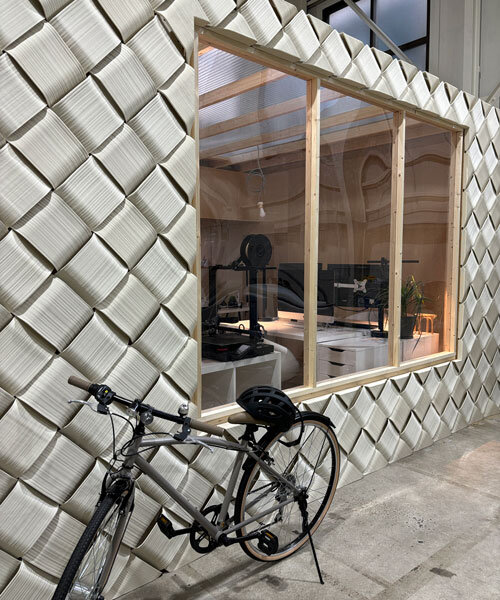
The exterior of CIRCULUS Atelier is wrapped in KNIT, a modular facade system developed and fabricated by the practice using large-scale 3D printing. Instead of functioning as conventional cladding, the facade operates as a woven surface made from repeated printed units. The modules share a common logic but vary slightly in geometry, producing depth, shadow, and visual rhythm across the building envelope.
The KNIT system does not attempt to hide its method of production. Layering, joints, and connections remain visible, allowing the fabrication process to be directly expressed on the facade. As light conditions change throughout the day, the surface responds by casting shifting shadows and revealing different levels of transparency.
Key aspects of the KNIT facade include:
- Modular 3D printed components assembled as a continuous surface
- Subtle geometric variation across repeated units
- A textile-like appearance created through repetition and layering
- Visible fabrication traces that communicate the printing process
- Components designed to be removed, repaired, or replaced
By prioritizing modularity and disassembly, the facade supports long-term adaptability. Individual elements can be adjusted or reused without altering the entire system, aligning with the project’s emphasis on circular design.
Interior Spaces Shaped by Suspended Elements
Inside the atelier, the same material logic is applied in a different way. Instead of rigid ceilings or fixed partitions, flexible 3D printed elements are suspended from above, forming a draped installation across the workspace. The ceiling becomes a hanging field rather than a fixed plane, shaped by gravity and material behavior.
These suspended elements perform multiple roles. They filter daylight, moderate acoustics, and help define different working zones without enclosing them. The installation introduces softness into the interior while remaining fully fabricated through controlled digital processes.
Interior strategies include:
- Hanging 3D printed components forming a layered ceiling condition
- Flexible material behavior that allows folding and overlap
- Spatial zoning without walls or permanent divisions
- Daylight diffusion across the workspace
- Elements that can be removed or rearranged as needed
Through this approach, softness becomes a functional architectural quality rather than a decorative effect. The interior remains open and adaptable, supporting changes in work patterns over time.
Digital Fabrication and Circular Production
All architectural elements within CIRCULUS Atelier are produced in-house using 3D printing. This allows precise geometric control while reducing material waste. Discharged or excess printing material is reused within the studio, including as wall-mounted objects and furniture components.
Shelving systems inside the atelier further reflect this thinking. Instead of relying on standardized furniture, 3D printed cells are assembled into custom storage units that can be reconfigured as needs change. Fixed geometry is replaced with an approach based on adjustment and reuse.
This fabrication strategy reinforces the project’s broader goals:
- Reduced material waste through controlled production
- Reuse of discharged printing material
- Custom components tailored to daily use
- Systems designed for modification rather than replacement
Architecture is treated as an ongoing assembly, capable of responding to time, wear, and changing requirements.
A Workspace That Functions as Research
CIRCULUS Atelier is not only a design studio but also a testing environment. Because Oka Architecture occupies the space themselves, material performance, comfort, and durability are evaluated through everyday use. This direct relationship between design and occupation allows feedback to inform future projects.
Rather than relying solely on simulations or prototypes, the atelier enables architectural research to take place through lived experience. Adjustments can be made incrementally, and systems can be refined as conditions change.
CIRCULUS Atelier presents an approach to architecture rooted in continuity rather than completion. By integrating digital fabrication, modular systems, and daily occupation within a single framework, the project demonstrates how architecture can support long-term flexibility, material awareness, and circular design principles.
Images- designboom.com