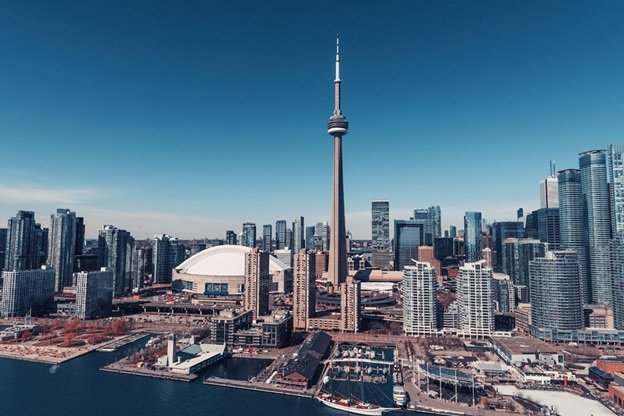
Toronto is a city that builds constantly. It grows in height, in reach, and in complexity. Across the Greater Toronto Area, construction cranes have become part of the skyline, signaling both progress and pressure. Population growth, housing demand, and economic investment have converged to reshape one of North America’s fastest-evolving metropolitan regions.
Yet Toronto’s expansion is not just about size. It is about how the city is being reorganized to meet the future. The question is not whether Toronto will grow, but where, and how sustainably that growth can be managed.
A City at Its Limits
Toronto’s geography has always influenced its development. The lake defines its southern edge, while ravines and transit corridors carve out natural boundaries. For decades, growth radiated outward in predictable patterns. Suburbs like Etobicoke, North York, and Scarborough filled with low-rise housing and shopping plazas. The core remained the economic heart, driven by finance, education, and culture.
That pattern began to shift around the early 2000s. Rising property values, limited land, and renewed investment in downtown infrastructure encouraged infill development rather than sprawl. Vertical expansion became the only logical direction. Today, Toronto has more cranes operating than any other city in North America, and most are clustered along transit lines and mixed-use corridors.
The result is a city under transformation. Where single-family homes once dominated, mid-rise and high-rise residential towers now redefine the skyline. Parking lots are turning into condominiums. Industrial zones are being reimagined as innovation districts. Each project is a small piece of a larger story about how Toronto is adapting to both opportunity and constraint.
The Push for Density
The province’s Growth Plan for the Greater Golden Horseshoe identified density as essential for sustainability. Compact, mixed-use communities reduce dependence on cars, improve transit efficiency, and limit environmental impact. Toronto’s official plan aligns with this, prioritizing intensification in designated areas known as “avenues,” “centres,” and “nodes.”
In practical terms, this means the city is growing upward and inward rather than outward. New developments are concentrated along major routes like Yonge Street, Bloor Street, and Eglinton Avenue, where public transit infrastructure already exists or is expanding. The Eglinton Crosstown LRT, the Ontario Line, and SmartTrack are catalysts for new residential and commercial clusters.
But intensification is not just a planning term. It changes the way people experience the city. Denser neighbourhoods create more walkable communities, stronger local economies, and better access to public services. The challenge lies in balancing growth with livability.
Transit as the Backbone of Expansion
Transit-oriented development has become the cornerstone of Toronto’s planning philosophy. Every major infrastructure project carries with it a ripple effect of investment. New stations attract residential towers, retail hubs, and public amenities.
The most significant of these is the Ontario Line, a 15.6-kilometre rapid transit line connecting Exhibition Place to the Ontario Science Centre. It is expected to relieve pressure on the congested Yonge-University subway and unlock new areas for high-density growth.
The Eglinton Crosstown and Finch West LRT lines are equally transformative. They bring accessibility to neighbourhoods historically underserved by transit, turning overlooked corridors into high-demand destinations.
For developers, proximity to transit has become more than an advantage. It is now a necessity. Buyers and renters alike prioritize connectivity, and zoning policies reflect that shift. The future of Toronto’s housing supply depends on how well it integrates with public infrastructure.
The Vertical Neighbourhood
Toronto’s condo boom is well documented, but the nature of vertical living is evolving. Early high-rises focused on maximizing units and profitability. The newer generation of towers aims for community. Developers are incorporating co-working spaces, rooftop terraces, daycare centers, and retail floors to make high-density living more sustainable.
This trend is changing how residents interact with their environment. Amenities that once required leaving the building are now built into it. Vertical communities function almost like small villages, complete with shared spaces and micro-economies.
This approach is particularly visible in neighbourhoods such as Liberty Village, CityPlace, and the Canary District. Each represents a version of Toronto’s urban experiment: the merging of design, convenience, and density. The result is a hybrid of residential and public space that challenges traditional definitions of a neighbourhood.
Reimagining Industrial Lands
Some of the most significant growth is occurring in areas once defined by manufacturing and warehousing. The Port Lands, Downsview, and parts of Scarborough are being repositioned as mixed-use districts. These spaces offer rare opportunities for large-scale, master-planned development within city limits.
The Port Lands redevelopment, for instance, is one of the largest urban renewal projects in North America. It aims to transform a flood-prone industrial area into a vibrant waterfront community with housing, offices, and parks. The design emphasizes sustainability, with flood protection infrastructure, green spaces, and low-carbon construction.
Similarly, the Downsview redevelopment envisions 100 acres of new parks, transit-oriented housing, and employment space, designed to integrate with future transit connections. These projects illustrate how the city’s growth is moving beyond reactive construction and toward strategic, long-term urban design.
The Role of Neighbourhood Identity
Despite large-scale transformation, Toronto’s neighbourhoods remain central to its character. Each area tells a different story about the city’s evolution.
The downtown core is defined by glass towers and constant movement. The Junction has become a model of adaptive reuse, where factories have turned into cafes and studios. Leslieville reflects how proximity to transit and waterfront revitalization can transform industrial pockets into desirable residential zones.
Further north, midtown neighbourhoods like Yonge and Eglinton show the tension between local identity and high-density development. Longtime residents push for balanced growth that preserves heritage while welcoming modernization.
This dynamic is visible across the city. Change is rarely uniform. Each community negotiates it differently, influenced by geography, zoning, and public sentiment. For a closer look at these evolving dynamics, resources like this Toronto neighbourhood guide offer insight into how growth and design interact at the local level.
Infrastructure as Catalyst
The pace of construction is not limited to housing. Roads, bridges, water systems, and public spaces are being upgraded to support the growing population. Toronto’s infrastructure is being asked to carry more weight than ever before.
The city’s $28 billion capital plan focuses on maintaining aging assets while accommodating expansion. Green infrastructure, stormwater management, and energy-efficient retrofits are priorities. At the same time, public realm investments, from cycling networks to street redesigns, aim to make dense living more functional and appealing.
What makes this phase of Toronto’s development distinct is coordination. City planners, developers, and communities are beginning to align around shared goals of sustainability, accessibility, and resilience.
Affordability and Access
No discussion of Toronto’s expansion can ignore affordability. Rapid development has not yet solved the housing shortage. Supply continues to lag behind demand, and costs remain high.
In response, new policies promote inclusionary zoning, mandating affordable units in certain developments. Co-operative housing, modular construction, and rental incentives are part of the broader toolkit. These approaches attempt to make growth equitable rather than exclusive.
The success of Toronto’s next decade of expansion depends on how well it manages this balance. Growth without affordability leads to displacement. Affordability without investment leads to stagnation. The solution lies in maintaining both momentum and inclusivity.
Sustainability as Framework
Toronto’s future depends on how it addresses the environmental footprint of its expansion. Green building certifications, low-emission designs, and adaptive reuse projects are becoming standard practice. Developers are using materials with smaller carbon footprints and integrating renewable energy systems.
The city’s TransformTO strategy targets net-zero emissions by 2040. Achieving that goal will require rethinking how neighbourhoods function. More green roofs, efficient transit, and energy-smart retrofits are not optional; they are the foundation of growth that lasts.
Sustainability is also about livability. Green corridors, parks, and tree canopies are critical to urban health. As the city densifies, these elements ensure that expansion does not come at the cost of well-being.
The Shape of What Comes Next
Toronto is entering a defining period. The choices made now about density, design, and infrastructure will determine the quality of life for decades to come. The goal is not simply to build more, but to build better.
Cities grow in cycles, and Toronto’s current cycle reflects maturity. It has moved past expansion for its own sake and into a phase of strategic redefinition. How it manages land use, affordability, and sustainability will influence how other Canadian cities approach their own transformations.
The story of Toronto’s growth is ultimately one of adaptation. The city has reached a point where expansion is both a necessity and an opportunity. It is learning how to build within its boundaries without losing its balance.