Most guys start a construction business because they know how to build. They buy a truck. They get a license. They think framing houses or hanging drywall will make them rich. That is a massive trap. I see it every single day. You bill $150,000 in a quarter. You think you are absolutely killing it. You brag to your buddies at the hardware store. Then your accountant runs the end of year numbers. Your actual take home profit is barely enough to buy a used Honda Civic.
Where did the money go? It vanished right into the hidden cracks of running a real business.
Hidden Work Truck Costs and The Financing Trap
Let’s talk about vehicles. A work truck isn’t just a monthly payment. It’s a depreciating liability that bleeds cash. You go online and plug your down payment into a truck finance calculator. The screen spits out $850 a month. Great. You can afford that easily.
Wrong.
You forgot commercial auto insurance. You forgot diesel. You forgot the expensive suspension work it needs after hauling heavy concrete for six months. The real cost of a rig is roughly double the monthly payment.
I learned this the hard way back in 2015. I bought three brand new trucks for my growing crew. The monthly payments looked totally fine on paper. But routine maintenance, blown tires, and massive insurance premiums ate my profit margins alive. I bled $28,000 that year just keeping those shiny trucks on the road. Don’t make my mistake. Buy used. Pay cash if you can.
Calculating True Labor Burden in Construction
Next up is your labor cost. You hire a guy for $25 an hour. You bid your jobs assuming he costs you $25 an hour. Stop doing that immediately. He actually costs you closer to $38 an hour. You have to pay payroll taxes. You have to pay workers compensation insurance. General liability insurance scales directly with your payroll.
If you bid a job using base hourly rates, you are essentially paying for the privilege of putting your guys to work. Calculate your true labor burden. Multiply your base wage by 1.5. Use that specific number for every single estimate.
Tool Replacement and Consumables Overhead
Let’s look at tools and materials. Saws break down. Batteries refuse to hold a charge. Some new kid leaves your $400 laser level out in the rain. Thieves target job sites constantly. You will replace 15 percent of your small tools every single year. Build that replacement cost into your overhead right now.
Also, factor in the small stuff. Screws. Nails. Caulk. Saw blades. Trash bags. These consumables vanish instantly. If you don’t charge the client for them, they come straight out of your own pocket.
Why You Need a Real Accountant and Not a Spreadsheet
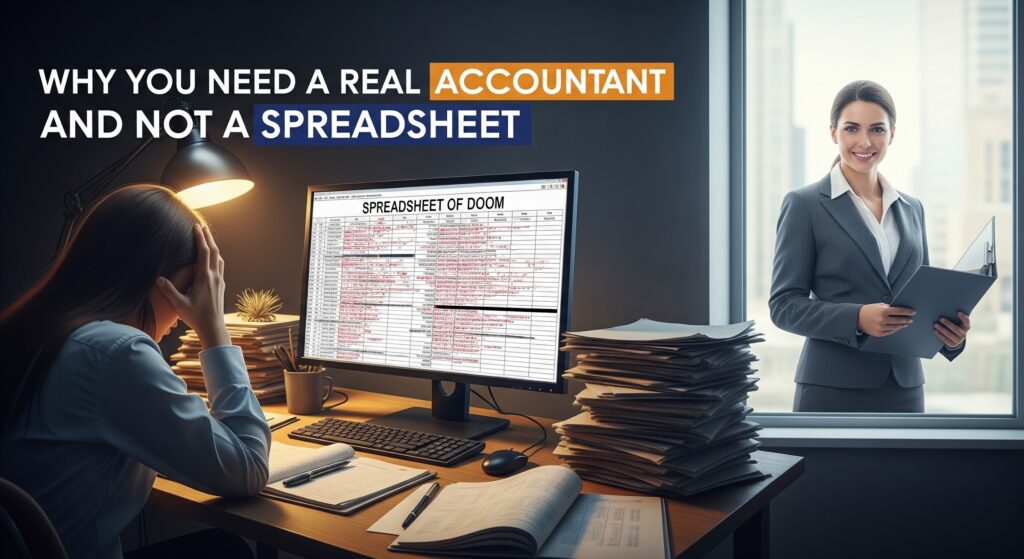
Listen up. You cannot run a six-figure business out of a dirty shoebox filled with faded receipts. You think you’re saving money by doing your own books on Sunday night. You’re not. You’re leaving ten grand on the table and you don’t even know it. Your actual profit is invisible until a professional finds it. Stop trying to be an accountant. Hire one. It’s not an expense; it’s the only guardrail between you and bankruptcy.
This is what professional business accounting services fix. They confront the Labor Burden Lie that $25 an hour guy actually costs you $38. They give you the dead-accurate 1.5x labor burden multiplier you must use on every bid, or you’re paying your crew to work for free. They also find your “ghost costs”, the unbilled administrative time, the tool replacement overhead, and the vehicle depreciation that comes straight out of your personal pocket. Their job is to pull every single one of those non-billable expenses out of the shadows and show you exactly how to build them into your final pricing.
Finally, they are your oxygen mask against the Commercial Cash Flow Killer. You land a massive Net 90 contract for commercial building repairs and have to front all the labor and materials until you finally get paid months later. An accountant forecasts your money coming in and going out, forcing you to maintain the cash reserve you need to survive. They systematize your invoicing and expense tracking to plug the leaks, ensuring small stuff like disputed change orders or unbilled consumables stops draining your margins. Don’t die holding a massive IOU.
Preventing Scope Creep and Unpaid Change Orders
Customers also love to change their minds. They want a different tile. They want a window moved two feet to the left. Most contractors just say yes and do the work. They figure they will bill for it later. Do you know what happens later? The client disputes the bill. They claim you never told them it would cost extra.
Always get change orders in writing. Always. Get a signature before you pick up a hammer. I lost $8,000 on a kitchen remodel because I trusted a firm handshake on a custom cabinet upgrade. Never again.
Unbilled Contractor Admin Time and Business Overhead
Administrative time is the ghost cost. You spend your evenings typing up estimates on your couch. You chase unpaid invoices on Sunday mornings. You sit on hold with the city permit office for two hours on a Tuesday. Who pays you for that time? Nobody.
Recent industry data shows the average small contractor loses roughly 18 percent of their gross profit to unbilled administrative time. That is your weekend gone. You need to raise your hourly rate to cover the time you spend actually running the business. You are not running a charity.
Contractor Mindset: Pricing for Profitability
You have to change your entire mindset. You are a business owner first. You are a builder second.
Track every single penny that leaves your bank account. Price the risk into your bids. Build your cash reserve. Charge more. If you lose bids because your price is too high, let the other guy go broke doing cheap work.
Keep your margins fat. Protect your cash flow. That is how you stay alive in this game.