Water costs are rising across the US, a change driven by climate change, mounting operational costs, regulatory changes, inflation, and necessary capital investments into aging and unsuitable infrastructure. As our communities grow, this places increased strain on systems; with utility costs rising year-on-year, consumer expectations rise with them. Today’s communities expect fair, transparent, and accurate billing.
Water submetering is becoming a standard solution to these problems, supported by regulatory environments and rapidly changing consumer needs. Instead of allocating costs across an entire property, water submetering enables unit-level consumption tracking and billing, giving property owners better data and residents greater visibility into how their water is used.
When planned during the construction phase, submetering systems can be efficiently integrated into new developments, avoiding complex, often expensive retrofits and preparing properties for modern, innovative, and data-driven water management.
What are Water Submeters?
Many people are familiar with traditional metering systems in which water is supplied by a single municipal water meter, and where costs are allocated via RUBS (ratio utility billing system) to each unit. This setup is common in many multifamily properties, but it’s increasingly being phased out in favor of water submetering systems.
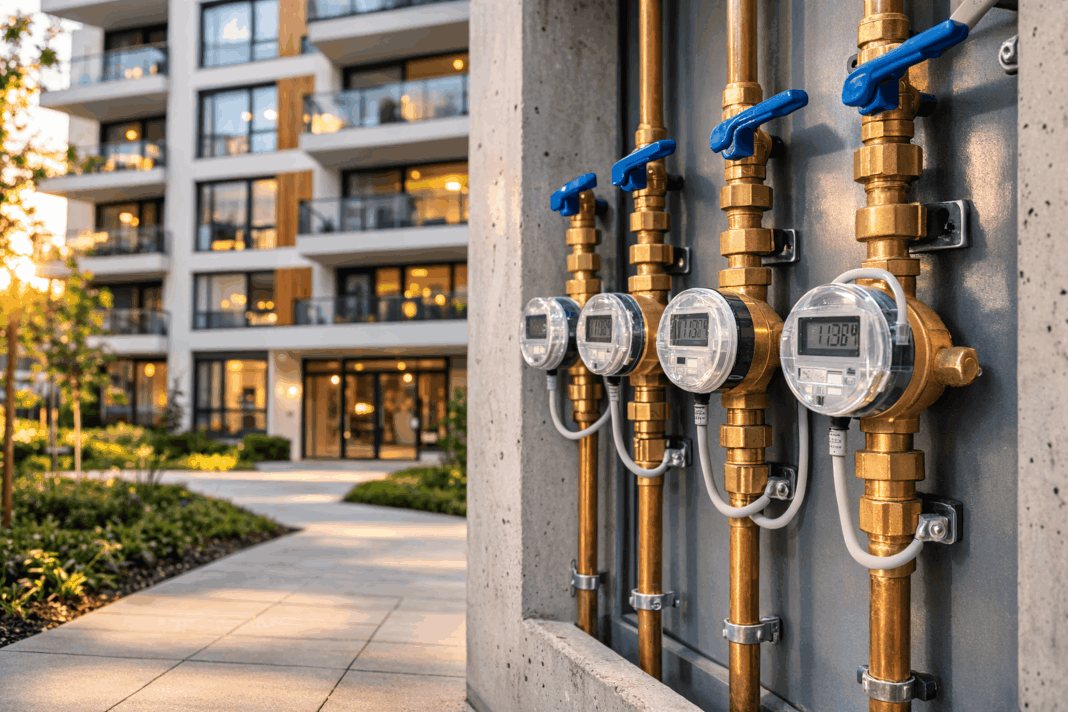
In a water submetering system, the utility supplies the master meter, while the property owner installs individual water submeters and a data collection system to monitor per-unit consumption. This supports fair, transparent, and individual billing rather than allocated costs. Typical installation scenarios include apartments, condominiums, student housing, mobile home parks, and mixed-use buildings.
Benefits of Water Submetering
Water submetering brings benefits across the entire spectrum, from developers to property owners and to residents.
Benefits for Homeowners and Residents
Homeowners and residents can enjoy:
- Billing fairness and transparency
- Control over costs and consumption
- Lower average water consumption
- Unit-level leak detection
Benefits for Property Managers and Owners
Property managers and owners enjoy a wide range of benefits from water submetering, including operational and financial advantages as well as improved risk management. As a property owner, you can benefit from:
- Reduced utility spending
- Improved recovery of water and sewer costs
- Improved NOI (Net Operating Income)
- Early leak detection
- Data-driven maintenance
- Documentation of consumption
- Reduced billing disputes
- Transparent billing processes
- Easier integration with smart building systems
- Support for ESG reporting and sustainability initiatives
- Compliance where submetering is a regulatory requirement
Benefits for Developers
There are tangible benefits to implementing submetering systems for property developers, including:
- Meeting green building standards
- Alignment with certifications, e.g., US Green Building Council or ENERGY STAR
- Future-proofing new construction
- Appeal to institutional investors prioritizing ESG metrics
Regulatory and Legal Considerations
Regulatory and legal considerations are a major driver of transitions away from RUBS and allocated billing towards comprehensive water submetering systems. Responsibility for implementation is increasingly passed to developers and property owners, necessitating a deeper understanding of regulations.
State-level Regulations
Each state has its own regulatory approach, and submetering laws vary. Some states mandate submetering for new multifamily constructions, such as California, while others have regulatory systems that strongly encourage it, such as Texas.
It’s important to verify relevant state laws before proceeding with any developments, as submetering may be a hard legal requirement rather than merely something nice to have.
Local Codes and Building Requirements
Local codes provide an additional layer of regulatory and legal considerations, including:
- Plumbing code compliance
- Meter certification standards
- Installation specifications
- Accessibility requirements
Billing & Consumer Protection
Many jurisdictions have specific rules on billing and consumer protection, including caps on admin fees, rules around late fees and shut-offs, and requirements for dispute resolution. Check that any system meets these requirements before deployment.
Submetering Integration During Construction Simplifies Installation and Implementation
Integrating water submetering at the construction stage has many benefits. This approach simplifies processes across the lifetime of the system, including:
- Simplified design and installation:
Retrofits can bring considerable complexity, including the inability to properly install some components, e.g. when opting for wired data transmission options, as well as making meter placement more complex. - Integration with building management systems
Day-one integration with other smart management systems simplifies the entire process, making it easier and often cheaper than a retrofit. - Long-term maintenance requirements
Careful planning during construction can make maintenance simpler and more effective by enabling dedicated, simplified access. - Regulatory compliance and futureproofing:
Day-one regulatory compliance is great news for developers and investors alike, as all the major steps are covered. Even where regulations don’t yet require submetering, properties will be futureproofed and more attractive to prospective buyers and investors.
The Future of Submetering in New Constructions
Water submetering is an increasingly common feature in new builds for good reasons – whether financial, regulatory, or conservation-driven. This rapidly changing environment means early planning during construction is vital, and many developers choose to partner with experienced providers such as Mainlink.net to design and implement comprehensive systems from the ground up. Other providers, including Truety (QMC), also offer submetering services and may support projects where developers are exploring different implementation approaches. As communities continue to grow and thrive, water conservation will remain a key concern, making water submetering an essential tool for developers and property owners to meet both regulatory requirements and resident expectations.