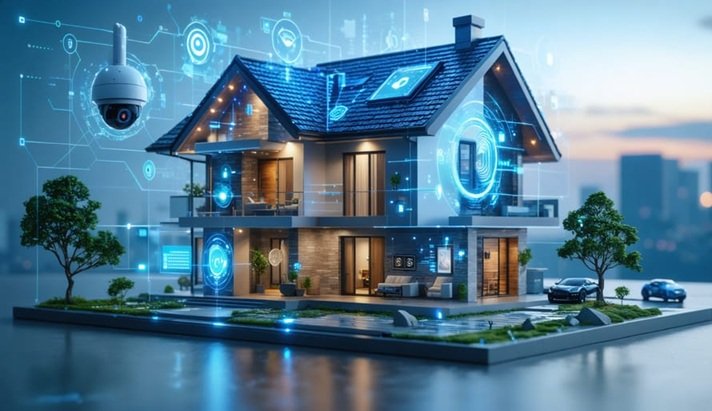
Residential architecture is no longer shaped only by walls, layouts, and materials. It now reflects how people protect their living spaces while maintaining ease of daily movement. Modern households expect security solutions that operate quietly in the background while responding accurately to human presence. This expectation has pushed advanced biometric and artificial intelligence-based security into residential planning rather than treating it as an added layer.
Biometric AI security focuses on recognizing individuals through unique physical traits. Homeowners are increasingly interested in solutions that blend reliability with architectural harmony, ensuring protection does not interfere with design intent or usability.
Biometric AI security focuses on recognizing individuals through unique physical traits. Homeowners are increasingly interested in solutions that blend reliability with architectural harmony, ensuring protection does not interfere with design intent or usability.
As residential projects grow more complex, professional-grade security concepts are becoming essential. They must consider adaptive systems that learn patterns, support controlled access, and align with long-term residential use while respecting privacy and ethical boundaries.
Technical Foundations of AI Biometrics
1. Core Biometric Foundations and Recognition
Biometric security relies on identifying people through measurable human traits. These traits provide a dependable method for distinguishing authorized residents from unknown individuals. Within residential architecture, biometric foundations are designed to operate seamlessly without demanding constant attention from occupants. Systems are embedded into entry points and shared spaces to maintain continuity.
Modern residential designs integrate biometric readers in ways that do not disrupt visual balance. Sensors are compact and positioned thoughtfully to match architectural lines. The use of artificial intelligence improves recognition accuracy over time, adapting to changes in appearance or routine without frequent reconfiguration.
Within professional residential planning, biometric foundations also support layered security strategies. They work alongside monitoring components, ensuring each element contributes to a unified protective structure. This approach minimizes reliance on single-point defenses and strengthens overall household protection.
2. AI Decision Logic and Pattern Recognition
Artificial intelligence forms the reasoning layer behind biometric systems. It evaluates collected information and determines whether access should be granted. In residential architecture, this logic must remain dependable yet flexible enough to support everyday life. The system learns from routine patterns while remaining alert to unusual activities.
AI-driven decision logic reduces false alerts that often frustrate occupants. It recognizes contextual cues such as time patterns. This adaptability improves trust in the system and encourages consistent use rather than workarounds.
Professional-grade residential security also requires explainable logic. Designers and homeowners benefit from systems that provide clear reasoning for access decisions. Transparency ensures confidence and simplifies maintenance without technical complexity.
Design and Access Integration
1. Smart Entry Design and Sensor Placement
Well-planned entry design ensures biometric security supports daily movement without friction. Residential entrances must balance protection with ease of use, allowing authorized individuals to move naturally.
- Entry layouts guide residents toward recognition points without altering normal walking paths or movement habits
- Sensor placement considers lighting variations to maintain reliable identification during different times of day
- Intelligent thresholds reduce repeated scans while preserving strict access verification for unfamiliar individuals
- Architectural framing conceals technology components to preserve a clean visual structure at entry zones
- Integrated signaling provides clear feedback to residents without producing distraction or confusion
2. Residential Access Control Systems
Access control defines how individuals move between private and shared areas within a home. A structured approach helps maintain boundaries while supporting flexibility for residents and guests.
- Permission layers separate private zones from shared spaces using identity-based recognition rules
- Temporary access options allow approved visitors without permanent enrollment or manual supervision.
- Resident profiles adapt to schedule changes without repeated configuration or system disruption.
- Central dashboards provide simple oversight for homeowners without technical knowledge.
- Integration planning supports an access control system for Australia and New Zealand within broader residential security frameworks.
Privacy, Security, and Architectural Harmony
1. Data Privacy Safeguards and Local Processing
Protecting private statistics is a vital factor of biometric security. Residential customers count on a guarantee that their identification data remains included and managed. Architectural making plans need to include privacy safeguards on the system level as opposed to treating them as elective functions.
Professional systems system biometric facts regionally whenever feasible. This approach limits pointless record switches and reduces exposure risks. Encryption methods make sure stored statistics stay unreadable to unauthorized events even as preserving machine responsiveness.
Clear consent control additionally plays a role in privacy protection. Residents can review and regulate how their statistics are used. Such transparency aligns security generation with moral residential living standards.
2. Comprehensive System Integration
Successful biometric security depends on how well it integrates with existing residential systems. Smooth coordination prevents isolated components and promotes unified protection.
- Integration planning aligns biometric tools with lighting and monitoring systems for consistent operation
- Communication protocols ensure components share information without delay or confusion
- Maintenance processes simplify updates without interrupting household routines
- Power management designs support continuous operation during temporary electrical interruptions
- Expansion readiness allows future upgrades without structural changes
3. Achieving Architectural Harmony
Security technology must respect architectural intent. Professional residential projects require systems that enhance rather than distract from design. Biometric components are selected and positioned with aesthetics in mind to preserve spatial balance.
Materials and finishes often conceal hardware elements, allowing technology to blend naturally. Architects collaborate with security specialists to ensure structural compatibility. This cooperation results in solutions that feel intentional rather than imposed.
Architectural harmony also improves user acceptance. When security features feel integrated, residents are more likely to trust and rely on them. This balance between form and function defines successful residential biometric security.
Future Readiness and Scalability
Residential architecture continues to evolve as technology advances. Homes prepared for future requirements benefit from adaptable security frameworks. Biometric AI systems are designed to scale as household needs change.
Future-ready residential properties support software enhancements without structural disruption. This adaptability protects long-term investment while keeping security current. Designers prioritize modular components that can evolve alongside architectural updates.
A well-planned residential security approach ensures protection remains relevant for years. By integrating intelligence, privacy, and architectural coherence, modern homes achieve lasting resilience. Thoughtful adoption of biometric systems, including an access control system for Australia and New Zealand, enables homeowners to maintain control while embracing progress within residential design.