
Wednesday, December 17, 2025
spot_img
Home Blog Page 1646

An overview of Formwork System Types and Potential

The global formwork market size is expected to reach USD 6.06 billion by 2024. The growth is attributed to rapidly expanding residential and commercial construction sector due to new construction activities and renovation of old sites across the globe. Demand for residential spaces due to rising population will also present potential growth opportunities for the global market. Timber and plywood are the key raw materials used in manufacturing formworks. However, aluminum formworks are increasingly gaining popularity as they are light weight and have low density. Aluminum formworks have longer lifespan compared to their counterparts made of timber and plywood and therefore are more economical as well. Over the years to come, the market is expected to derive significant growth from aluminum formworks.

Construction companies are growing at a rapid rate where overall formwork market size is estimated to reach around USD 6.12 billion by 2024 from 5.21 Billion in 2017 registering a healthy CAGR. This growth is taking place because construction companies are paying high attention to labor and severe time-saving methodologies.

The determining factor in the growth of the formwork market is the strong demand of the construction sector. The industry is growing at a very fast pace and it is estimated that the current cement production will become double in the near future. In recent years, concrete technology has grown by leaps and bounds. Advances in concrete technology have led to many innovations and emerging trends as a result of construction speed and durability. New concrete variations such as high-performance concrete, concrete with large ashes, concrete powder reactive with superplasticizer even changed the perception of the design, while posing new challenges in the field of formwork.

Formwork makers are situating their R&D towards turning out on account of item developments keeping the interesting working states of India. Peri, another worldwide market pioneer in the area, had prior in the year propelled Peri Liwa, a lightweight kind of board formwork, which can be utilized wherever there are just constrained crane limits accessible or where all the work must be done physically. Solid development of modules is normally utilized as a part of private lodging, where a similar design must be imitated in extensive numbers. This kind of formwork systems could assume a key part in India which is ready to enter a period of gigantic advancement of moderate lodging ventures.

In the development business, diverse sorts of cement formwork are utilized. Generally, concrete formwork is being utilized. Numerous sorts of formwork are accessible for any building venture. In light of sort, the formwork market is delegated designed formwork system, conventional timber formwork, re-usable plastic formwork, stay set up auxiliary formwork systems, lasting protected formwork, and adaptable formwork.

Why Formwork:

Acute shortage of labour is amongst the key factors that have been driving forward the demand for formwork and scaffolding systems. Labour shortage has added to the pressure on contractors, who are already grappling with issues of construction costs being on the rise. In this day and age of lean construction methods, featuring tightened purses, semi-automated and automated formwork systems have come as a boon.The Formwork should have sufficient strength to carry a dead load and live load coming on it during casting operation and after that till concrete gets hard and gain some percentage of design strength. Therefore choosing the best one is almost a necessity for a successful system. Discussed below are some of the popular formwork system available.

To fulfil the housing and infrastructure requirements of increasing population, in last few decades Indian construction industry has grown in large amount. With the introduction of multinational companies in Indian construction sector, accuracy and speed of work has increased. Now-a-days to cope up with the demand is becoming crucial. Conventional construction methods are economical but they are unable to give required quality work and speed. Hence, in today’s date there is a need to think on latest construction technology. Formwork is an important part of construction which takes almost 30-35% of total cost of construction. The various new technologies of formwork systems are introduced which helps to increase the overall economy, high quality construction and speed of construction. In this paper, analysis of new formwork technology implemented on site is done and it is proven that how it is more useful than the previous method of formwork technology.

Different types of Formwork System

Traditional timber formwork: The formwork is built on site out of timber and plywood or moisture-resistant particleboard. It is easy to produce but time-consuming for larger structures, and the plywood facing has a relatively short lifespan. It is still used extensively where the labour costs are lower than the costs for procuring reusable formwork. It is also the most flexible type of formwork, so even where other systems are in use, complicated sections may use it.

Engineered Formwork System: This formwork is built out of prefabricated modules with a metal frame (usually steel or aluminium) and covered on the application (concrete) side with material having the wanted surface structure (steel, aluminum, timber, etc.). The two major advantages of formwork systems, compared to traditional timber formwork, are speed of construction (modular systems pin, clip, or screw together quickly) and lower life-cycle costs (barring major force, the frame is almost indestructible, while the covering if made of wood; may have to be replaced after a few – or a few dozen – uses, but if the covering is made with steel or aluminium the form can achieve up to two thousand uses depending on care and the applications).

Re-usable plastic formwork: These interlocking and modular systems are used to build widely variable, but relatively simple, concrete structures. The panels are lightweight and very robust. They are especially suited for similar structure projects and low-cost, mass housing schemes. To get an added layer of protection against destructive weather, galvanized roofs will help by eliminating the risk of corrosion and rust. These types of modular enclosures can have load-bearing roofs to maximize space by stacking on top of one another. They can either be mounted on an existing roof, or constructed without a floor and lifted onto existing enclosures using a crane.

Permanent Insulated Formwork: This formwork is assembled on site, usually out of insulating concrete forms (ICF). The formwork stays in place after the concrete has cured, and may provide advantages in terms of speed, strength, superior thermal and acoustic insulation, space to run utilities within the EPS layer, and integrated furring strip for cladding finishes.

Stay-In-Place structural formwork systems: This formwork is assembled on site, usually out of prefabricated fiber-reinforced plastic forms. These are in the shape of hollow tubes, and are usually used for columns and piers. The formwork stays in place after the concrete has cured and acts as axial and shear reinforcement, as well as serving to confine the concrete and prevent against environmental effects, such as corrosion and freeze-thaw cycles.

Flexible formwork: In contrast to the rigid moulds described above, flexible formwork is a system that uses lightweight, high strength sheets .of fabric to take advantage of the fluidity of concrete and create highly optimised, architecturally interesting, building forms. Using flexible formwork it is possible to cast optimised structures that use significantly less concrete than an equivalent strength prismatic section,[3] thereby offering the potential for significant embodied energy savings in new concrete structures.

Slab formwork: Slab Formwork essentially consists of a horizontal load-bearing structure which supports the formlining and transfers the forces into the shoring. Some its types are- Timber beam slab formwork,Traditional slab formwork, Metal beam slab formwork, Modular slab formwork, Table or flying form systems and Tunnel forms.

Climbing formwork: Climbing formwork is a special type formwork for vertical concrete structures that rises with the building process. While relatively complicated and costly, it can be an effective solution for buildings that are either very repetitive in form (such as towers or skyscrapers) or that require a seamless wall structure (using gliding formwork, a special type of climbing formwork).

Various types of climbing formwork exist, which are either relocated from time to time, or can even move on their own (usually on hydraulic jacks, required for self-climbing and gliding formworks).

Info and Image

  • hexaresearch.com
  • https://www.researchcosmos.com\
  • https://www.prnewswire.com/
  • https://www.ijiert.org/admin/papers/1511271070_Volume%204%20Issue%2011.pdf
  • https://www.slideshare.net/natesh0142/formwork-57176879

Safety Wireless communication- Construction Industry

Wireless communication, or sometimes simply wireless, is the transfer of information or power between two or more points that are not connected by an electrical conductor. The most common wireless technologies use radio waves. With radio waves distances can be short, such as a few meters for Bluetooth or as far as millions of kilometers for deep-space radio communications. It encompasses various types of fixed, mobile, and portable applications, including two-way radios, cellular telephones, personal digital assistants (PDAs), and wireless networking. Other examples of applications of radio wireless technology include GPS units, garage door openers, wireless computer mice, keyboards and headsets, headphones, radio receivers, satellite television, broadcast television and cordless telephones. Somewhat less common methods of achieving wireless communications include the use of other electromagnetic wireless technologies, such as light, magnetic, or electric fields or the use of sound.

Wireless communication is a broad term that incorporates all procedures and forms of connecting and communicating between two or more devices using a wireless signal through wireless communication technologies and devices.Wireless communication involves the transmission of information over a distance without the help of wires, cables or any other forms of electrical conductors.

Wireless communication can be used for cellular telephony, wireless access to the internet, wireless home networking, and so on. Other examples of applications of radio wireless technology include GPS units, garage door openers, wireless computer mice, keyboards and headsets, headphones, radio receivers, satellite television, broadcast television and cordless telephones.

Why Wireless Communication in construction?

According to the new market research report ā€œWireless Power Transmission Market by Technology (Induction, Magnetic Resonance), Implementation, Transmitter, and Receiver Application (Smartphones, Electric Vehicles, Wearable Electronics, and Furniture) and Geography – Global Forecast to 2022ā€, the wireless power transmission market is expected to be worth USD 11.27 Billion by 2022, growing at a CAGR of 23.15% between 2017 and 2022. The factors that are driving the growth of the wireless power transmission market include the convenience offered by and consumer preference for wireless connectivity and need for effective charging systems. The market has also witnessed significant developments for wireless charging as many start-ups have developed the products based on laser and microwave technologies, which can charge multiple devices at a time.

The construction industry is booming. According to Dodge Data & Analytics, 2016 is going to be a $712 billion year. To take advantage of the boom, your employees in the work zone need to work at maximum efficiency.

Boosting construction productivity increases your overall efficiency. You can take on more projects to earn more revenue. When everyone is working smarter, your bottom line is the beneficiary.

Many sources accurately point out that improvements to jobsite layout, equipment maintenance, and materials management will boost productivity. But the greatest return on your productivity investment comes from enabling seamless team communication on the jobsite. Productivity suffers without clear communication.

When wired communication can do most of the tasks that a wireless communication can, why do we need Wireless Communication? The primary and important benefit of wireless communication is mobility. Apart from mobility, wireless communication also offers flexibility and ease of use, which makes it increasingly popular day – by – day. Wireless Communication like mobile telephony can be made anywhere and anytime with a considerably high throughput performance.

Another important point is infrastructure. The setup and installation of infrastructure for wired communication systems is an expensive and time consuming job. The infrastructure for wireless communication can be installed easily and low cost. In emergency situations and remote locations, where the setup of wired communication is difficult, wireless communication is a viable option.

With wireless communication, supervisors can deliver clear instructions at the outset. Craftspeople can ask questions at any time and receive immediate answers without having to stop work. Teams complete the job right the first time. Fewer mistakes on the job result in higher quality; the level of quality you envision in your original plans and work hard to deliver at project completion.

Wireless communication also eliminates the need for hand signals and lets you control the conversation. Each team can have their own channel to talk to each other. And the boss can talk to them all.

Only wireless communication systems give you that level of control in your work zone. They make all construction crew members more productive and greatly improve your chances for success.

Wireless communications let employees work without interruption, resulting in fewer unproductive hours. No one has time to waste chasing down a colleague on the job site. Equipment operators can clearly hear and execute instructions in real time without shutting down equipment. Supervisors can alter plans on the go with confidence that crew members whose jobs are impacted by those changes are clear on new instructions.

Two-way radios can be cumbersome if you’re trying to communicate while actually working. Noise-cancelling earmuffs or foam ear plugs require a worker to use a hand to lift the headset or remove the ear plug to hear instructions or listen to the surrounding environment. With one hand off the wheel or a jackhammer, saw or other tool, work is either stopped, inefficient, or unsafe.

Wireless communication frees up every worker’s hands, increasing mobility and efficiency. The flagger can hold a sign, wave traffic through, and respond to the crane operator all at the same time. The crane operator can communicate with his signaler and the flagger while maneuvering his load. And the truck driver can position her vehicle in the ideal location to land the crane’s load.With wireless communication, all hands are always on deck.

In this regard TALK PRO WIRELESS SERVICES is giving a great advantage for wireless communication system in India.

Safety Factor

Recent advancements in technology provide a solution to this problem in the form of portable wireless communication systems. At the heart of these systems, wireless headsets reduce background noise and allow work crews of almost any size to communicate clearly, even on opposite sides of a work site. Properly designed, they also leave the worker’s hands free.

Wireless headsets are designed to fit completely over the ear for hearing protection and are outfitted with a boom microphone and ear speakers to allow voice transmission and reception through a mobile base station using a wireless signal. When coupled with a mobile base station, they create the equivalent of a local audio network wherever they are deployed. In more advanced systems, the local audio network itself can be connected to a remote work site or dispatch center by means of a mobile radio interface

Ideally, radio-interface systems should also allow crew supervisors to select which headsets will be allowed to broadcast over the radio (usually by a push-to-talk button on the headset) and which will provide ā€œlocal onlyā€ communication. Configurability greatly reduces the amount of ā€œchatterā€ that can occur with systems that do not offer this functionality. Up to 60 users can communicate in an efficient and orderly fashion on a configurable wireless system, making it an ideal solution for even the largest work crews.

Conclusion

The introduction of Internet and communication technologies has seen the urgency in the expectations of people within the industry to have access to the latest information produced at any point in the project life. These expectations reflect the increasingly competitive pressure within the construction sector to deliver quicker and cheaper solutions. It also reflects the increased electronic awareness that internet use has cultured, realising a one-stop ā€˜information on demand’ medium. The invention of handheld computing device enabled with a suitable wireless capability has proved a valuable innovation which reduces travel costs, increase operative efficiency, and speed data transfer. Data can easily be keyed on site and communicated wirelessly to the office computer. This information can further be uploaded on from the computer to the internet or extranet enabling faster and quicker process which reduces times.Mobile communication technologies therefore can strategically be implemented to reduce cost and increase returns on investment. There are many applications of mobile communications in the construction industry. This report however focuses on the impact of mobile communication technologies in the construction industry.

Info

  1. https://www.soneticscorp.com/3-ways-to-boost-construction-productivity-with-wireless-communication/
  2. https://www.tutorialspoint.com/wireless_communication/wireless_communication_overview.htm
  3. https://www.forconstructionpros.com/business/construction-safety/article/10705077/wireless-communication-enhances-safety-of-construction-crews

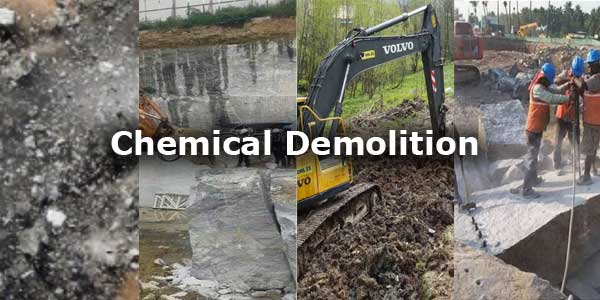
Chemical Demolition of Rock and Soil Excavation

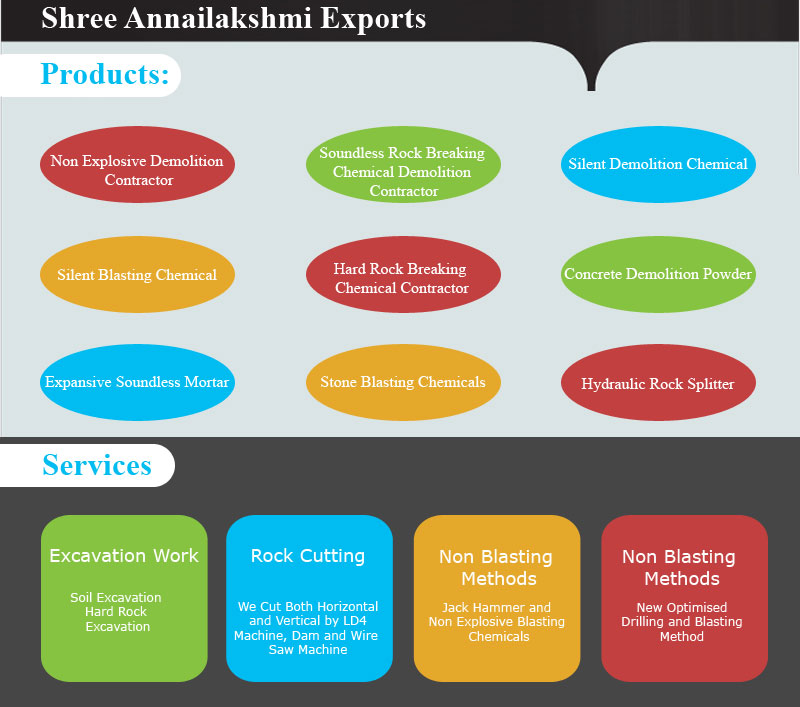
Shree Annailakshmi Exports is a growing company in demolition technology, earthworks and material handling industry. We are engaged in providing reliable solutions related to concrete structures demolition, rock excavation and boulders demolition, Drilling Service, Core Cutting, Concrete Chipping Service, Land Development Service, Transport and other services.

Fill Your Details
Subscribe Our Newsletter
reCAPTCHA field is required please complete!

The firm comprises of multidisciplinary team of qualified mining, civil & mechanical engineers, technicians and skilled workers backed by hard earned experience in mining service using heavy earth moving equipment’s and transportation equipment’s of various makes.

Conclusion

They take all measures to ensure the completion of work within the stipulate period and maintain the quality of work as per specifications.

Contact

Shree Annailakshmi Exports

#8, 6th Cross Road, Shamana Layout, Lingarajapuram, Bengaluru – 560084

Ph: +91-888-000-1889

Email: annaieports@gmail.com

Web: www.easyblast.in

Service-Life Design for RC Infra to be Repaired by Concrete Recasting

This article introduces the methodology for durability design of concrete repairs for infrastructures affected by deterioration in mid-life. A change of design approach is recommended, from the conventional ā€œprescriptive approach” practiced by current design standards to performance-based approach” which considers the actual ageing process through probabilistic treatment. Corrosion of steel reinforcement is considered as the most critical process and subject to performance-based design. The target design-life and durability limit states are attributed to concrete elements according to their desired maintenance free life. This article is based on experience of the author in dealing with durability assessment of infrastructures.

1.Motivation

Signicant amount of national funds are invested worldwide in the construction of infrastructure required to support society’s needs. In India it was forecasted that an investment of about Rs. 65 lakh crores in infrastructure was required for the 12th five year plan [Planning Commission]. Such high initial cost of infrastructure justies the importance of durability for such facilities. However existing infrastructure is undergoing deterioration faster than predicted, because the mechanism of degradation was not understood well at the time of construction and was not taken into account in the planning [Faroz and Ghosh, 2017]. As a result infrastructures such as bridges have degraded well before their expected service life is reached. As a result extensive repairs are needed for such infrastructures. In U.S., the annual cost for repair, maintenance and strengthening is estimated between $18 and $21 billion [Emmons and Sordyl, 2006]. Similar estimates can be expected for our country. Additionally, hindrance to the usability of facilities because of repair works cause signifcant revenue loss.

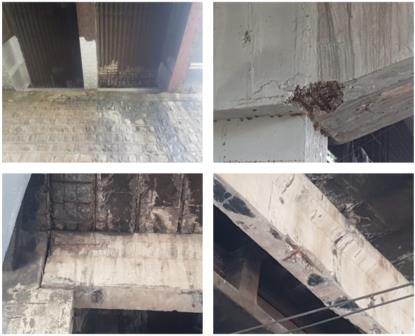
Corrosion of reinforcement steel is the leading cause of deterioration of reinforced concrete structures. Figure 1 shows visual of corrosion a affected bridges. Corrosion is conditioned on the uncertainty associated with the concrete construction, e.g. environmental exposure, early-age cracking, unintended lower concrete cover, accidental use of saline water for concrete mixing and/or curing. Joshi et al. [2018] highlights an example where a reinforced concrete bridge started corroding within two years of its inauguration because saline water was used for its curing. Such structures needs to be repaired by total concrete recasting of the covercrete which is economically expensive. Even after repairs are completed, questions still remain in the conscience of the Asset owner:

How long will the repairs last?
How long before the next repair is due?

This is because premature failure of repaired concrete structure as well as performance of the majority of repaired concrete structures affects many countries. A, CON REP NET study found out that only 75% of repairs survive 5 years, 25% of repairs survive 10 years and only 5% survive 25 years [Vimmr, 2004].

This article introduces the aspect of the performance based service life design of repaired concrete structures, with an aim of ensuring a maintenance free life. Such approach is part of Infrastructure Risk Management, which allows better utilisation of available resources [Faroz, 2018b]. This article is based on experience of the author in dealing with durability assessment of infrastructures [Faroz, 2018a,c].

2. Repair Through Concrete Recasting

This technique involves full/partial depth replacement of the contaminated concrete. The concrete can be contaminated by chlorides or may be carbonated, which promote corrosion initiation. Figure 2 shows schematically various methods of repair by recasting.

3. Concrete Durability

Concrete durability problems arise from the aggressiveness of the environment to which the structure is exposed. The chloride-induced corrosion is the most critical processes for durability design. The main reasons for such durability problems are the interconnected porous nature of the hydrated cement paste and the heterogeneity of concrete properties. Better quality control in the selection of materials and processes on site can control the problems related to the concrete system.

In the construction industry, durability is expected to be achieved through strength. But there is no simple or unique relationship between strength and any of the durability parameters. The key to concrete durability is the achievement of a ā€œdesigned concrete pore structure”. The simple way towards this goal is by specifying the concrete accurately for its intended purpose. The specification should address different aspects such as intended service-life, quantifiable description regarding serviceability requirement and failure, acceptable level of risk and possible extent of maintenance.

3.1. Conventional durability aspect

Conventionally, the durability design of a concrete structure for a target working life is achieved using a ā€œprescriptive (deemed-to-satisfy) approach”. This approach is followed by most design codes in use (IS 456:2000, IRC 112:2011, IRS CBC:1997). The provisions include limits of:

  • Minimum cement content,
  • Maximum water cement (w/c) ratio
  • Minimum grade of concrete
  • Nominal concrete cover

Following these rules the designer could ā€œassume” that the structure would achieve an acceptable long, but unspecified service life. However, the fulfilment of a particular service-life, if all of these prescription are satisfied, cannot be quantified using this approach. In other word, ā€œif all requirements are satisfied, what will be the achieved service-life?”. Thus this approach cannot be used to achieve a desired life of repairs. The ā€œPerformance Based Durability Design” is useful for achieving this objective.

4. Performance Based Durability Design

The performance-based approach involves modelling the real ageing process of structural materials under environmental actions and employs mathematical models to evaluate the required properties and structural dimensions for expected design lives through probabilistic treatments. These methods allow the uncertainty associated with all levels of corrosion process to be incorporated into the analysis, leading to a robust and informed design. The performance-based approach is an ā€œengineered approach” to durability design.

4.1. Design Life and Durability Limit State

The asset owner desires a long working life for the infrastructure, which is usually 100 years. However due to unexpected deterioration due to corrosion in an intermediate stage of the life, the design service life of the repairs can be the residual time upto 100 years.

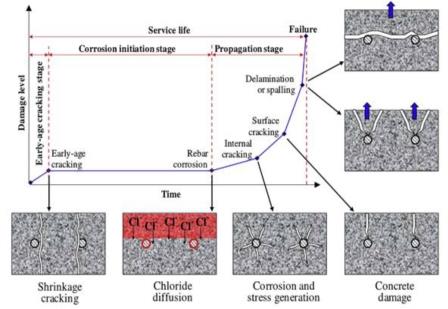
Durability Limit States (DLS) are needed for quantitative durability design using the performance-based approach. These are the minimum acceptable performance levels for different durability processes. The stages in life of a corroding concrete element is shown in Figure 3 for visualising various DLS. From this Figure 3 it is seen that once the chlorides reach the rebar level and accumulate in sufficient quantity, corrosion commences. Further propogation of corrosion leads to cracking of concrete cover and ultimately leading to spalling or delamination. For a ā€œmaintenance free” repair it is advised to adopt the limit state of corrosion initiation.

4.2. Design Methodology

Considering structural design of durability for corrosion processes, the design factors are concrete cover quality (diffusivity), concrete cover thickness, and crack control criteria. The concrete cover quality and thickness are designed through the durability models with the target service lives and appropriate DLS adopted. For the performance design procedure, the concrete surface is supposed to be exposed directly to aggressive agents (Cl Ā­). The model-based design follows a reliability analysis format with a target probability of failure (PT ), depending on the life desired (TL) for the repair.

4.3. Design Model

The design model for chloride-induced corrosion is adapted from the analytical model of dilusion. With the DLS specified as the corrosion initiation state, the design equation can be written as,

G = Cth – C(Cs, xd, Dc, TL) (1)

C(:) is the chloride concentration function in concrete. This model has four governing random parameters:

  • Threshold chloride concentration (Cth)
  • Concrete surface chloride concentration (Cs)
  • Chloride diffusion coefficient of concrete (Dc)
  • Concrete cover thickness (xd)

The objective being to obtain cover thickness (xd) and speci cations of the concrete such as the chloride diffusion coefficient of concrete (Dc) for the speci ed design life of repair (TL) subject to

P (G < 0)= PT (2)

The four random parameters have significant dispersion for a given exposure condition, and their statistical nature must be taken into account to guarantee a large enough safety margin for the durability design. Towards this aim, the design is performed by a full probabilistic scheme using directly the statistical properties of the parameters.

4.4. Testing of Parameters

The statistical properties of model parameters are analysed on the basis of the long-term in-place structural investigations and exposure tests in vicinity of the proposed project. It is advised to identify these parameters and must be included in the feasibility investigation for the project. The investigation comprises of environmental data extracted from site investigation for atmospheric temperature, humidity, and air-borne chloride content and wind speed. Further, the evaluation of chloride profiles of structures in the vicinity of the proposed project or similar projects elsewhere must be incorporated. This investigation helps to statistically characterise the diffusive property of concrete and evaluate the distribution of surface chloride concentration. Furthermore migration tests are adopted to investigate the concrete to be used in repairs. Since the concrete cover is the only structural parameter in the design equation, correct specification of concrete cover thickness is the central issue for durability design. The statistical properties of concrete cover thickness are important for correct estimation of reliability with respect to the design equation, and are related closely to the construction methods and practice. Statistical analysis based on the data of achieved cover thickness of similar concrete infrastructures must be investigated.

5. Closure

There is massive capital investment on infrastructure in our country. To safeguard these investments and prolong life of costly repairs and renovation, it is prudent to design the properties of concrete cover (its penetrability and thickness). This technical article adopts the performance-based design for the durability design. This article highlights important steps involved in the durability design for to be repaired concrete components.

References

  • D. Cusson, Z. Lounis, and L. Daigle. Benefits of internal curing on service life and life-cycle cost of high-performance concrete bridge decks – A case study. Cement & Concrete Composites, 32:339-350, 2010.
  • P. H. Emmons and D. J. Sordyl. The State of the Concrete Repair Industry, and a Vision for its Future. Concrete Repair Bulletin, pages 7-14, 2006.
  • S. A. Faroz. Performance Based Durability Design of Bridges for 120 Years. Indian Society of Structural Engineers (ISSE) Journal, 20(3):10-15, 2018a.
  • S. A. Faroz. Infrastructure Risk Management – Towards an Exciting Future of Bridge Management. The Masterbuilder, 20(7):124-128, 2018b.
  • S. A. Faroz. Durability Design Methodology of Metro Rail Bridges for 120 Years. Metro Rail News, 2:26-31, 2018c.
  • S. A. Faroz and S. Ghosh. Falling Short but not Falling Down: Challenges and Solution for the Service-Life Estimation of Gradually Degrading Bridges. The Masterbuilder, 19 (7):144-148, 2017.
  • M. Joshi, M. Yadav, and S. Gaonkar. Investigation and Retrofitting of RCC Deck Suffering from Accelerated Corrosion. The Masterbuilder, 20(2):150-152, 2018.
  • Planning Commission. Infrastructure funding requirements and its sources over the implementation period of the twelfth five year plan (2012-2017). http://planningcommission.nic.in. Last accessed: September, 2018.
  • D. Vimmr. Future performance-discussion on industry response to owners’ aspirations. In CON REP NET Network Newsletter No. 4, pages 5-9. 2004.
Dr. Sharvil Alex Faroz Infrastructure Risk Management (IRM)

What are you looking in our Website.*

What are you looking in our Website.*

Clear selection

Name*

Name*

Clear selection

Email*

Email*

Clear selection

Mobile No*

Mobile No*

Clear selection

Industry*

Industry*

Clear selection

This will close in 0 seconds