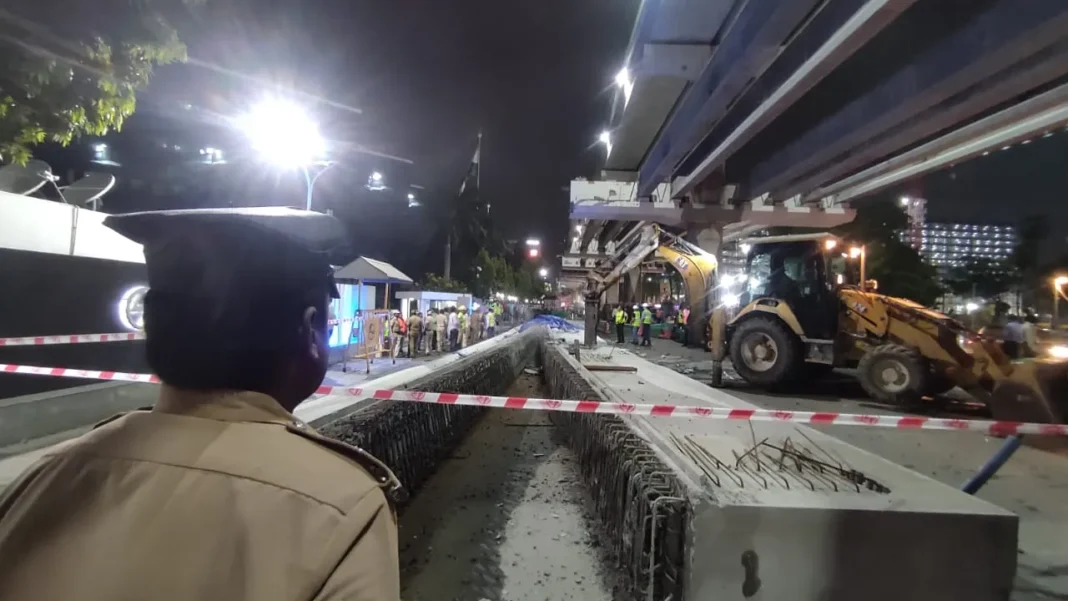
A tragic accident occurred at a Chennai Metro construction site in Ramapuram on Thursday evening, resulting in the death of a motorcyclist. Two recently installed steel girders collapsed during civil works on Corridor 4 of Chennai Metro’s Phase II project.
The collapse took place near the main gate of Larsen & Toubro’s (L&T) head office in Manapakkam, along Mount Poonamallee Road — a key arterial corridor in West Chennai. According to Chennai Metro Rail Limited (CMRL), the incident happened when a supporting A-frame, temporarily holding the I-girders in position, slipped and failed, causing the heavy steel structures to fall onto the road below.
The girders, part of the elevated viaduct construction, had been installed just a week earlier. They were located on Corridor 4, which spans 26.1 km from Poonamallee to Light House. The segment between Poonamallee and Porur was scheduled for partial commissioning by December 2025.
As of Friday morning, the identity of the deceased motorcyclist had not been officially released. Authorities are also investigating unconfirmed reports that a pillion rider may have been present at the time of the incident.
CMRL expressed regret and committed to a full inquiry:
“It is with regret that we confirm the death of one motorcyclist, and it is being ascertained whether the motorcycle also had a pillion rider. We express our deepest condolences to the family of the deceased. The incident will be enquired thoroughly.”
Emergency response units from the Tamil Nadu Fire and Rescue Services, local police, and metro contractors reached the site within minutes. Debris clearance operations continued through the night using cranes and heavy machinery to restore partial traffic movement.
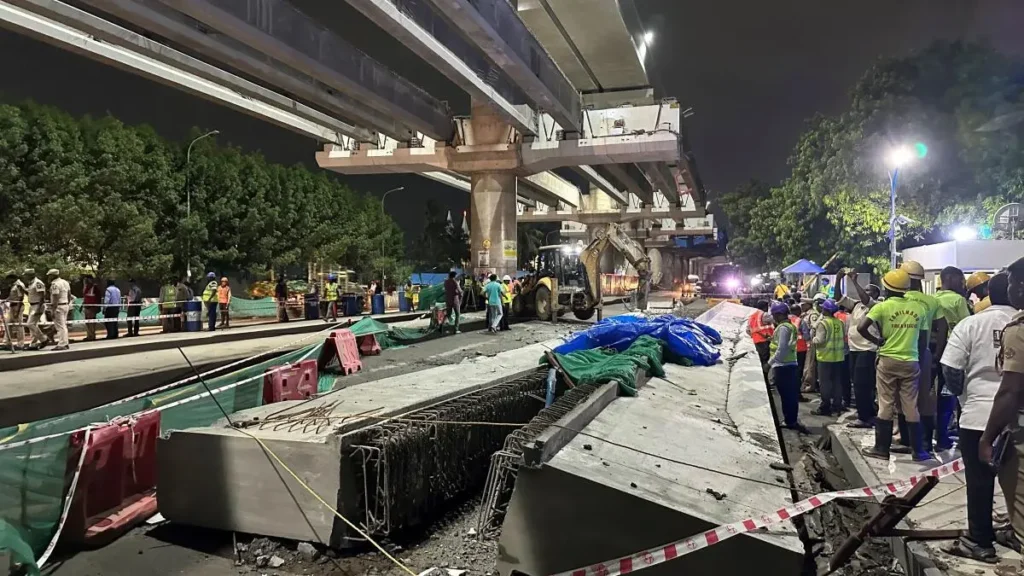
Structural Elements and Technical Faults
The I-girders involved in the collapse are primary components in elevated metro construction, serving to support deck slabs between piers. These girders are temporarily supported by steel A-frames until they are fixed in place using diaphragms and bearings.
CMRL’s Initial observations suggest that the failure of the A-frame — possibly due to misjudgment of design loads, improper anchoring, or ground settlement — triggered the collapse. Each girder reportedly weighed between 50 and 100 tonnes. Industry experts highlighted that even minor instability in temporary support systems can cause significant failures, particularly if load distribution changes post-placement.
CMRL issued a statement confirming the collapse:
“Two I-girders that had been erected a week ago near the L&T Head Office main gate in Manapakkam have collapsed unexpectedly when one of its supporting A-frames gave way by slipping. CMRL, along with its contractors, are removing the debris on a war footing to restore traffic movement. Investigation will be conducted to ascertain the cause of the collapse.”
Contractor Roles
Construction work for four major elevated and underground packages under the 118.9 km Phase II project had been awarded to Larsen & Toubro (L&T), Tata Projects, and the HCC–KEC International joint venture. Corridor 4 is among the stretches being executed by L&T.
Other portions of Corridors 3, 4, and 5 are under the scope of different contracting agencies. Following the incident, CMRL has directed all contractors involved in Phase II to immediately review safety procedures and re-assess the stability of temporary structures such as A-frames used during girder erection.
Investigators are expected to examine engineering documentation and interview project engineers, site managers, and safety officers. Preliminary indications point to potential lapses in inspection and anchoring assessments of the A-frame that failed.
The collapse disrupted traffic along Mount Poonamallee Road, affecting key links between Porur, Guindy, and Nandambakkam. Traffic was diverted overnight, with partial movement restored by Friday morning, though congestion continued in adjoining areas.
Residents and office commuters in Ramapuram and Manapakkam expressed concern over recurring safety hazards and traffic obstructions near ongoing construction zones. The incident has renewed calls for improved on-site safety enforcement, better barricading, and visible signage, especially during peak hours.
Corridor 4 and Phase II Overview
Corridor 4, part of the 118.9 km Phase II of the Chennai Metro, includes a combination of elevated and underground stretches. It connects western suburbs like Poonamallee and Porur to city centres such as Alwarpet and Light House. The corridor is important due to its coverage of densely populated residential zones, commercial districts, and high-traffic junctions.
The Ramapuram–Porur section is among the busiest, flanked by schools, hospitals, and IT parks. Ongoing construction activities in this area involve precast segment launching, pier erection, and girder staging — often in tight urban spaces with constrained traffic widths.
Following the accident, CMRL has ordered a safety audit of all erected components on Corridor 4, including temporary systems like staging frames and shuttering. Inspections are expected to temporarily slow construction in adjacent stretches until certified safe.
The incident at Ramapuram highlights the risks associated with elevated construction in urban zones, where failure of even temporary elements can lead to fatal outcomes. As investigations progress, CMRL and the involved contractors are under pressure to demonstrate compliance with safety norms, improve structural oversight, and ensure such incidents are not repeated.
A detailed report from technical and safety consultants is expected in the coming days. For now, the focus remains on restoring normalcy in traffic movement, supporting the family of the deceased, and instituting system-wide reviews across Phase II works.
We are closely monitoring this developing story. Once the detailed investigation report is released, we will provide an in-depth follow-up.
Stay tuned and keep watching this space for further updates.
Images- newsx.com, thehindubusinessline.com