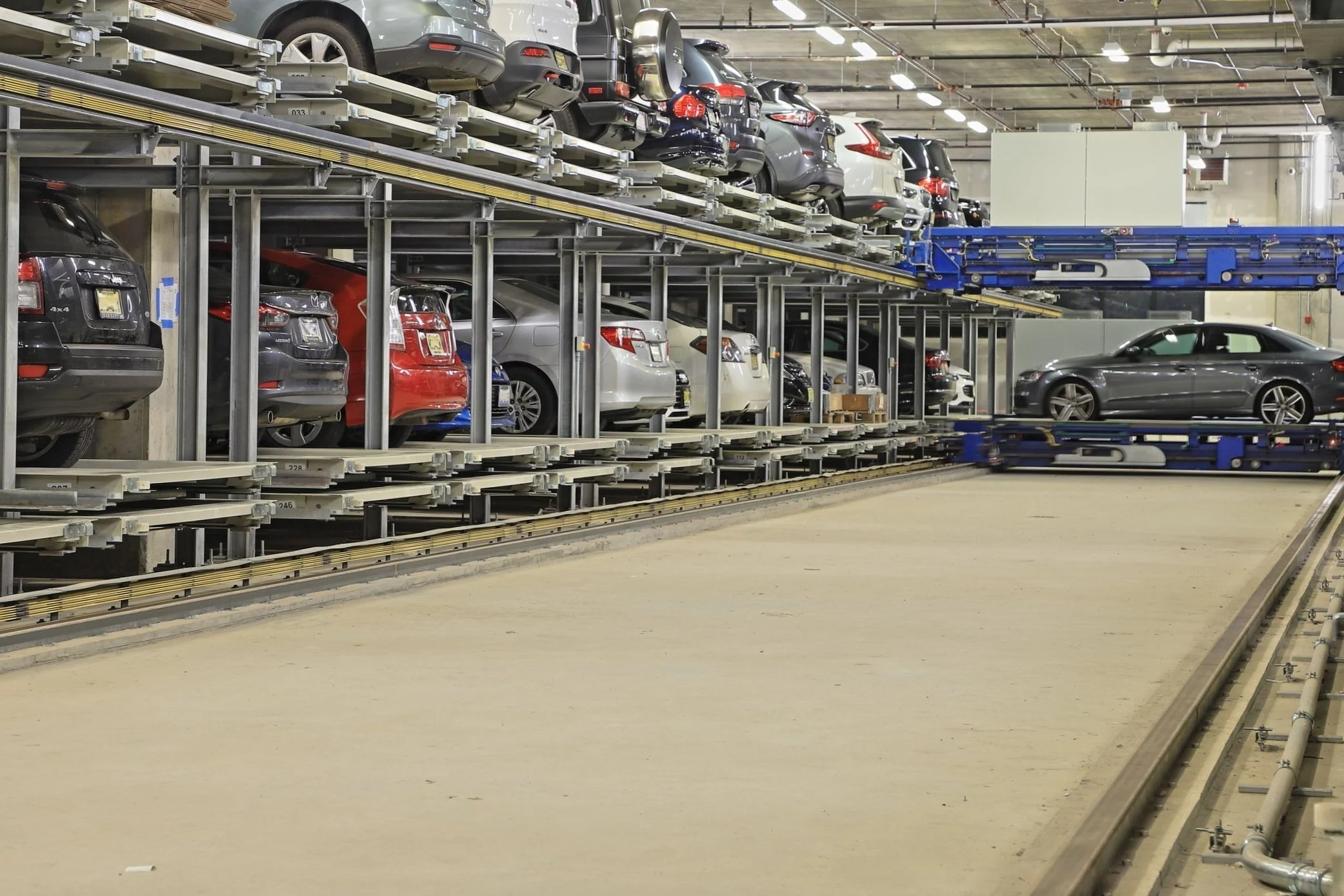
The shift toward automated car parking systems reflects changing requirements in urban and commercial developments. Increasing vehicle ownership and space constraints make conventional parking structures less effective. Automation helps optimize layout design, reduce circulation losses, and improve overall parking efficiency.
Traditional parking models often face challenges such as uneven space utilisation and operational variability. Automated systems address these issues through controlled vehicle transfer, real-time monitoring, and centralised management. These features support consistent performance and make automation suitable for projects with long-term operational expectations.
How Automated Car Parking Systems Work
In automated car parking facilities, vehicle movement and space assignment follow system-driven processes rather than manual control. Design choices depend on layout limitations, expected demand, and the level of operational automation required.
Key elements typically involved:
- Detection and tracking systems to identify vehicles and available slots
- Automated entry and exit controls to manage access and flow
- Parking management software to monitor operations and generate usage data
- Digital payment and billing interfaces linked to entry and exit events
- Mechanical storage or transfer equipment used in space-constrained designs
In fully automated layouts, vehicles do not circulate inside the facility, which allows higher parking density and controlled internal movement.

Reasons for Adopting Parking Automation
The adoption of automated parking systems is linked to structural and operational limits within conventional parking facilities. These limits become more pronounced in high-density and high-usage environments.
Primary drivers influencing adoption include:
- Limited land availability and high land cost in urban and transit-oriented developments
- Demand for higher parking density within fixed site boundaries
- Need to reduce manual operational dependency in large or high-turnover facilities
- Requirement for accurate usage data to support planning, pricing, and compliance
- Operational consistency across multiple sites or public parking assets
These factors apply across municipal, commercial, and mixed-use projects, shaping both system selection and deployment strategy.
Functional Benefits of Automated and Smart Parking Solutions
- Optimised space utilisation through vertical stacking and efficient layout design
- Reduced internal vehicle circulation, lowering congestion and idle emissions
- Standardised user experience with guided parking and automated entry and exit
- Improved operational efficiency through centralised control and reduced manpower
- Enhanced safety and security by limiting human access and monitoring vehicle movement
- Data-driven management using real-time parking analytics and reporting
Design and Planning Considerations
Automated parking systems require early technical evaluation due to higher initial investment and system complexity. Lifecycle cost assessment is essential to compare long-term value against conventional parking solutions.
System performance depends on reliable coordination between sensors, control software, and utility services. Designs must account for continuity of operation in high-usage conditions.
Key considerations include:
- Lifecycle cost and maintenance planning
- System reliability and fail-safe operation
- Power and network availability with backup provisions
- Compatibility with existing structures and services
Retrofit installations may require structural and electrical modifications to support automated equipment.

Challenges in Large-Scale Parking Automation
- Capital expenditure approvals and budget constraints
- Compatibility with legacy buildings and layouts
- Requirement for trained technical and maintenance teams
- User adaptation to automated workflows
- Alignment with regulatory requirements and site-specific standards
Implementation Steps for Automated Parking
- Assess site: Check demand patterns, peak usage, and space constraints
- Select system: Ensure reliability, scalability, and local service support
- Pilot test: Validate performance and workflow before full rollout
- Provide guidance: Signage and instructions for users
- Monitor: Track system operation and adjust if needed
Conclusion
Automation in car parking systems offers a structured solution to modern parking constraints when aligned with site conditions and operational goals. By focusing on space efficiency, system reliability, and user experience, automated parking solutions support sustainable infrastructure development and effective urban parking management for both public and private stakeholders.