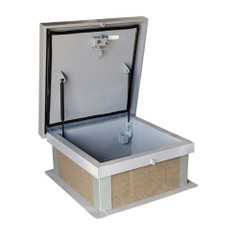
For most commercial applications, the roof access hatch size must be large enough to accommodate:
- Safe worker passage
- Rooftop equipment components
- Material handling during installation or replacement
- Required fall protection systems
- Code-mandated clearances
Most commercial roofs house HVAC units, solar panels, and exhaust fans. So, whether you’re installing a commercial roof access hatch on a new building or replacing an existing one, you need to consider the space required to safely service roof equipment.
Choosing a roof access hatch size is a vital decision that balances safety, code compliance, and long-term efficiency. This means accounting for OSHA safety standards and IBC codes, to ensure every maintenance trip is both legal and injury-free.
Why Does Roof Access Hatch Size Matter on Commercial Projects?
On a commercial job site, the dimensions of the roof access hatch determine how easy rooftop maintenance will be. If the opening is too small, a routine motor replacement for an air handling unit becomes a logistical nightmare.
Proper sizing reduces liability exposure. It ensures technicians maintain three points of contact on a ladder while carrying smaller parts.
Planning for the worst-case equipment replacement cycle is what sets roofing contractors apart. By specifying the right rooftop equipment access points early, you avoid the dreaded Request for Information (RFI) mid-construction.
Furthermore, a well-sized hatch integrated with a safety railing system ensures the building remains inspection-ready and compliant with OSHA roof access requirements for the next several decades.
What are the Standard Roof Access Hatch Sizes?
As with other access doors and panels, the industry relies on several standard roof-hatch sizes. These accommodate different ascent methods and equipment needs. While custom sizes are available, these common dimensions cover most commercial applications.
Common Commercial Sizes
- 30″ x 36″: Ideal for access via a fixed ladder and perfect for personnel access where only small hand tools are needed.
- 36″ x 36″: Provides a square opening that offers more shoulder room for technicians wearing tool belts or carrying small component bags.
- 48″ x 48″: The go-to for moving larger components like blower motors or localized exhaust fan parts that can’t be disassembled.
For buildings with interior stairwells, larger rectangular hatches (e.g., 30″ x 54″ or 36″ x 96″) allow a natural walking gait during the transition to the roof.
How Do You Determine the Right Roof Access Hatch Size for Your Project?
Step 1: Evaluate Rooftop Equipment Dimensions
Start by measuring the largest non-reducible component of your HVAC unit panels or solar inverters. Add a minimum of 6 to 12 inches of roof hatch clearance around that object. This “buffer zone” prevents hand injuries and equipment damage during the transfer.
Step 2: Consider Access Method
Your choice of a fixed ladder, ship ladder, or alternating tread stair dictates the hatch length. OSHA ladder access rules require a safe transition point. A ship ladder, for example, requires a longer hatch opening to accommodate the stair angle.
Step 3 – Plan for Future Equipment Replacement
Think about the building’s 20-year lifecycle. If the current mechanical units are slated for an upgrade in a decade, a slightly oversized roof access hatch today prevents the need for structural demolition and roof membrane modifications tomorrow.
Which Code Requirements Influence Roof Hatch Size
Compliance isn’t optional. Both the IBC and OSHA set standards for how your roof access is configured.
OSHA Access & Fall Protection Considerations
The Occupational Safety and Health Administration treats roof hatches as floor openings. Meaning, they must be protected from fall hazards.
In most commercial settings, this requires:
- A compliant safety railing system or guardrails
- A safe ladder-to-roof transition
- Protection while the lid is open
Hatch size matters because fall protection must fit without blocking access. If guardrails interfere with ladder clearance or restrict safe movement through the opening, the installation may fail inspection.
The hatch must allow a worker to climb up, step onto the roof, and move clear of the opening without obstruction. If it cannot accommodate both access and fall protection, it’s not compliant.
IBC and Local Code Impacts
The International Code Council sets minimum access and egress standards that many jurisdictions adopt. For instance:
- Rooftops used as occupied spaces or mechanical service platforms may require minimum egress widths.
- Buildings with life-safety systems on the roof, such as smoke exhaust fans, may require more unobstructed access.
- Some fire-rated roof assemblies require specific hatch types, which can reduce the available clear opening width.
Before finalizing hatch dimensions, confirm:
- The required clear opening
- Fire rating requirements
- Whether the roof is service-only or part of the building’s egress system.
What Should Contractors Consider When Specifying Roof Access Hatches?
- Gas Spring-Assisted Lid: These cylinders make one-handed operation possible but take up a few inches of lateral space. Ensure your equipment can clear these springs.
- Safety Railings and Guardrails: A permanent safety railing system is often required by code. While these are mounted to the curb, they can change the “approach” angle for a technician, making a larger hatch feel more necessary for comfort and safety.
- Roof Hatch Insulation Value: High R-value hatches are thicker. This added insulation and weather-tight sealing are great for energy codes, but can slightly reduce the “pass-through” area if the curb is heavily tapered.
What Common Mistakes Do Contractors Make When Sizing Roof Hatches?
- Matching the ladder instead of the equipment. Just because a ladder is 18 inches wide doesn’t mean a 24-inch hatch is sufficient for a technician carrying a tool kit.
- Ignoring the lid swing. Forgetting that the lid needs 90 to 105 degrees of travel can lead to obstructions with nearby piping or equipment.
- Overlooking the railing footprint. Installing a safety railing system after the fact can sometimes narrow the perceived entrance if not planned correctly.
- No sub-contractor coordination. Mechanical subs often know the real size of their equipment better than the general plans. Consult them before cutting into the roof.
Conclusion
Getting the roof access hatch size right is a small detail that has a massive impact on a commercial building’s safety, compliance, and lifecycle costs.
By integrating a high-quality curb-mounted roof hatch with a fall protection system, you protect both workers and the roof’s structural integrity.
Early coordination between architects, mechanical engineers, and safety teams helps ensure that your roof access gateway remains an asset rather than a bottleneck. When you plan for future equipment while meeting today’s codes, you create a facility that lasts.