
Modern transportation infrastructure demands roadways that can withstand heavy traffic volumes, increasing axle loads, and environmental stresses while minimizing long-term maintenance costs. Traditional flexible pavements are typically designed for a service life of 15 to 25 years before requiring major rehabilitation or reconstruction. However, the Perpetual Pavement Design Method offers a fundamentally different approach. Instead of planning for periodic structural replacement, this method aims to construct asphalt pavements capable of lasting 50 years or more without deep structural failure. Only the surface layer requires periodic renewal.
Perpetual pavement does not mean a pavement that literally lasts forever. Rather, it refers to a pavement structure engineered so that the important layers never experience structural fatigue or permanent deformation. By controlling internal stresses and strains within the pavement, engineers ensure that structural damage does not accumulate over time. Surface wear may occur, but the underlying structure remains intact.
Concept of Perpetual Pavement
Perpetual pavement is a long-life asphalt pavement system designed using mechanistic principles. The design ensures that load-induced strains remain below important thresholds that cause fatigue cracking or rutting. When these strain limits are not exceeded, structural damage does not accumulate, allowing the pavement to perform for decades without reconstruction.
Traditional pavement design methods relied heavily on empirical data derived from historical performance. While effective for shorter design lives, these approaches did not explicitly control internal stress responses. The perpetual pavement method incorporates mechanistic-empirical principles, allowing engineers to calculate strain responses within each layer and adjust thickness and material properties accordingly.
The primary objective is to eliminate two major structural distresses:
- Bottom-up fatigue cracking caused by excessive tensile strain at the bottom of the asphalt layer
- Structural rutting caused by excessive compressive strain on the subgrade
By keeping these strains below endurance limits, deep structural failure is prevented.

Structural Composition of Perpetual Pavement
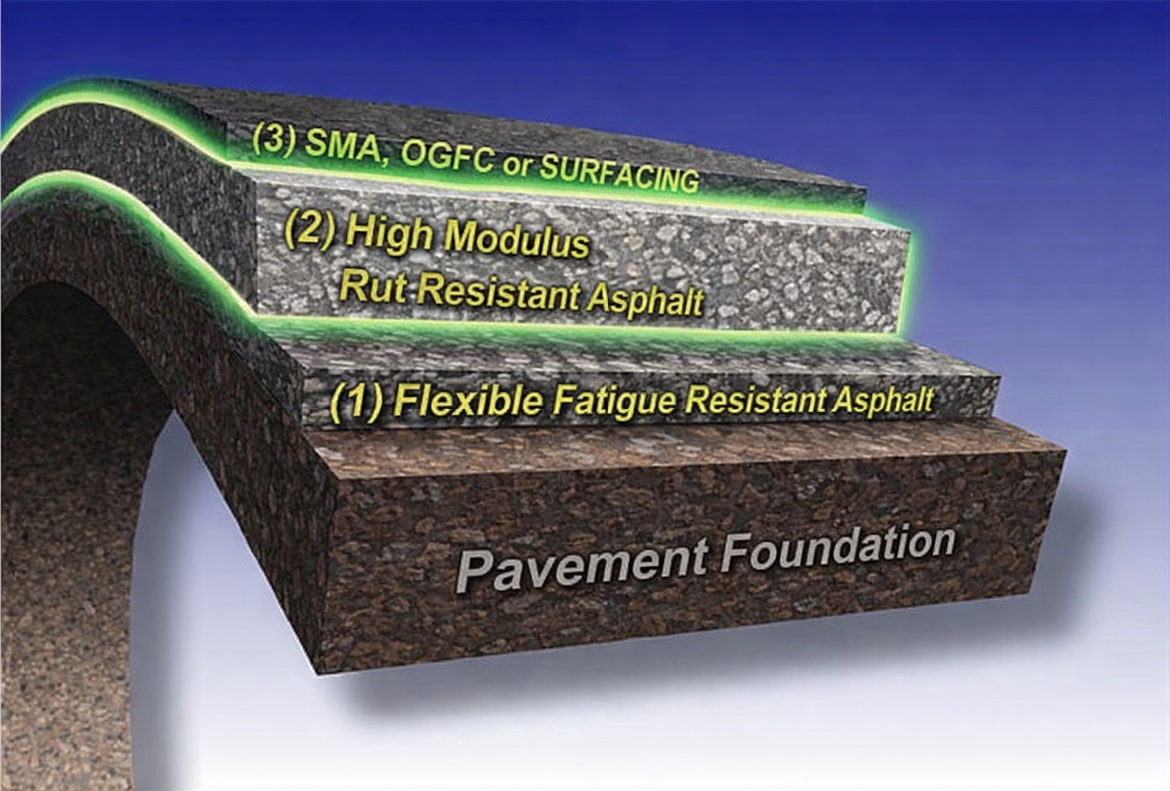
A perpetual pavement structure typically consists of multiple asphalt layers placed over a prepared base and subgrade. Each layer serves a specific structural function and is designed with targeted material properties.
- Bottom layer designed for fatigue resistance
- Intermediate structural layer designed for rut resistance
- Surface layer designed for durability, skid resistance, and smoothness
Fatigue Resistant Base Layer
The bottom asphalt layer is engineered to resist tensile strain. It usually contains a higher asphalt binder content and is designed to remain flexible. This flexibility allows the layer to absorb repeated traffic loading without cracking. Low air void content improves durability and fatigue life.
Intermediate Structural Layer
The intermediate layer provides structural stiffness. It distributes traffic loads and resists permanent deformation. This layer is typically designed with a higher modulus mixture that balances stiffness and durability.
Surface Course
The top layer provides skid resistance, ride quality, and environmental protection. It resists abrasion, oxidation, and weathering. When surface distress develops over time, this layer can be milled and replaced without disturbing the structural layers beneath.
Design Principles
The perpetual pavement design method is rooted in mechanistic analysis. Engineers use layered elastic theory or advanced finite element modeling to determine stress and strain responses within pavement layers under repeated loading.
Key design considerations include:
- Control of tensile strain at the bottom of the asphalt layers
- Control of compressive strain on top of the subgrade
- Selection of asphalt mixtures with proven fatigue endurance limits
- Adequate total asphalt thickness to reduce structural strain
- Consideration of temperature variations and environmental effects
The concept of endurance limit plays a central role. Research has shown that asphalt mixtures exhibit a strain threshold below which fatigue damage does not accumulate. When the design ensures strain levels remain below this threshold, the pavement can theoretically withstand an unlimited number of load repetitions.
Material Considerations
Material selection is important to achieving perpetual pavement performance. The asphalt mixtures used in each layer must be carefully engineered and tested.
Important material characteristics include:
- Fatigue resistance
- Rutting resistance
- Adequate stiffness without brittleness
- Proper binder selection based on climate
- High-quality aggregates with strong interlock
Modified binders are often used to enhance performance under heavy traffic and extreme temperatures. Laboratory testing such as dynamic modulus testing and fatigue beam testing helps characterize mixture behavior.
Thickness Design
Perpetual pavements generally require greater total asphalt thickness compared to conventional flexible pavements. Increased thickness reduces tensile strain at the bottom of the asphalt layer and decreases compressive strain on the subgrade.
Thickness design depends on:
- Traffic volume and projected growth
- Percentage of heavy axle loads
- Subgrade strength
- Climate conditions
- Desired design life
By increasing asphalt thickness and optimizing layer properties, strain levels are kept within safe limits.
Construction Quality Control
Even the best design cannot succeed without proper construction practices. Quality control during construction ensures that the pavement performs as intended.
Critical construction factors include:
- Proper compaction to achieve target density
- Uniform layer thickness
- Avoidance of segregation
- Effective bonding between layers
- Proper drainage design
Poor compaction or inadequate bonding can lead to premature distress, even in well-designed structures.
Maintenance Strategy
Perpetual pavements are not maintenance-free. However, maintenance is limited to surface renewal rather than full structural reconstruction.
Typical maintenance practices include:
- Periodic surface milling and overlay
- Crack sealing
- Surface rejuvenation treatments
- Skid resistance improvements
By addressing surface issues early, deeper structural layers remain protected.
Advantages of Perpetual Pavement
The perpetual pavement design method offers numerous advantages compared to traditional pavement systems.
- Extended service life exceeding 50 years
- Elimination of deep structural reconstruction
- Reduced life-cycle cost
- Lower long-term maintenance frequency
- Improved sustainability due to reduced material consumption
- Minimal traffic disruption during rehabilitation
- Enhanced ride quality and safety
Although initial construction costs may be higher, life-cycle cost analysis often demonstrates long-term economic benefits.
Sustainability Benefits
Perpetual pavements contribute significantly to environmental sustainability.
- Reduced raw material usage over time
- Lower greenhouse gas emissions from reduced reconstruction
- Recyclability of asphalt surface layers
- Improved fuel efficiency due to smoother surfaces
- Reduced traffic congestion during maintenance
By minimizing full-depth reconstruction, energy and resource consumption are substantially reduced.
Limitations and Challenges
Despite its benefits, the perpetual pavement method requires careful planning and investment.
- Higher initial construction cost
- Greater design complexity
- Requirement for advanced material testing
- Strict construction quality control
- Not always economical for low-traffic roads
It is particularly suitable for highways, freight corridors, and heavily trafficked urban roads where long-term durability is important.
Comparison with Conventional Flexible Pavement
Conventional flexible pavements are typically designed for a fixed design life, after which significant rehabilitation or reconstruction is expected. Structural damage accumulates over time, leading to fatigue cracking and rutting.
In contrast, perpetual pavements are designed to prevent structural damage accumulation. Only the surface layer deteriorates, allowing cost-effective renewal without affecting the structural base.
This difference in philosophy represents a shift from reactive maintenance planning to proactive long-term structural preservation.
Future Outlook
Advancements in mechanistic modeling, improved asphalt binder technologies, and better performance testing methods continue to enhance perpetual pavement design. As traffic volumes increase globally and infrastructure budgets face pressure, long-life pavement strategies are becoming increasingly attractive.
With proper design, material selection, and construction quality, perpetual pavement represents a sustainable and economically viable solution for modern roadway infrastructure.
Conclusion
The Perpetual Pavement Design Method is a scientifically grounded approach to long-life asphalt pavement design. By controlling internal strains and preventing structural damage accumulation, it ensures durability exceeding five decades with only surface-level maintenance.
Through careful engineering, appropriate material selection, adequate thickness design, and strict construction quality control, perpetual pavements deliver long-term performance, economic efficiency, and environmental sustainability. For heavily trafficked roads where reliability and durability are essential, perpetual pavement stands as one of the most advanced solutions in modern pavement engineering.






