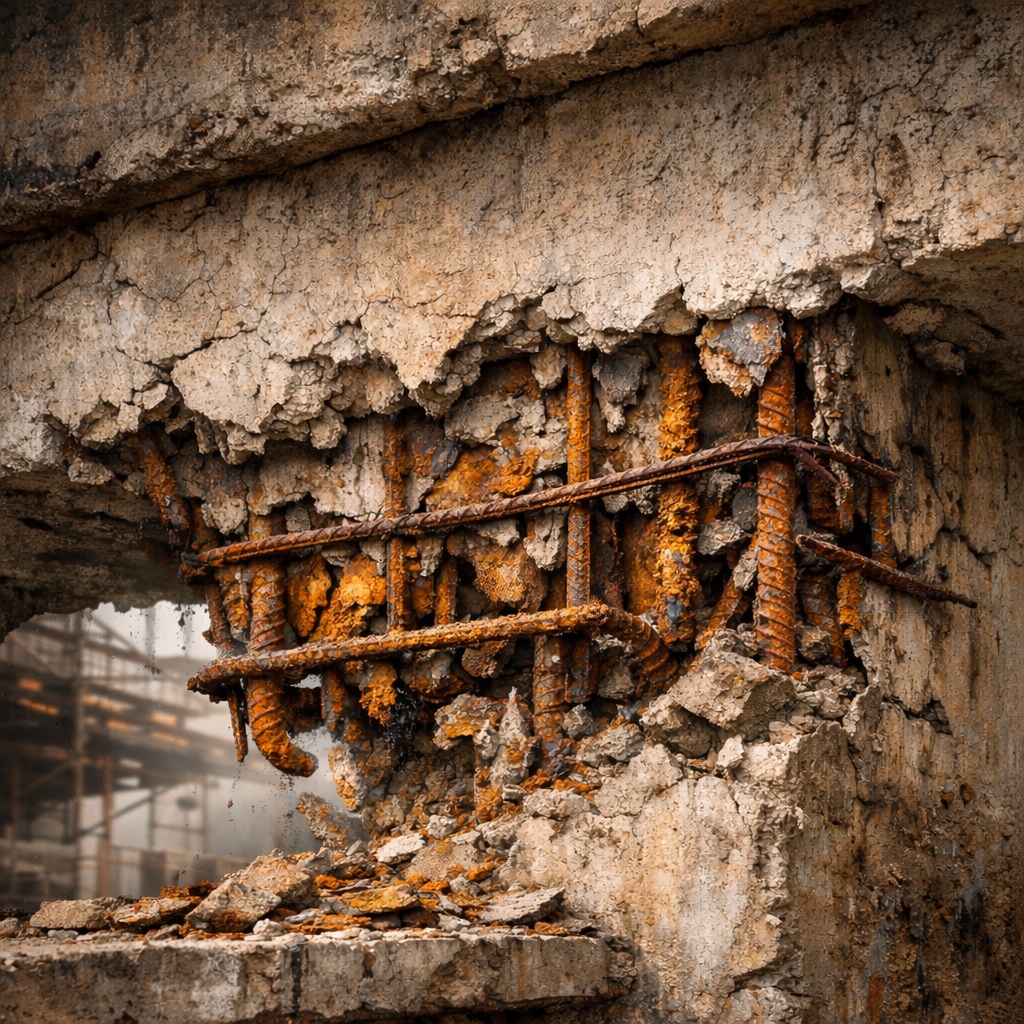
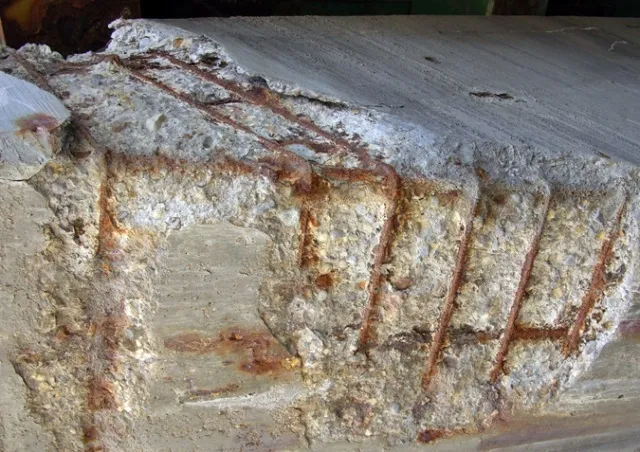
Corrosion-related damage caused many RCC buildings to collapse before. This is mostly a result of ignored corrosion processes during construction, waterproofing, and early maintenance phases rather than of design code violations. Visible damage appears late in the cycle as corrosion develops internally, therefore rehabilitating is costly and often redundant.
Corrosion is not a sudden event. It is a progressive process that begins internally and becomes visible only after significant damage has already occurred. Once visible, repair options become expensive, disruptive, and often ineffective.
Why Corrosion Occurs in RCC
With trapped residual moisture playing a major role, corrosion in RCC results from combined exposure to moisture, oxygen, and corrosive substances.
Technical observations:
- Residual moisture retained beyond permissible BIS limits enables electrochemical corrosion of steel
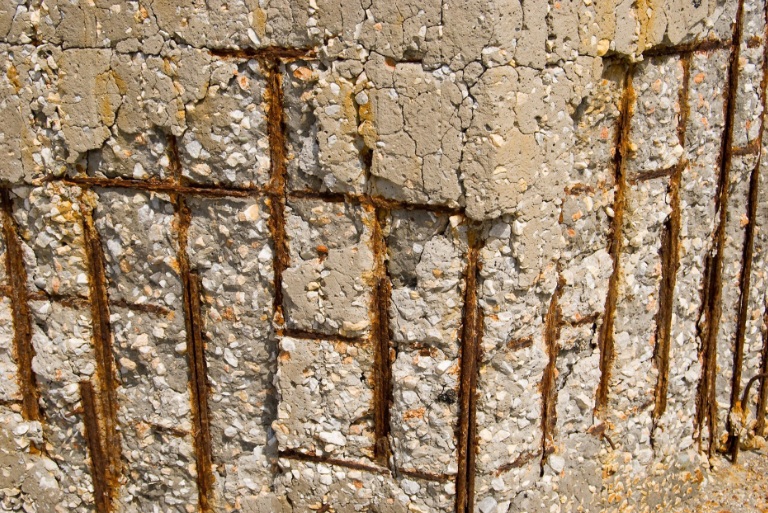
- Corroding steel expands, generating internal stresses
- These stresses crack concrete and reduce bond strength
- Structural capacity and durability decline rapidly
When residual moisture remains high for prolonged periods, corrosion accelerates regardless of surface protection measures.
Entrapped Dampness in RCC
Entrapped dampness refers to high residual moisture content locked inside RCC after construction or waterproofing. This condition often develops due to:
- Inadequate curing and compaction
- Poor-quality construction water containing chlorides or fluorides
- Defective plumbing or waterproofing systems
- Surface coatings applied without moisture release pathways
Conventional waterproofing typically addresses external water ingress. If applied without assessing internal moisture levels, these systems restrict moisture release from RCC, allowing corrosion processes to continue beneath the treated surface.
Industry-Level Impact of Corrosion
Corrosion-related distress is not an isolated project issue. It has systemic economic and environmental consequences.
Industry Impacts:
- 4–6% of India’s GDP lost annually due to corrosion-related damage and repairs
- Cumulative losses exceeding INR 500 lakh crore over the last few decades
- Frequent dismantling leading to high debris generation and pollution
- Reduced service life of assets and increased life-cycle costs
These losses stem largely from reactive repair practices rather than preventive diagnostics.
Limitations in Current Practice
Despite advancements in materials and design, the construction and rehabilitation ecosystem lacks a standardized way to assess internal RCC health.
Current gaps:
- No mandatory on-site system to measure residual moisture content
- No linkage between construction quality and long-term durability certification
- Limited feedback mechanisms for engineers during execution
- Over-reliance on coatings without understanding crack movement or RCC behavior
As a result, corrosion risks remain undetected until visible failure occurs.
Residual Moisture Assessment
Residual moisture auditing provides a non-invasive, on-site method to evaluate internal moisture levels in RCC during and after construction.
Audit Findings:
- Early identification of corrosion-prone structures
- Verification of construction, waterproofing, and plumbing quality
- Objective data for engineers and consultants
- Prevention of premature repairs and dismantling
Structures built and protected correctly exhibit residual moisture within reference limits. Deviations act as early indicators of future distress.
Crack Management in RCC Waterproofing
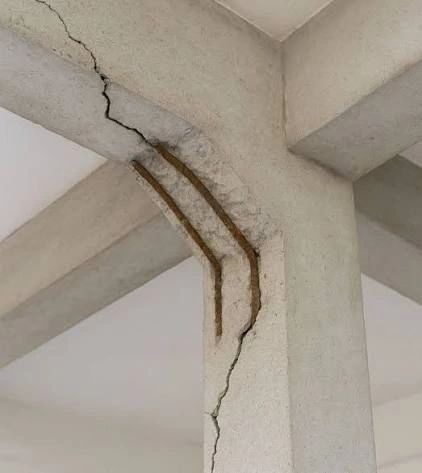
Crack behavior in RCC further complicates waterproofing performance. Structural movement can produce crack elongations exceeding the elastic limits of many liquid-applied membranes. When moisture remains trapped below such systems, failures become inevitable.
Moisture & Crack Focus:
- Controlled release of entrapped moisture
- Understanding crack dynamics and structural movement
- Treating corrosion causes rather than visible symptoms
Long-term observations show that structures treated using moisture management principles achieve 20–30 years of additional service life, along with reduced maintenance frequency and environmental impact.
Crack Behavior and Membrane Limitations
Cracks in RCC slabs evolve continuously throughout the structure’s life due to loading, temperature changes, shrinkage, and creep. Waterproofing systems often fail when membranes cannot accommodate this ongoing movement, particularly in substrates with trapped moisture.
Crack and Membrane Insights:
- Crack width and movement increase progressively due to structural behavior
- Repeated opening and closing of cracks reduce membrane adhesion over time
- Laboratory elongation values do not fully represent site conditions
- Aging, UV exposure, and substrate moisture reduce membrane flexibility
- Failure becomes inevitable when crack movement exceeds membrane capacity, particularly in RCC with high residual moisture
How AAYKA Contributes to This Approach
AAYKA Waterproofers Pvt. Ltd. addresses corrosion-related early distress by integrating Entrapped Dampness Management Protocols with non-invasive residual moisture diagnostics. The method allows excess internal moisture to be released from RCC structures without dismantling. By addressing moisture behavior, crack movement, and concrete response, it moves waterproofing and rehabilitation beyond surface treatments toward improved structural durability and longer service life.