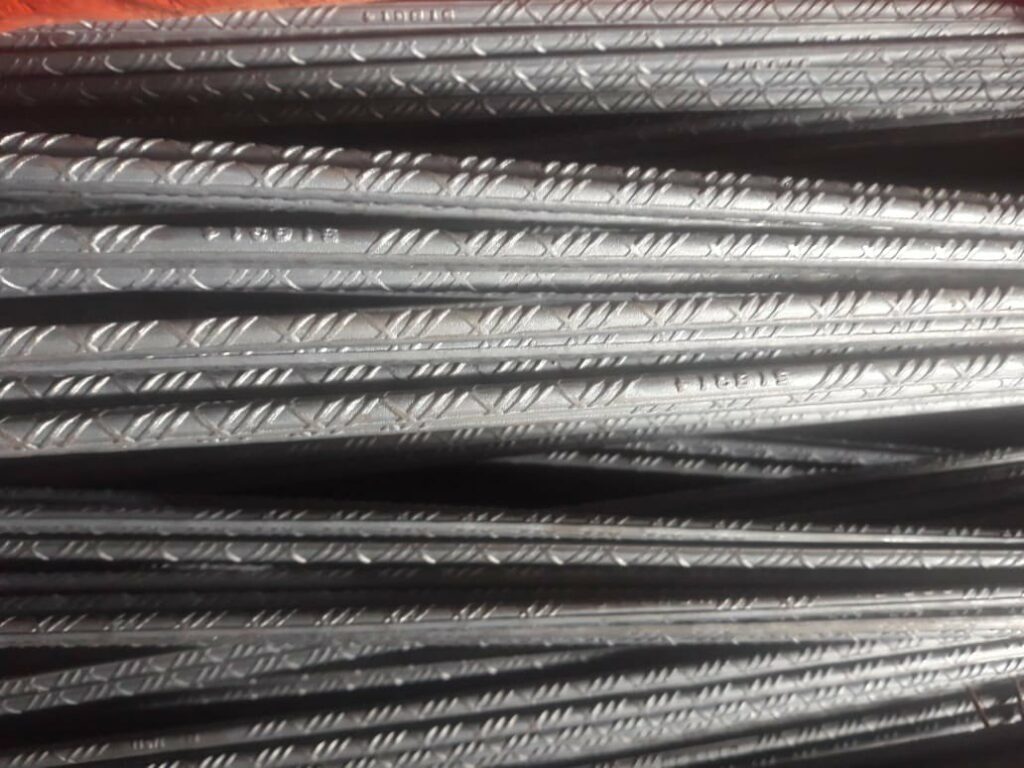
Fe-600 TMT bars are high-strength thermo-mechanically treated reinforcement bars with a minimum yield strength of 600 MPa. They are designed for applications where superior load-bearing capacity, structural rigidity, and durability are required. Compared to conventional grades, Fe-600 bars allow for reduced steel consumption in heavily loaded structures while maintaining or improving safety margins. Produced through a carefully controlled TMT process, Fe-600 bars combine a tough outer surface with a softer, more ductile core. This microstructure ensures that the bars can withstand significant tensile stresses while also maintaining the necessary elongation for seismic and dynamic load conditions.
Applications of Fe-600 TMT Bars
- High-rise buildings – Enables reduced column sizes and lower steel congestion in heavily reinforced members.
- Bridges and flyovers – Suitable for long-span structures requiring high tensile capacity and fatigue resistance.
- Industrial plants – Ideal for heavy equipment foundations and structures exposed to dynamic loading.
- Metro and railway projects – Used in viaduct piers, station structures, and elevated tracks.
- Marine and port structures – When combined with corrosion protection, they handle high stresses in saline environments.
- Large commercial complexes – Supports longer spans with fewer intermediate columns for flexible layouts.
- Dams and water infrastructure – Performs well in spillways, intake towers, and hydraulic structures with high pressure loading.
Manufacturing Process of Fe-600 TMT Bars
The production of Fe-600 TMT bars follows the same broad thermo-mechanical treatment principle as other grades, but with tighter quality control and precise chemistry to achieve the higher yield strength:
- Steel making and casting – High-quality billets with controlled levels of carbon, manganese, sulfur, and phosphorus are produced in basic oxygen or electric arc furnaces.
- Hot rolling – Billets are reheated to uniform temperatures and passed through a series of rolling stands to reach the desired bar diameter.
- Quenching – Immediately after the final rolling pass, bars are rapidly cooled with high-pressure water jets to form a hard martensitic outer layer.
- Self-tempering – Heat from the still-hot core tempers the martensitic surface, relieving brittleness and improving toughness.
- Atmospheric cooling – Bars are cooled in ambient conditions, allowing the core to form a ferrite-pearlite microstructure.
- Straightening and cutting – Bars are cut to standard lengths, straightened, and bundled for dispatch.
- Testing and certification – Each batch undergoes tensile, bend, re-bend, elongation, and chemical composition tests to ensure compliance with IS 1786 standards for Fe-600.
Advantages of Fe-600 TMT Bars
- Reduces steel consumption by up to 15–20% in certain structural members.
- Allows slimmer structural sections without compromising strength.
- High yield strength of 600 MPa ensures better load-bearing capacity.
- Good ductility and elongation ensure resistance to dynamic and seismic forces.
- Enhanced fatigue resistance for structures subject to repeated loading.
- Lower congestion in heavily reinforced members, improving concreting quality.
- Compatible with all conventional construction and welding methods.
- Long service life when combined with corrosion-resistant coatings or mix designs.
- Uniform rib pattern ensures better bond with concrete.
- Certified to meet IS standards for structural safety and reliability.

Types of Fe-600 TMT Bars
While the base grade is defined by the yield strength, Fe-600 bars are available in different variants depending on surface finish, coating, or manufacturing refinements:
1. Standard Fe-600 TMT Bars
Standard Fe-600 TMT bars are uncoated high-strength reinforcement steel bars designed for heavy-duty structural applications where environmental corrosion risk is moderate. With a yield strength of 600 MPa, these bars provide superior load-bearing capacity compared to lower-grade TMT options, enabling reduced steel consumption in large-scale projects. They are widely used in the construction of high-rise towers, commercial complexes, large-span industrial buildings, and bridges in non-coastal regions where moisture and salinity levels are low. The absence of protective coatings makes them more economical, while still delivering reliable performance in environments that do not present extreme corrosion challenges.
2. Corrosion-Resistant Fe-600 TMT Bars
Corrosion-resistant Fe-600 TMT bars are manufactured with the addition of alloying elements such as copper, chromium, or phosphorus, which enhance the steel’s resistance to rust formation. These alloying agents help create a passive protective film on the steel surface, slowing down the oxidation process and extending service life in structures exposed to moisture and mild salinity. Such bars are particularly suited for applications in humid inland climates, river bridges, water treatment facilities, and dam spillway structures. Their enhanced durability reduces long-term maintenance needs, making them a preferred choice where structural integrity over extended service life is a priority.
3. Epoxy-Coated Fe-600 TMT Bars
Epoxy-coated Fe-600 TMT bars feature a thin fusion-bonded epoxy layer applied uniformly over the steel surface to create a strong barrier against corrosive agents. This coating not only prevents chloride-induced corrosion but also improves bond performance with concrete by minimizing micro-cracking around the steel. The combination of high tensile strength and superior corrosion resistance makes these bars ideal for marine and coastal infrastructure such as ports, sea bridges, jetties, and desalination plants. They are also used in underground metro tunnels and foundations in saline soil conditions, where unprotected steel reinforcement would deteriorate more rapidly.
4. Earthquake-Resistant Fe-600 TMT Bars
Earthquake-resistant Fe-600 TMT bars are engineered to meet stringent seismic zone specifications, combining the high yield strength of Fe-600 with superior elongation properties. This balance of strength and ductility enables the bars to absorb and dissipate seismic energy without sudden brittle failure, a critical factor in safeguarding structural stability during earthquakes. These bars undergo precise thermo-mechanical treatment and controlled rolling processes to achieve uniform mechanical properties throughout their cross-section. They are extensively used in the construction of residential and commercial buildings in seismic-prone regions, as well as in infrastructure projects like flyovers, metro viaducts, and elevated corridors where dynamic loading is significant.
5. Galvanized Fe-600 TMT Bars
Galvanized Fe-600 TMT bars are coated with a protective layer of zinc through a hot-dip galvanizing process, which forms a metallurgical bond with the steel surface. The zinc layer acts as a sacrificial anode, corroding preferentially and protecting the underlying steel from atmospheric oxidation. This makes galvanized bars highly suitable for industrial facilities, chemical plants, rooftops, and exposed structural members in aggressive weather conditions. The coating also provides resistance to abrasion and mechanical damage during transportation and handling. These bars are particularly advantageous in projects where reinforcement remains partially exposed or where protective concrete cover cannot be ensured uniformly.
Structural Design Benefits
In structural engineering, higher grade reinforcement like Fe-600 allows for reduced cross-sectional steel area for the same load, leading to:
- Lower dead loads – Less reinforcement weight improves overall structural efficiency.
- Optimized member sizes – Smaller beams and columns increase usable floor space.
- Reduced congestion – Improved concrete flow and compaction in dense reinforcement zones.
- Cost efficiency – Though unit cost per tonne is higher, overall project steel tonnage may reduce.
Conclusion
Fe-600 TMT bars represent the higher end of reinforcement steel grades available in the market, delivering substantial strength, structural efficiency, and potential cost savings for large-scale and heavily loaded projects. When selected and detailed correctly, they offer designers and builders an opportunity to optimize structural layouts, improve construction speed, and extend service life. For marine, industrial, and high-rise applications where strength is paramount, Fe-600 is a strategic choice that aligns with modern construction demands.