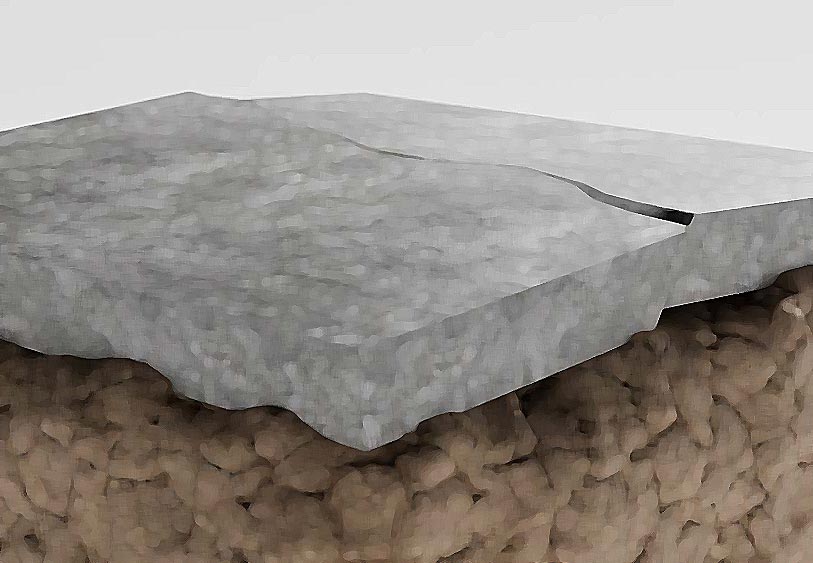
Expansive soils are natural clays that exhibit significant volume changes when subjected to moisture variations. These soils swell when they absorb water and shrink as they dry out. This movement causes uplift and subsidence, affecting the structural stability of buildings and infrastructure built on them. Expansive soils are widely encountered in arid and semi-arid regions and are known to cause distress in foundations if not properly accounted for during design and construction.
The volume change in expansive soils is a function of their mineral composition, primarily due to the presence of montmorillonite, a type of clay mineral with a high affinity for water. The soil’s plasticity, moisture content, density, and environmental conditions play a pivotal role in determining the extent of swelling or shrinkage.
Characteristics of Expansive Soils
- High Plasticity Index: Expansive clays typically exhibit plasticity indices above 20, indicating their ability to undergo large deformations with moisture change.
- Swelling Pressure: These soils generate considerable pressure during moisture intake, capable of lifting lightly loaded foundations.
- Moisture Sensitivity: Even minor changes in groundwater levels or surface water infiltration can lead to noticeable movement.
- Low Permeability: Despite absorbing water, expansive soils allow minimal water flow, leading to localized saturation and stress build-up.
- Development of Cracks: During dry seasons, the shrinkage leads to open cracks that may extend several meters deep.
Foundation Problems Caused by Expansive Soils
- Heaving of Foundations: Uplift forces cause plinth or floor slabs to rise unevenly, resulting in damage to internal finishes.
- Wall Cracks: Non-uniform soil movement transfers stress to masonry and RCC members, leading to horizontal and diagonal cracks.
- Loss of Structural Alignment: Over time, the cumulative effect of swelling and shrinkage can tilt or distort structural elements.
- Pavement Uplift: In road and airfield applications, expansive soils can cause bumps, ridges, and surface deterioration.
- Service Line Damage: Differential movements strain underground utilities, causing joint failures or misalignment.

Assessment of Soil Expansiveness
Proper site investigation is important before undertaking any construction on expansive soils. The following tests are commonly conducted:
- Free Swell Index (IS 2720 Part 40): Measures percentage volume increase in distilled water compared to kerosene.
- Swelling Pressure Test: Determines the pressure required to prevent swelling under confined conditions.
- Atterberg Limits: Helps classify the soil as low, medium, or high plasticity.
- Moisture Content and Dry Density: Indicates potential for volumetric changes during seasonal fluctuations.
- Grain Size Distribution: Fine content above 30% with high clay fraction often indicates expansive behaviour.
Mitigation Techniques for Expansive Soils
1. Soil Replacement
This technique involves excavation of expansive soil up to a certain depth (commonly 1.5 to 2.0 meters) and replacing it with non-expansive, compacted granular fill. It reduces the active zone but is suitable only when expansive layers are shallow.
2. Moisture Control Barriers
Water infiltration is restricted through surface drains, sloped paving, and impervious membranes around the structure. By maintaining a consistent moisture regime, the swelling-shrinkage cycle can be minimized.
3. Lime or Cement Stabilization
Adding 2–5% lime or cement to expansive soil initiates chemical reactions that reduce plasticity and improve load-bearing capacity. This method modifies the soil structure, making it less sensitive to moisture variation.
4. Use of Granular Mat and Sand Cushions
Granular mats or sand layers are placed below foundation slabs to absorb swelling movements and provide a flexible interface between the soil and structure.
5. Deep Foundations
Deep foundations are used to transfer loads beyond the active zone. Options include:
- Under-Reamed Piles: Feature enlarged bulbs to resist uplift and reduce settlement.
- Bored Piles or Drilled Shafts: Penetrate to stable strata and isolate the structure from expansive behaviour near the surface.
6. Void Form Techniques
A compressible layer (such as honeycomb cardboard or EPS) is placed below ground beams or slabs. It accommodates vertical movement due to swelling without transmitting stress to the structure.
7. Prewetting and Surcharge
Prewetting involves controlled wetting of the site to induce swelling before construction. Combined with surcharge loading, it causes early consolidation and reduces post-construction movement.
8. Floating Foundations
These foundations are designed such that the weight of the building equals the weight of soil removed. This approach balances the pressure and reduces differential movement in uniform expansive soils.

Suitable Foundation Types for Expansive Soil
- Isolated Footings on Granular Mats: Suitable for small structures with uniform load distribution.
- Raft Foundations: Distribute loads over a large area, reducing unit pressure on soil and allowing for minor movements.
- Pier-and-Beam Systems: Allow movement of individual supports without affecting superstructure continuity.
- Combined Pile-Raft Foundations (CPRF): Used in medium-rise structures for additional stability where both surface and deep soil behaviour are variable.
Engineering Guidelines and Code Provisions
In India, IS 9451:1994 provides guidelines for construction on expansive soils. It recommends:
- Limiting structure weight to minimize pressure on expansive soil.
- Avoiding shallow footings in high FSI zones.
- Adopting pile foundations where expansive soils extend to depths greater than 3 m.
- Use of surface protection to prevent moisture ingress.
Other relevant IS codes include:
- IS 2911 (Part 3): Design and construction of under-reamed pile foundations.
- IS 2720 (Part 5 & 40): Determination of liquid limit, plastic limit, and free swell index.
Precautionary Measures During Construction
- Avoid ponding of water near the foundation.
- Backfill using cohesionless soils wherever possible.
- Construct proper slope grading away from the structure.
- Use joint detailing in superstructure to accommodate minor movements.
- Monitor soil moisture during the curing and post-construction period.
Conclusion
Expansive soils present a unique set of challenges in geotechnical and foundation engineering. Without appropriate consideration during design and execution, these soils can significantly impact structural integrity. Through a combination of thorough geotechnical assessment, preventive design strategies, and effective construction practices, engineers can mitigate the adverse effects of expansive soil behaviour and ensure long-term structural performance.