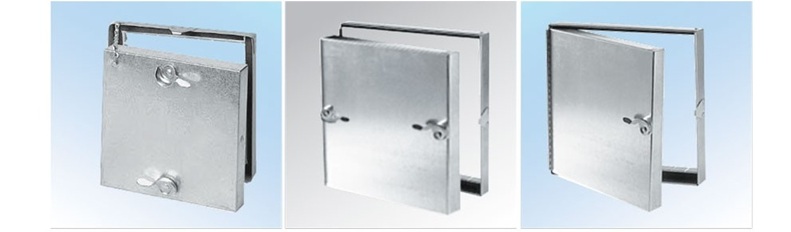
Every time you cut an opening in ductwork and add an access door, you’re creating a potential weak point. If you get the material wrong, that door can quickly turn into:
- An air leak that drives up fan energy use.
- A thermal bridge that increases condensation risk.
- A maintenance headache that makes routine inspections and damper testing hard.
Multiply that by every access point in a riser, plantroom, or ceiling void, and you’re no longer talking about a minor detail. You’re staring at comfort issues and scrutiny from inspectors.
To avoid that, you need to choose a low-leakage access door that lets you reach dampers, coils, and duct interiors without sacrificing air tightness, insulation performance, or safety. The material used to build that door is what makes the difference between a clean, low-leakage installation and a system that constantly works against itself.
In this article, we’ll walk you through why material choice matters in duct access doors and how features like galvanized steel construction, insulation, and gasketing are important for duct systems.
What Is a Duct Access Door?
A duct access door is a closable panel installed in sheet-metal ductwork that allows you to safely access the inside of the duct without cutting or dismantling it.
You’ll usually find these doors in areas where you need to:
- Inspect and test fire and smoke dampers.
- Reach coils, sensors, and controls in air-handling sections.
- Clean duct interiors and verify cleanliness for indoor air quality.
- Check for damage or debris in problem areas.
What Materials Are Most Commonly Used for Duct Access Doors?
The most common materials used to build duct access doors are galvanized steel for the door and frame, supported by aluminum and steel components for hinges and hardware.
Galvanized steel is usually the default choice for duct access doors and panels because it offers:
- A good balance of cost and durability.
- Compatibility with conventional sheet metal ductwork.
- Straightforward installation and detailing.
Typical construction features you’ll see on a well-designed galvanized duct access door include:
- Door and frame in galvanized sheet steel: Smaller doors (up to roughly 300 × 300 mm / 12″ × 12″) often use a lighter gauge, with larger sizes using a thicker gauge for added stiffness.
- Continuous aluminum piano hinge: A full-length hinge keeps the door aligned, spreads the load, and limits points of wear.
- Notched knock-over tabs or flanges: These tabs bend over the duct wall, helping you secure the frame quickly and evenly without resorting to improvised fastening.
Why Does Material Choice Matter for Duct Access Doors?
Material choice matters because it determines how the duct access door will perform over the life of the system.
Manufacturers often consider these four factors when determining the type of material to use for duct access doors:
- Structural durability: Will the door deform under system pressure or repeated use?
- Air and thermal performance: Will it hold a seal and limit thermal bridging so it’s not leaking air or creating cold spots?
- Fire and safety: Does the system or location call for specific fire-resistance or high-temperature performance?
- Corrosion resistance: Will the material tolerate humidity, cleaning regimes, and local conditions without rusting or pitting?
System pressure can also influence material selection because it dictates how robust the door and frame need to be.
In pressure-sensitive HVAC systems, a lightly framed door is more likely to flex under load. Once the leaf flexes, the gasket line breaks and it starts leaking air.
To avoid that, you should:
- Match the door gauge to the pressure class and size.
- Choose frames that resist bowing.
- Prioritize low-leakage details.
How Do Insulated Panel Cores and Gasketing Improve Energy Efficiency in Duct Access Doors?
Insulated panel cores and gasketing improve energy efficiency by controlling conduction through the access door and air leakage around the perimeter—two main ways ducts lose energy.
Many commercial buildings have running ducts that go through unconditioned spaces, along cold or hot plant rooms, and outdoors, where ambient conditions are far from room temperature.
If you use a plain sheet-metal door in those locations, you’ll create a cold (or hot) spot that:
- Loses more heat or cooling than the surrounding insulated duct.
- Drops below dew point and start sweating, which can stain ceilings or cause corrosion.
To counter this, you need to specify access doors with:
- A fiberglass or similar insulation core, often around 50 mm (2″) nominal thickness, compressed within the leaf.
- A known thermal resistance (R-value) so you can understand how it compares with the duct insulation.
When it comes to preventing air leakage, the access door needs a gasket that has:
- Closed-cell materials so it doesn’t soak up moisture.
- Adequate thickness and resilience to maintain contact over minor misalignments.
- Temperature and chemical resistance suited to the duct environment and cleaning regimes.
Wrapping It Up
The best duct access door material for commercial projects is the one that matches your system’s pressures, environment, and energy targets.
In most duct systems, this means using galvanized steel for the main door and frame. It is often paired with aluminum and other corrosion-resistant components at the hinge line and in the latching hardware, so the door operates smoothly and withstands regular use and cleaning.
When you’re unsure, it’s always worth checking with the access door manufacturer or a specialist to confirm that the construction materials indicated in the spec sheet will perform as expected years down the line.