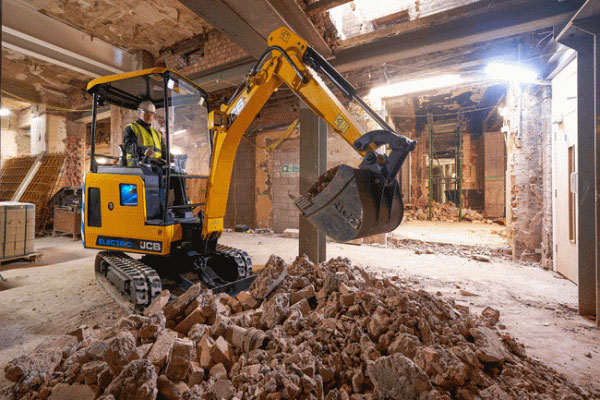
JCB won the 2020 MacRobert Award from the Royal Academy of Engineering for its 19C-1 electric excavator.
The MacRobert Award is a prize for innovation that has been presented since 1969 to honor a wide variety of engineering feats, including the CT scanner and Rolls-Royce’s Pegasus engine used in the Harrier jump jet, according to JCB.
Other finalists for the award were the all-electric I-PACE sports utility vehicle from Jaguar Land Rover and ecoSMRT liquid natural gas reliquification technology from Babcock’s LGE business, according to JCB.
“To win one of the world’s most respected engineering prizes is an outstanding endorsement for JCB’s electrification team, who have achieved so much in applying a science which was new to our business,” said JCB chairman Lord Bamford, in a prepared statement. “JCB’s electric mini excavator will contribute to a zero carbon future and it’s a huge honor for our contribution to be recognized in this way.”
Professor Sir Richard Friend FREng FRS, Chair of the Royal Academy of Engineering MacRobert Award judging panel, said in a statement:
“JCB’s electric digger is a huge engineering achievement. The team has developed all parts of the electric propulsion system to deliver system performance that matches real customer requirements. This is a huge achievement in itself, but the additional benefits of zero exhaust emissions and much lower noise has lifted the 19C-1E excavator to a new level.”
The 19C-1E electric excavator is the world’s first volume-produced fully electric mini excavator and with it, JCB says it has shown it is possible to make powerful construction machinery without an internal combustion engine. Hundreds of the machines have been sold and so far they have saved the equivalent of 33,290 lbs in CO2 emissions across 5,616 hours of work, according to the company.
As well as significantly reducing carbon emissions, the electric mini excavator has zero exhaust emissions and very low noise levels. This combination makes it much better suited than traditional construction equipment for operating inside buildings or in areas where noise must be kept to a minimum, for example near hospitals and schools and in cities where night shift work is often necessary.
Source: constructionequipment.com