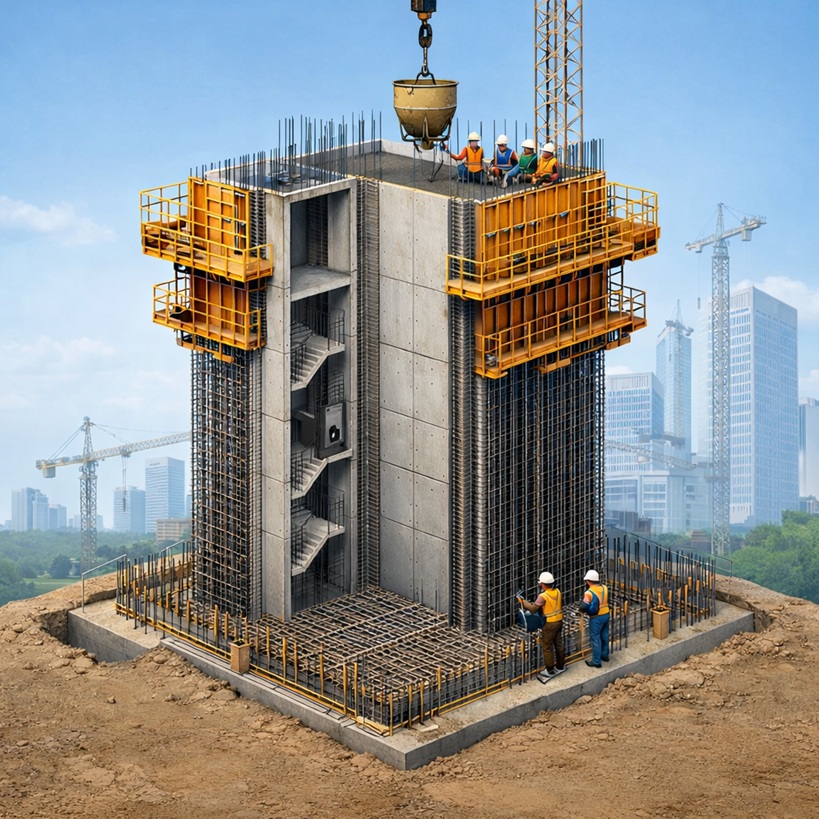
Tall buildings depend on core walls, which bear vertical loads and fight wind and seismic forces. They have service shafts, stairs, and elevators as well. A well-built core wall supports the stability of the structure while allowing effective integration of critical building systems.
Materials and Design Considerations
Usually constructed of reinforced concrete, core walls provide great fire resistance and strong compressive strength. Engineers use it with strong steel reinforcement to preserve wall thinness while boosting load capacity.
Prefabricated panels are increasingly used in modern high-rise developments to guarantee consistent quality and save time. Post-tensioning reinforces the core even further, therefore lowering the possibility of cracks and bending.
Common Construction Techniques
- Slip Form Construction: Teams cast concrete continuously using climbing formwork, suited for tall, repetitive cores.
- Jump Form Method: Forms move incrementally, allowing flexibility for mixed-use floors and unique core shapes.
- Prefabricated Concrete Panels: Off-site built panels guarantee accuracy and cut hand labor. Installing panels fast reduces manual labor.
- High-Strength Reinforcement: Strategic steel positioning offers effective load support without increasing wall thickness.
- Post-Tensioning: Tensioned cables help to stiffen the core against bending and deflection.
Planning and Coordination
- To avoid redesign or construction delays, align core walls with fire exits, HVAC ducts, plumbing, and elevators.
- Arrange wall casting in line with façade installation and floor slabs to preserve fluid flow.
- Check formwork alignment, rebar positioning, and concrete strength to guarantee long-term life.
- Put in safety precautions during pouring and curing to safeguard equipment and staff on site.
- For fractures, deflection, and correct load transfer, conduct periodic monitoring and testing all throughout construction.
Choosing the Right Technique
- Slip Form works best for uniform high-rise towers with tight schedules.
- Jump Form provides flexibility for complex cores or mixed-use floors.
Prefabricated Panels suit repeated sections where speed and consistency matter. - Post-Tensioning strengthens taller cores and enhances structural performance.
Selecting the method depends on building height, design complexity, and project timeline.
Structural Benefits
Building core walls properly elevates buildings, lowers building hazards, and guarantees long-term toughness. Engineers and consultants may maximize materials, scheduling, and safety while preserving the building for elevators, HVAC systems, plumbing, and other construction services.
Choosing the appropriate construction method guarantees that core walls can withstand vertical and lateral loads as well. Moreover, it helps seamless integration of important building systems and preserves stability throughout the lifetime of the structure.
Sustainability and Performance
Modern construction techniques help to advance environmentally friendly operations. Prefab panels cut on-site trash; high-strength concrete helps to minimize material consumption. Good task planning and sequencing reduce energy and manpower. Early cooperation among engineers, contractors, and inspectors lowers rework while preserving high standards for quality and safety.