
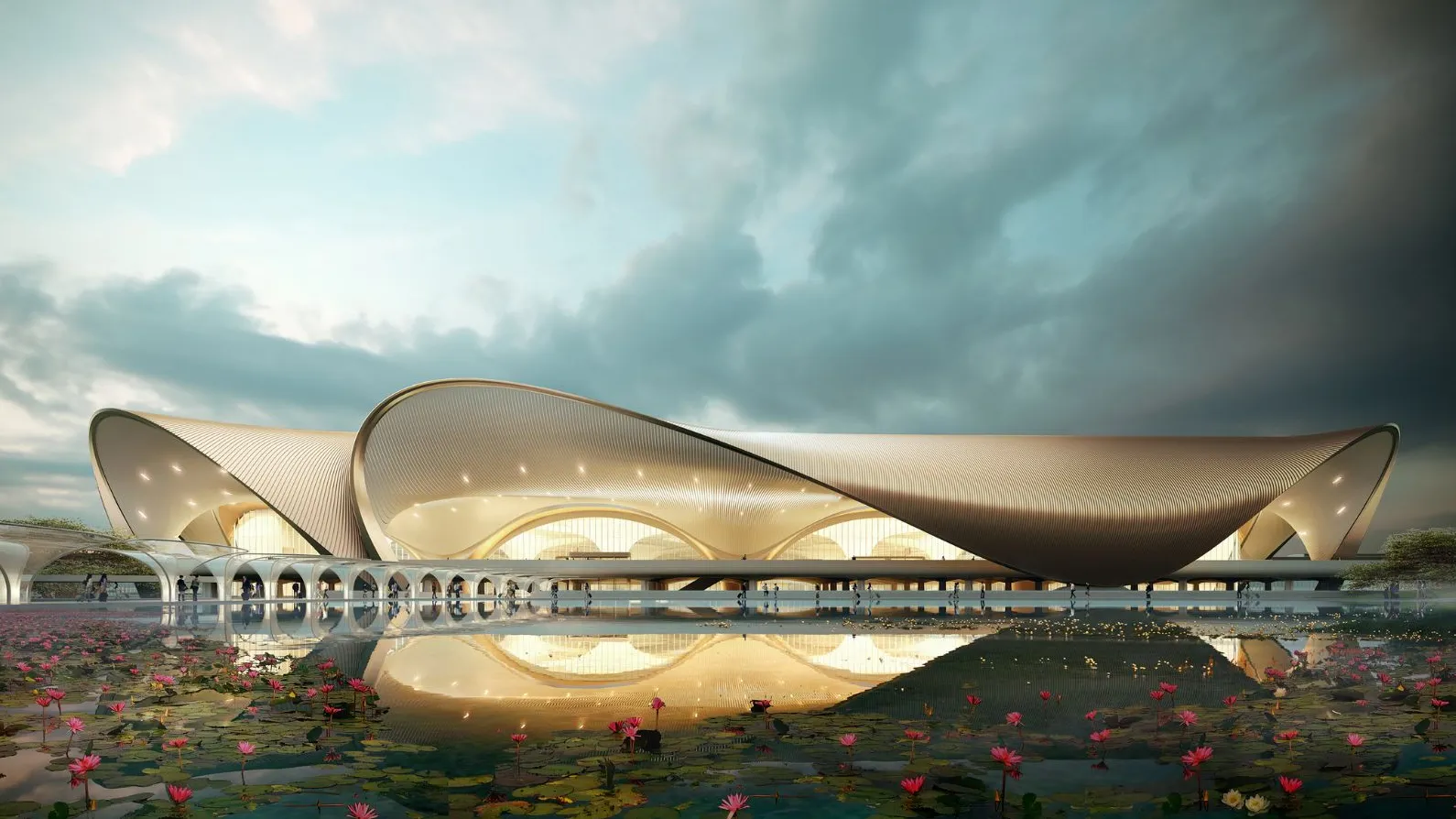
The Navi Mumbai International Airport (NMIA) is one of India’s most ambitious aviation developments — a project that combines engineering precision, large-scale urban planning, and architectural symbolism. Designed by Zaha Hadid Architects (ZHA) and developed by Adani Airports Holdings, the Rs 19,650-crore project is envisioned as a second major gateway to Mumbai, easing congestion at the existing Chhatrapati Shivaji Maharaj International Airport (CSMIA) and serving as a new model for Indian airport design.
A New Aviation Hub for the Mumbai Metropolitan Region
Located on a 1,160-hectare site in Ulwe, Navi Mumbai, the airport is strategically placed to serve the expanding Mumbai Metropolitan Region (MMR). Its location offers proximity to industrial clusters, port facilities, and new residential zones — linking aviation with regional economic growth.
The project’s first phase establishes the operational core, while later phases will expand capacity and functionality.

Phase 1 specifications include:
- Runway: One operational runway, 3,700 metres long
- Terminal: A single passenger terminal with capacity for 20 million passengers annually
- Check-in: 88 counters — 66 staffed and 22 self-service kiosks
- Zones: Three operational centres named Alpha, Bravo, and Charlie
- Cargo handling: 0.8 million metric tonnes per year
When all phases are complete, NMIA will include:
- Two parallel runways for simultaneous operations
- Four integrated terminals handling up to 90 million passengers annually
- A total cargo capacity expandable to 2 million metric tonnes
Design Philosophy: A Lotus That Rises Above the City
Zaha Hadid Architects’ design draws inspiration from India’s national flower — the lotus. The concept symbolises purity, renewal, and progress, while transforming a traditional motif into a modern engineering structure.
Architectural highlights:
- A floating steel-and-glass roof supported by 12 sculptural petal-shaped columns and 17 mega-columns designed to handle seismic and wind loads.
- The roof form creates a sense of levitation, allowing daylight to flood the concourses.
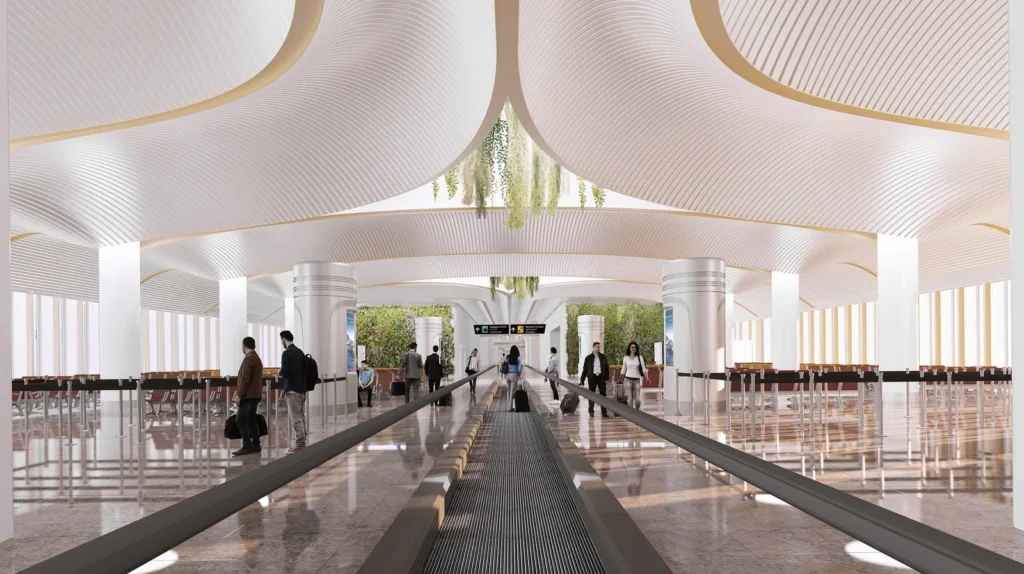
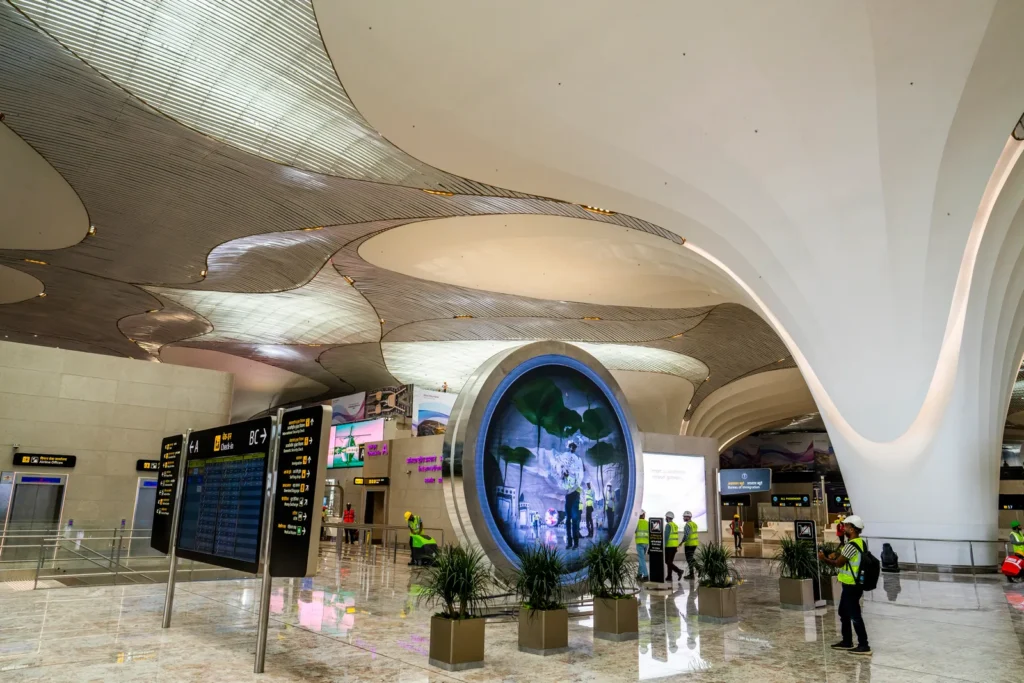
- The lotus pattern repeats in the floor geometry, column details, and terminal ceiling, uniting structure and symbolism.
The terminal’s visual composition aligns with ZHA’s global design language — organic, fluid, and futuristic — yet distinctly Indian in character. The design balances efficiency with an architectural narrative that speaks to India’s cultural identity and growing global stature.
Engineering and Sustainability
Behind the expressive form lies a technically advanced structure built for resilience and environmental performance.
Key engineering and sustainability measures include:
- High-strength steel framework engineered to meet international seismic standards.
- Energy-efficient glazing and shading to reduce heat gain while maximising natural light.
- Rainwater harvesting systems and recycled water loops for landscape irrigation.
- LED-based lighting and smart energy controls to optimise power consumption.
- Modular mechanical and baggage systems for scalability and future technology integration.
The integration of daylight and natural ventilation not only reduces energy costs but also enhances the passenger experience — creating bright, open spaces that feel connected to the environment.
The Passenger Experience: Seamless and Intuitive
NMIA’s terminal layout prioritises clarity, comfort, and flow. Each spatial element is designed to support an intuitive journey from entry to boarding.
Passenger-centric features include:
- Clear sightlines across check-in, security, and boarding areas to reduce confusion.
- Travelators and wide circulation zones for smooth pedestrian movement.
- Intuitive wayfinding through visible signage and digital navigation tools.
- Lounges, food courts, and retail clusters arranged along central concourses to maintain visual openness.
- Smart security and biometric check-in systems for faster processing.
The aim is to make travel efficient yet calm — a space where architecture enhances usability rather than overwhelming it.
Connectivity and Access
The airport’s success relies heavily on how well it connects to Mumbai and the surrounding regions. NMIA is envisioned as a multi-modal transport hub, integrating road, rail, and metro systems into a single framework.
Planned and existing connectivity initiatives:
- Mumbai Trans Harbour Link (MTHL): Provides direct road access to South Mumbai in under 30 minutes.
- Dedicated rail corridor: Connecting the airport to Panvel and the wider suburban network.
- Metro and shuttle integration: Future links with upcoming metro corridors for seamless urban access.
- Upgraded arterial roads and expressways for cargo and passenger traffic.
- Landscaped forecourt for smoother landside circulation and reduced congestion.
These connections ensure that NMIA will function not only as an aviation hub but also as a catalyst for regional mobility.
Phased Development and Execution
The project has progressed through multiple planning and implementation stages. Initially conceptualised under GVK and CIDCO, it transitioned to Adani Airports Holdings for execution and operations.
Development priorities across phases:
- Phase 1: Core terminal, runway, air traffic control, and basic cargo facilities.
- Phase 2: Expansion of passenger and cargo terminals, additional taxiways, and apron areas.
- Phase 3 and beyond: Second runway, satellite terminals, and enhanced multimodal access.
Construction has been synchronised with land acquisition, environmental management, and regional planning, ensuring minimal disruption and long-term sustainability.
Cultural Identity and Global Vision
Zaha Hadid Architects’ design philosophy extends beyond form — it reflects a dialogue between technology, culture, and identity. The lotus-inspired architecture symbolises India’s balance between tradition and innovation.
The design also mirrors ZHA’s earlier transport icons, such as Beijing Daxing International Airport and Baku Heydar Aliyev Centre, known for merging sculptural design with functional precision. In Navi Mumbai, this approach takes on a regional narrative — one that positions the airport as both a civic landmark and a modern infrastructure asset.
A Symbol of India’s Infrastructure Transformation
Beyond architecture, the Navi Mumbai International Airport represents how India is reshaping its approach to public infrastructure. It signals a shift from purely functional designs to integrated, people-centric, and environmentally responsive systems.
The project stands on three guiding pillars:
- Design and identity: A structure that visually represents India’s aspirations.
- Technology and performance: Integration of automation, sustainability, and digital efficiency.
- Regional development: A hub designed to stimulate trade, tourism, and employment across Maharashtra’s coastal belt.
At full scale, NMIA is expected to handle up to 90 million passengers annually and serve as one of Asia’s busiest and most advanced airports.
Conclusion
As India modernises its air transport infrastructure, NMIA showcases how design can contribute to both functionality and national identity. The lotus-inspired structure, its engineering precision, and its sustainable framework together represent a new era of Indian airport development — one that combines aesthetic integrity, operational intelligence, and cultural expression.
Image credit: NMIA/ZHA

