
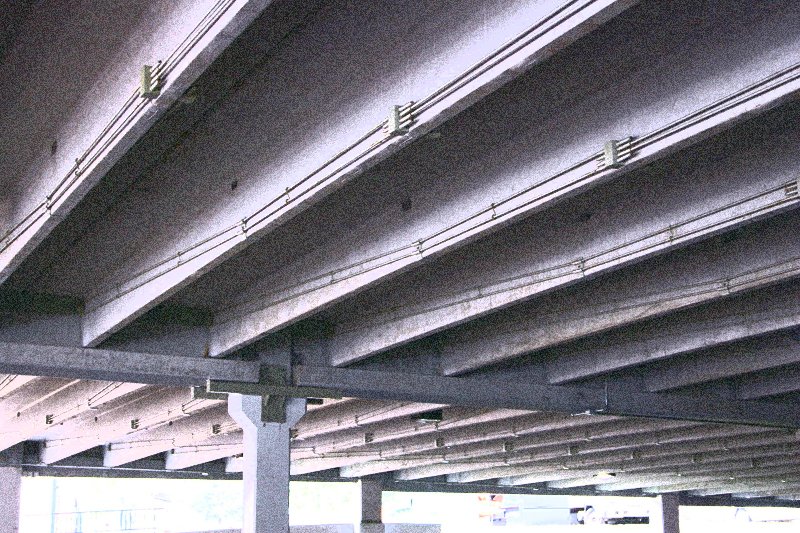
External post-tensioning (EPT) is a structural strengthening and load management technique used in reinforced concrete beams and slabs. Unlike conventional reinforced concrete, which relies solely on internal reinforcement to resist bending and shear, post-tensioning introduces high-strength steel tendons under controlled tension to counteract tensile stresses. External post-tensioning differentiates itself from internal post-tensioning by placing the tendons outside the concrete section, often in dedicated ducts or anchored externally, allowing for retrofit applications, easier inspection, and tendon replacement when necessary. This technique is increasingly applied in bridges, industrial buildings, multi-story structures, and slabs requiring enhanced load-carrying capacity.
Components of External Post-Tensioning Systems
- Tendons: The core of EPT systems, tendons are typically high-strength steel strands, bars, or wires designed to sustain tensile forces. External systems use strands with high ductility to allow controlled elongation and anchorage.
- Anchorages: End anchorages transfer the tensile force from the tendon to the concrete. Mechanical anchorages are common in external post-tensioning, providing reliable load transfer and adjustability.
- Ducts and Sheaths: While internal systems encase tendons within the concrete, external systems place them in metallic or polymeric ducts or channels attached to the concrete surface. This arrangement facilitates inspection, tension adjustment, and replacement if required.
- Stressing Equipment: Hydraulic jacks and tensioning devices are used to apply precise forces to the tendons. Calibrated gauges and load cells ensure that the correct pre-stress is achieved according to design specifications.
- Protection and Grouting: For durability, external tendons are coated with grease, epoxy, or similar corrosion protection materials and covered with sheaths or channels. Some designs allow grouting for additional protection and bonding.
Applications of External Post-Tensioning
- Bridge Girders and Decks: External post-tensioning is widely employed in highway bridges to increase span length, reduce member depth, and control deflection. External tendons can be replaced or adjusted, extending the service life of aging bridges.
- Industrial and Commercial Beams: In warehouses, factories, and industrial sheds, EPT allows for longer spans without increasing beam depth, facilitating unobstructed floor space for operations and machinery.
- Slabs on Ground and Elevated Slabs: Post-tensioning helps control shrinkage and temperature-induced cracking in floor slabs, particularly in large, flat surfaces such as commercial floors and airport hangars.
- Retrofit and Strengthening: Existing structures with inadequate load capacity or excessive deflection can be retrofitted using external post-tensioning, offering a minimally invasive solution compared to full section enlargement or reconstruction.
- Continuous Spans and Cantilevers: External tendons allow efficient load distribution in continuous beams and cantilevered slabs, improving structural performance under complex loading.

Advantages of External Post-Tensioning
- Provides additional load capacity without significant increase in member size.
- Reduces mid-span deflection and limits cracking in concrete.
- Facilitates inspection, maintenance, and tendon replacement.
- Suitable for retrofitting existing structures with minimal demolition.
- Allows flexible tendon layout, optimizing performance for variable load conditions.
- Enhances durability and service life by controlling tensile stresses.
- Enables longer spans, reducing the need for intermediate supports in industrial and bridge applications.
Types of External Post-Tensioning
External post-tensioning for beams and slabs can be classified into several types, each suited for specific structural requirements and applications.
Bonded External Post-Tensioning involves tendons placed in ducts attached to the concrete, which are subsequently grouted with cementitious or epoxy material. The bond between the tendon and grout provides partial force transfer along the tendon length, limits tendon movement, and offers long-term durability. This type is commonly used in bridge girders and continuous beams where both strength and service life are pivotal.
Unbonded External Post-Tensioning features tendons that are free to move within protective sheaths, relying solely on anchorages for load transfer. Tendons are greased and sheathed for corrosion protection, and the system allows for tendon replacement or adjustment. Unbonded EPT is particularly suitable for retrofitting existing beams and slabs or in industrial and commercial floors where flexibility is required.
Different Types of External Post-Tensioning Systems
Parallel Tendon Systems consist of tendons that run straight along the length of the beam or slab without significant draping. This arrangement efficiently resists uniform bending moments, simplifies installation, and reduces torsional effects. Parallel tendon systems are typically applied in parking decks, warehouse beams, and other structures with consistent load distribution.
Draped or Parabolic Tendon Systems use tendons arranged along a curved or parabolic profile to align with the bending moment diagram of the member. This configuration maximizes pre-compression where tensile stresses are highest, reducing cracking and deflection. Draped systems are commonly employed in bridge spans with mid-span sag and continuous beams with variable moment distributions.
Multi-Strand Systems group multiple strands in a single duct or channel, allowing staged tensioning and increasing load-carrying capacity. These systems provide redundancy, so if one strand fails, others can sustain the load. Multi-strand EPT is applied in large industrial beams, airport hangars, and heavy-duty commercial slabs.
Bar Systems use high-strength steel bars instead of strands, externally anchored along the member. Bars offer higher stiffness and reduced creep compared to strands, making them suitable for shorter spans or retrofit applications. Bar systems can also be combined with strands in hybrid configurations for enhanced performance.
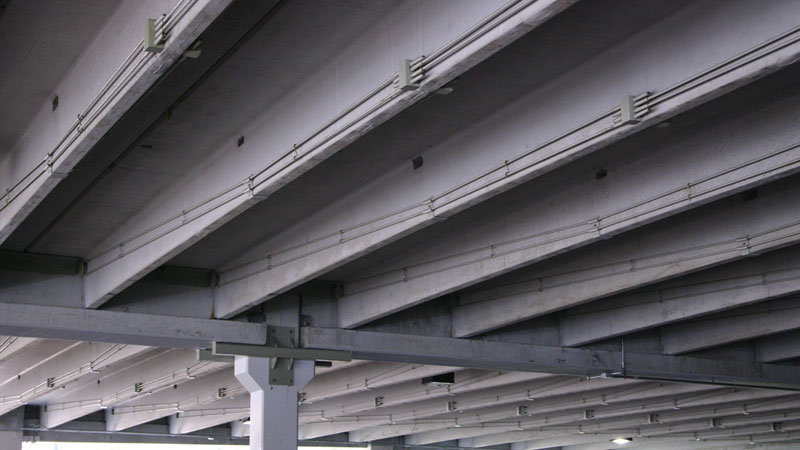
External Tendons in Protective Channels are placed in metallic or polymer channels attached to the concrete surface. These channels protect tendons from environmental exposure, facilitate inspection, and allow for easy maintenance or replacement. They are particularly suitable for exposed pedestrian bridges, elevated slabs, and industrial structures.
Hybrid Systems combine multiple external post-tensioning types, such as parallel bonded tendons with draped unbonded tendons, to optimize structural performance across different load zones. Hybrid EPT provides tailored responses, enhanced redundancy, and flexibility, and is typically used in long-span highway bridges, multi-story slabs, and complex industrial or commercial buildings.
Design Considerations for External Post-Tensioning
- Load Assessment: Determining the dead load, live load, and dynamic load effects is essential to define tendon size, layout, and tensioning forces.
- Tendon Profile: The alignment of tendons should follow the moment diagram of the beam or slab, typically draped to maximize pre-compression in regions of tension.
- Anchor Placement: End anchorage positions must provide adequate concrete cover, avoid congested reinforcement, and permit inspection and maintenance.
- Corrosion Protection: External tendons are exposed to environmental conditions; therefore, sheaths, coatings, and drainage measures must ensure long-term durability.
- Deflection Control: Tendon stress and layout must be designed to limit mid-span deflections and camber requirements, particularly for continuous spans.
- Interaction with Existing Reinforcement: For retrofit applications, EPT should account for pre-existing reinforcement, concrete cracking patterns, and local stress concentrations.
- Tendon Replacement and Adjustability: External tendons can be replaced or retensioned; designing for access and adjustability improves maintainability over the structure’s service life.
Standards and Guidelines
Design and execution of external post-tensioning systems follow standards such as:
- ACI 318 – Building Code Requirements for Structural Concrete.
- PTI (Post-Tensioning Institute) Recommendations for External Tendon Systems.
- IS 1343 – Indian Standard Code for Prestressed Concrete.
- Eurocode 2 – Design of Concrete Structures, including prestressing provisions.
These standards provide guidelines for tendon material properties, anchorage design, stress limits, tendon profile, and durability requirements.
Conclusion
External post-tensioning is an effective solution for enhancing the performance of concrete beams and slabs in new and existing structures. By introducing externally anchored tendons, engineers can increase load capacity, reduce deflection, control cracking, and extend service life. Its adaptability makes it suitable for bridges, industrial buildings, commercial floors, and retrofit applications. While it requires careful design, corrosion protection, and precise tensioning, external post-tensioning offers advantages in maintainability, flexibility, and performance that complement conventional reinforced concrete practices.
