

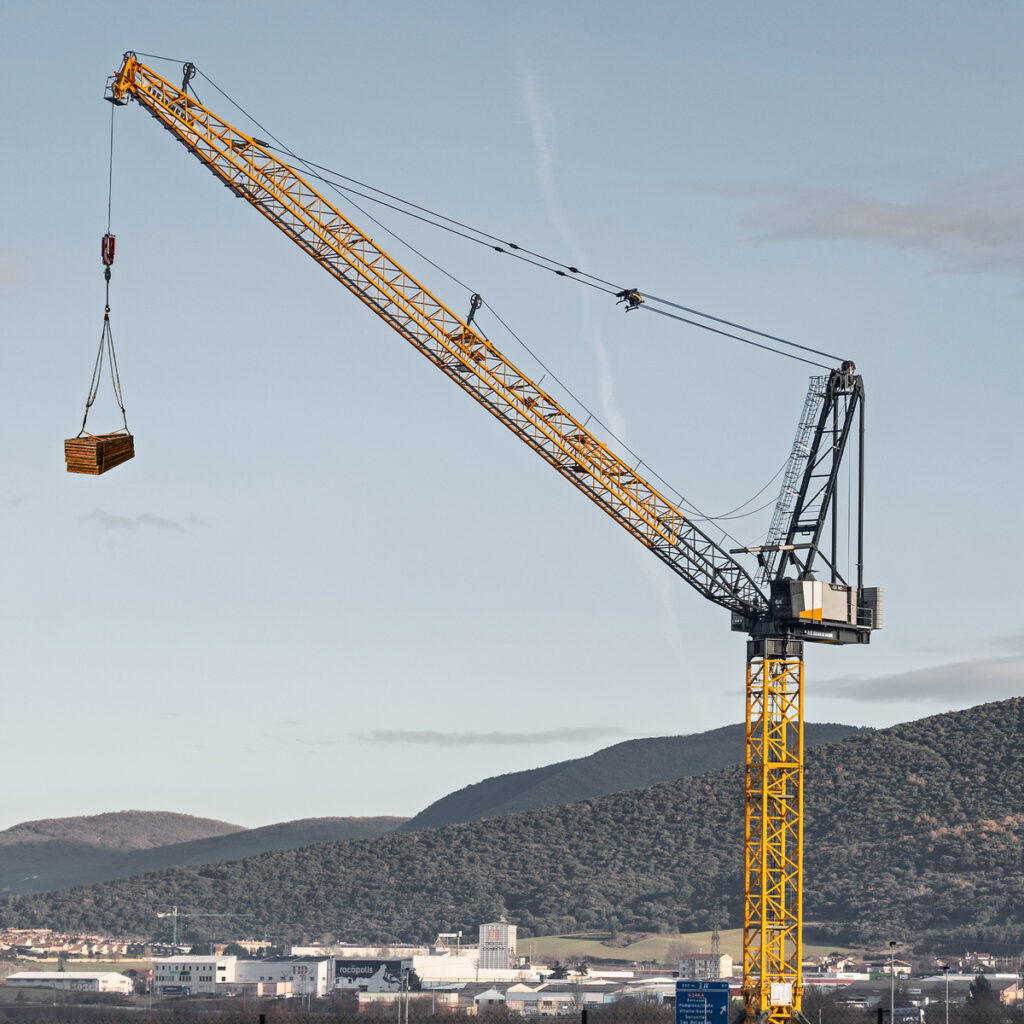
Luffing jib cranes are a specialized category of tower cranes designed to operate in urban and congested construction sites where limited working space and overlapping crane operations present significant challenges. Unlike conventional hammerhead tower cranes with fixed horizontal jibs, luffing jib cranes feature a pivoting jib that can be raised or lowered at varying angles. This capability allows contractors to minimize oversailing of surrounding properties, coordinate better with multiple cranes on the same site, and operate safely within confined airspace.
Key Components of Luffing Jib Cranes
- Mast Section – Vertical truss structure that provides height to the crane. Built from modular lattice sections for extension as building height progresses.
- Slewing Ring and Machinery Deck – Located at the top of the mast, this platform houses slewing motors, counterweight support, and electrical systems. Allows full 360-degree crane rotation.
- Luffing Jib – Articulated working arm that pivots at the jib foot. The angle of luffing (typically between 15° and 85°) enables load movement closer or further from the mast while reducing the out-of-service radius.
- Luffing Mechanism – Comprises winches, wire ropes, and hydraulic rams that adjust the jib angle. Controlled by operators for precise positioning of loads.
- Counter Jib and Counterweights – Shorter rear arm balancing the luffing jib. Houses counterweights, hoisting machinery, and control systems.
- Hoisting System – Winches, ropes, and hooks responsible for lifting and lowering loads. Designed with variable speeds to suit different load capacities.
- Operator Cabin – Ergonomically placed near the jib foot or on the slewing platform. Provides line-of-sight and control over hoisting, slewing, and luffing operations.
- Climbing Frame – Hydraulic climbing equipment that enables the crane to “grow” with the building. The mast is jacked upward, and new sections are inserted as the structure rises.
Applications of Luffing Jib Cranes
- High-Rise Buildings – Skyscrapers, residential towers, and office complexes in dense urban centers.
- Metro Rail Projects – Station construction and viaduct works where multiple cranes operate in limited space.
- Power Plants – Boiler house and turbine hall construction requiring heavy lifts within confined layouts.
- Industrial Plants – Refineries, cement plants, and steel factories with restricted crane placement areas.
- Mixed-Use Developments – Sites surrounded by existing properties where oversailing restrictions must be respected.
- Infrastructure in Urban Cores – Bridges, hospitals, and institutional projects located in compact city plots.

Advantages of Luffing Jib Cranes
- Reduced Out-of-Service Radius – Jib can be parked nearly vertical, minimizing obstruction to adjacent cranes and buildings.
- Improved Safety – Mitigates oversailing risks in restricted zones.
- Load Flexibility – Capable of handling heavy loads at shorter radii and lighter loads at extended outreach.
- Efficient Space Utilization – Operates effectively in sites where fixed-jib tower cranes are impractical.
- Height Adaptability – Climbing systems allow extension to great heights during skyscraper construction.
- Better Coordination – Multiple cranes can work simultaneously without collision by adjusting luffing angles.
- Precision Handling – Smooth winch control and jib articulation enable accurate material placement at height.
Types of Luffing Jib Cranes
1. Hydraulic Luffing Jib Cranes
Hydraulic luffing jib cranes use hydraulic cylinders to raise and lower the jib efficiently. Their faster luffing movements and compact counter-jib design make them ideal for urban construction projects where space is limited. These cranes consume less power and are easier to install, offering contractors both operational efficiency and flexibility.
2. Rope-Operated Luffing Jib Cranes
Rope-operated luffing jib cranes rely on wire rope systems and winches to articulate the jib. While their counter-jibs require more space, these cranes are highly reliable for heavy industrial lifting. They are a proven choice for long-duration projects and sites where robust lifting capacity and mechanical simplicity are critical.
3. Internal Climbing Luffing Cranes
Internal climbing luffing cranes are installed within the building core or elevator shaft. As each floor is cast, the crane climbs with the structure, saving external space and providing greater stability against wind loads. These cranes are particularly suited for super-tall buildings and projects where external clearance is minimal.
4. External Climbing Luffing Cranes
External climbing luffing cranes are mounted on the building’s exterior using tie frames. They are well-suited for towers with uniform geometry and projects that require multiple cranes at different heights. This design ensures stability and allows for efficient lifting throughout the building’s construction cycle.
5. Self-Erecting Luffing Jib Cranes
Self-erecting luffing jib cranes are smaller units designed for mid-rise buildings and refurbishment projects. They can be transported in fewer loads and quickly assembled on-site, making them ideal for constrained or temporary construction sites. Their compact footprint and rapid setup save both time and resources.
Selection Factors for Luffing Jib Cranes
- Site Constraints – Narrow sites or adjacent property lines requiring reduced slewing radius.
- Building Height – Determines mast sectioning, climbing system choice, and tie-in requirements.
- Load Characteristics – Maximum load weight, distribution of light versus heavy lifts, and lifting frequency.
- Project Duration – Long-duration projects may justify higher-capacity rope-operated systems, while short urban jobs may prefer hydraulic luffers.
- Wind and Weather Conditions – Wind loads influence jib articulation range and tie-in intervals.
- Crane Coordination – Number of cranes operating on site and their overlap zones.
- Operational Efficiency – Balance between lifting speed, luffing speed, and energy consumption.
- Maintenance and Serviceability – Availability of spare parts, local service support, and trained operators.
Conclusion
Luffing jib cranes provide a critical lifting solution for construction in restricted urban environments and high-rise projects. Their unique luffing capability ensures safe operation in areas with limited swing space, while their adaptability across load capacities, heights, and site conditions makes them a versatile choice for contractors. Careful selection based on project requirements, combined with proper maintenance and trained operation, ensures both productivity and safety. With advancements in automation, monitoring, and energy efficiency, luffing jib cranes are set to remain central to high-rise and infrastructure construction across projects.
Image Source: manitowoc.com, cranestodaymagazine.com

