
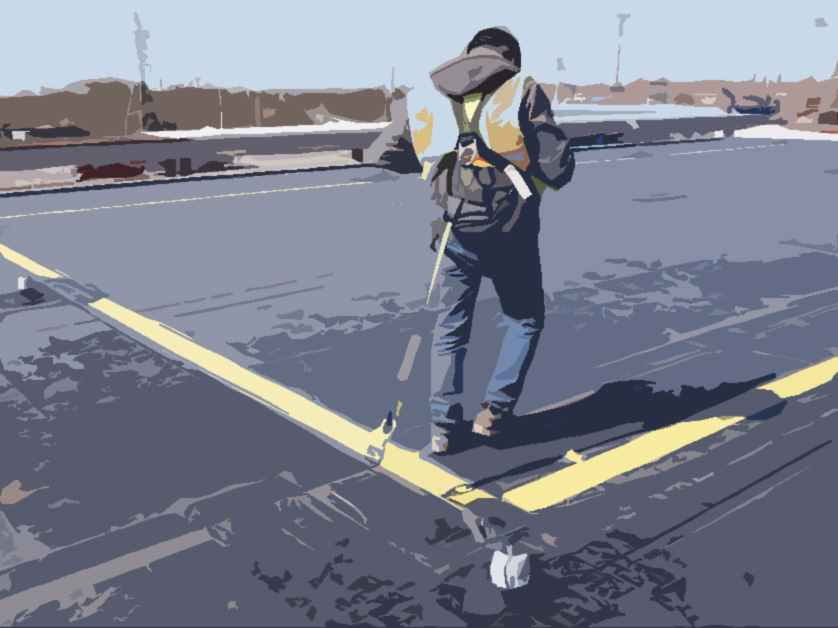
Fall protection is an essential aspect of occupational safety, particularly in construction, maintenance, and industrial operations involving work at height. Among the various categories of fall protection systems, such as fall arrest, fall prevention, and positioning systems—fall restraint systems serve a distinct role. Their primary function is not to arrest a fall once it begins, but to prevent the fall from occurring by limiting a worker’s movement within a predetermined safe area.
Fall restraint systems are designed to restrict a worker’s range of motion so that they cannot reach a fall hazard. Unlike fall arrest systems, which are activated only after a fall and must absorb the resulting energy, fall restraint systems are preventive. They are applicable in situations where physical barriers such as guardrails are not practical, and where fall arrest systems may present additional challenges or risks due to swing falls or limited fall clearance.
Key Components
A typical fall restraint system comprises the following components:
- Anchorage Point- A secure point of attachment for the lanyard, often located overhead or on a structural element rated for fall protection. It must be capable of withstanding a minimum static load as specified by safety regulations (often 1,000 lb or 4.5 kN for restraint).
- Body Support (Harness or Belt)- While a full-body harness is commonly used, in certain restraint applications, a body belt may suffice. However, body belts are not suitable for fall arrest and are used strictly in restraint systems.
- Connector (Lanyard or Restraint Line)- A fixed-length lanyard or adjustable line connects the body support to the anchorage. Its length is calculated to prevent the worker from reaching the fall hazard.
- Adjusters or Positioners- These allow workers to fine-tune the length of the lanyard or restraint line to fit different work areas or body positions.
- Warning Lines or Visual Markers (Optional)- Though not part of the primary fall restraint system, warning lines may be used in conjunction to mark restricted zones and reinforce awareness.
Applications of Fall Restraint Systems in Construction and Infrastructure
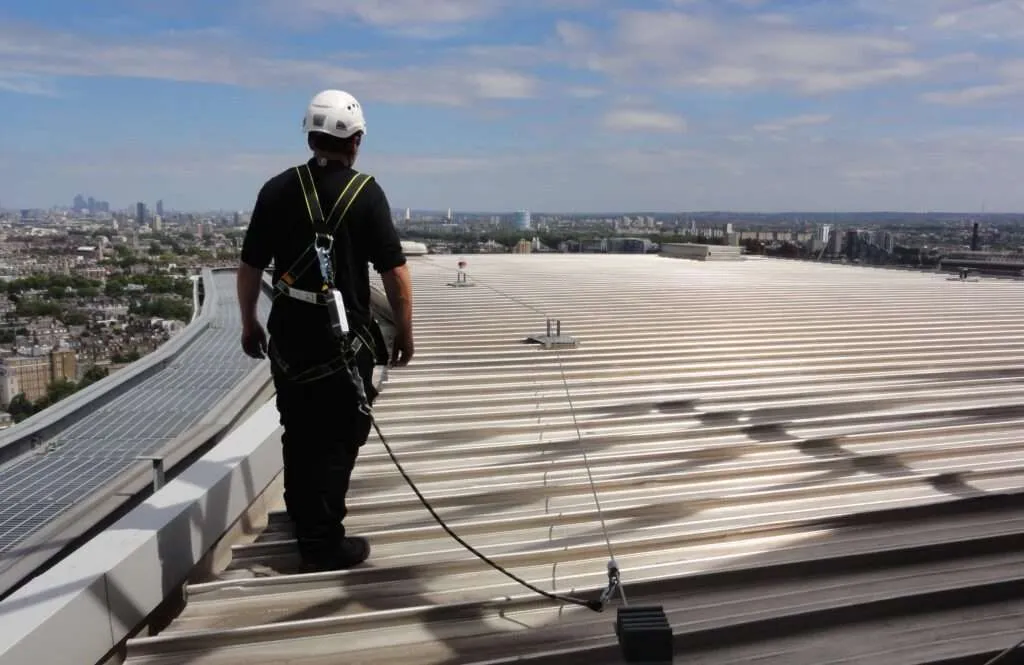
Fall restraint systems are commonly used in construction and infrastructure environments where workers are exposed to potential fall hazards but are not required to move freely near unprotected edges. These systems are designed to prevent a fall from occurring by physically restricting the worker’s range of movement.
- Work near unguarded roof edges during structural inspections, parapet installation, or waterproofing tasks.
- Elevated platform maintenance, such as servicing equipment on access platforms, scaffolds, or permanent structures.
- Bridge and flyover construction, where workers operate near edge zones during deck slab laying or expansion joint installation.
- Temporary work zones on highways or elevated structures, where edge protection is not yet fully installed but access is necessary.
- Tower erection and pylon work, especially when climbing ladders or working on catwalks at limited heights.
Common sectors in construction and infrastructure using restraint systems:
- Building construction (e.g., façade installation, roof flashing works)
- Metro and railway projects (e.g., viaduct maintenance, elevated station roof access)
- Power transmission infrastructure (e.g., substation roof access, switchyard maintenance)
- Highway and expressway works (e.g., noise barrier erection, signage installation on flyovers)
- Water and wastewater facilities (e.g., clarifier tank edge access, reservoir roof inspections)
Advantages Over Fall Arrest
While fall arrest systems are necessary where a fall hazard cannot be eliminated, fall restraint systems offer several advantages when feasible:
- Prevention-centric: Removes the risk of falling rather than mitigating its effects.
- Simpler recovery: No need for post-fall rescue procedures.
- Lower impact forces: No dynamic load is generated, reducing strain on equipment and structures.
- Fewer clearance requirements: No need to account for fall clearance below the working level.
Types of Fall Restraint Systems
Fixed-Length Restraint Systems
Fixed-length restraint systems use non-adjustable lanyards that are cut or configured to a specific length, ensuring that the worker cannot reach the fall hazard. This type of system is most effective in controlled environments with repetitive tasks, such as flat rooftops or platforms where the distance to the edge remains consistent. The key advantage is simplicity and reliability, as there are no moving components or adjustments that could compromise safety.
Adjustable Restraint Systems
Adjustable restraint systems allow the user to modify the length of the lanyard using manual or automatic adjusters, providing more flexibility for movement within safe boundaries. These systems are useful on sites where work zones change frequently, such as during façade installation, skylight access, or sloped roof work. While offering greater versatility, they require proper training to ensure the lanyard is adjusted correctly to maintain the restraint function.
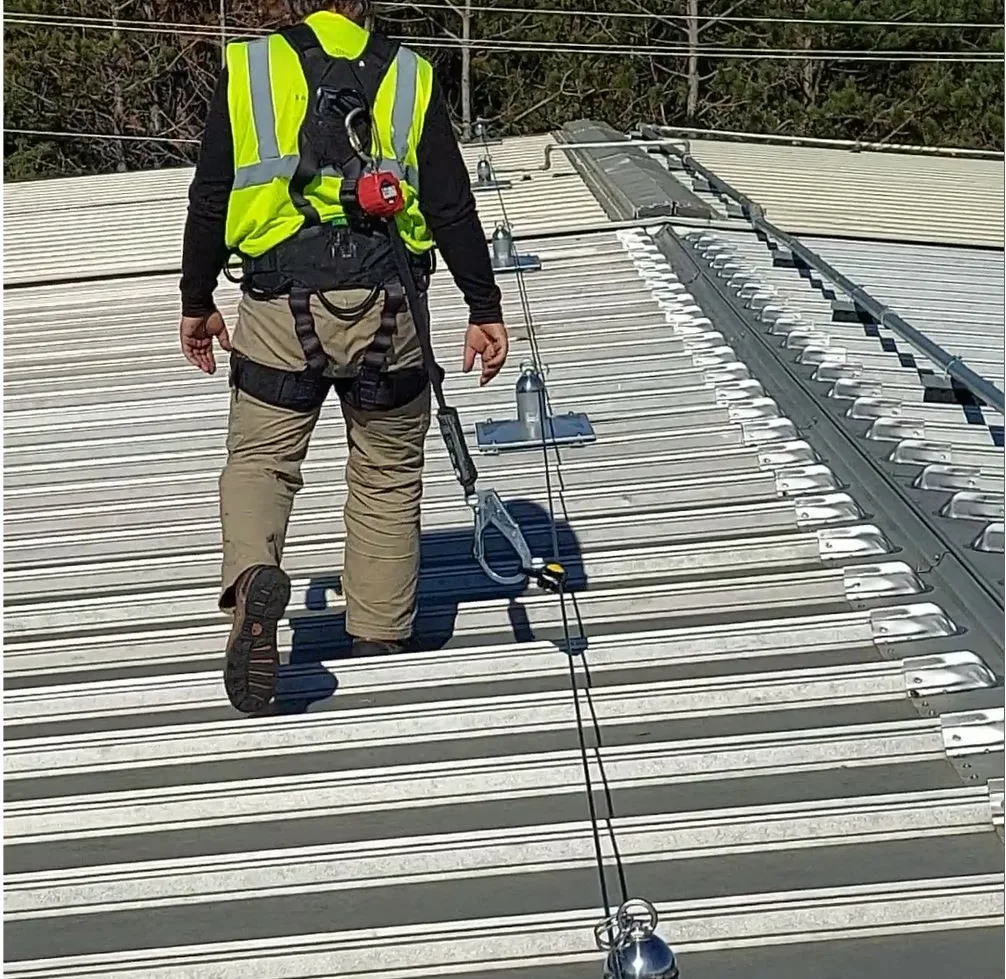
Horizontal Lifeline-Based Restraint Systems
Horizontal lifeline-based restraint systems are used when fixed anchorage points are not ideally located. In these setups, a horizontal lifeline (HLL) is installed along the work area, and workers attach a short lanyard to a movable anchor on the line. The HLL must be positioned and tensioned carefully so that even at full extension, the worker cannot reach the fall edge. This system is common on bridge decks, elevated corridors, and large roof spans where continuous protection along a linear path is needed.
Mobile Anchor Restraint Systems
Mobile anchor restraint systems involve temporary, non-penetrative anchorage points such as weighted bases or counterbalanced carts. These are typically used on flat rooftops or slab surfaces where permanent anchors are not feasible. The anchors are placed to limit the reach of connected lanyards, ensuring workers cannot access unprotected edges. Mobile systems are well-suited for short-term tasks like HVAC installation, solar panel alignment, or maintenance inspections on infrastructure rooftops.
Design and Layout Considerations
A fall restraint system’s effectiveness depends on careful site-specific design, taking into account:
- Distance from fall edge: The length of the connector must be less than the distance from the anchorage to the fall hazard.
- Anchor placement: Anchor points must be located such that swing falls or bypass of the restraint zone are not possible.
- User positioning: Restraint lines must be designed considering both reach and posture while working.
- Surface characteristics: Sloped or uneven surfaces may require reevaluation of restraint angles and anchorage locations.
Regulatory Framework
Fall restraint systems are governed by various national and international safety standards. In the United States, OSHA (Occupational Safety and Health Administration) provides guidelines under 29 CFR 1926 for construction and 1910 for general industry. Key considerations include:
- Restraint systems must be designed to prevent a fall rather than arrest one.
- Anchorage points for restraint must be capable of supporting a minimum of 1,000 lb (4.5 kN).
- Workers must be trained in proper use and limitations of the system.
ANSI Z359 (Fall Protection Code) also sets performance criteria and testing protocols for restraint components.
Inspection and Maintenance
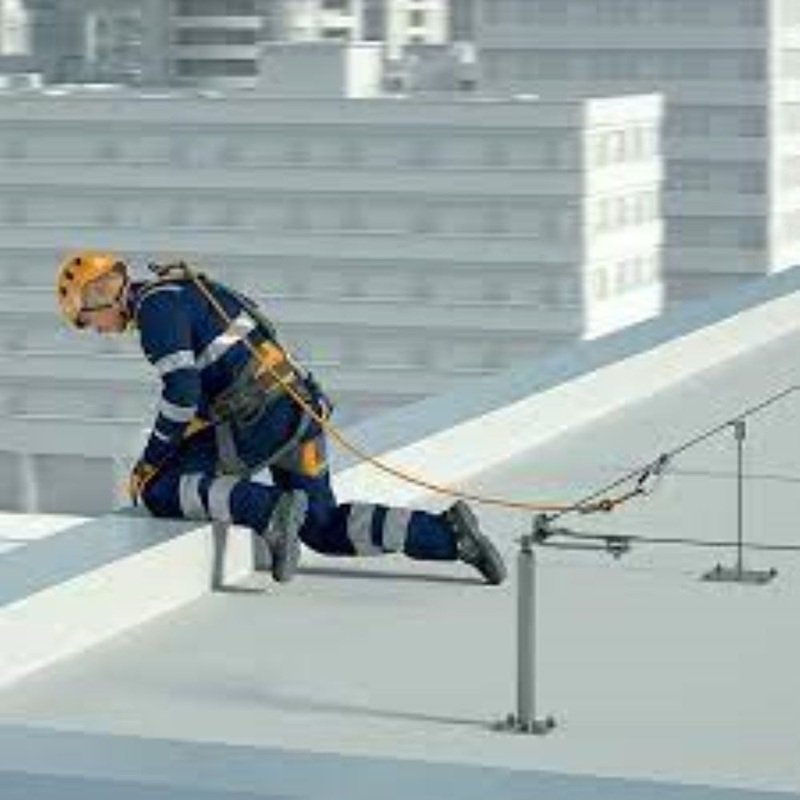
All components of a fall restraint system require regular checks, both prior to each use and during scheduled maintenance cycles. Areas to inspect include:
- Lanyard wear, fraying, or deformation
- Anchorage hardware corrosion or damage
- Adjuster functionality
- Harness integrity (webbing, stitching, buckles)
If any component fails inspection, it must be removed from service immediately. Maintenance records should be kept for traceability and compliance.
Conclusion
Fall restraint systems play an important role in occupational safety where fall hazards exist but can be managed by restricting worker access to hazardous edges. When implemented correctly, these systems help prevent falls entirely, reduce the need for complex rescue procedures, and simplify overall safety planning.
Their effectiveness depends on proper system design, correct placement of anchorage points, routine inspection, and thorough user training. Integrated as part of a comprehensive fall protection strategy, fall restraint systems offer a practical and preventive solution for working at height, minimizing risk by ensuring that workers remain within safe boundaries at all times.
