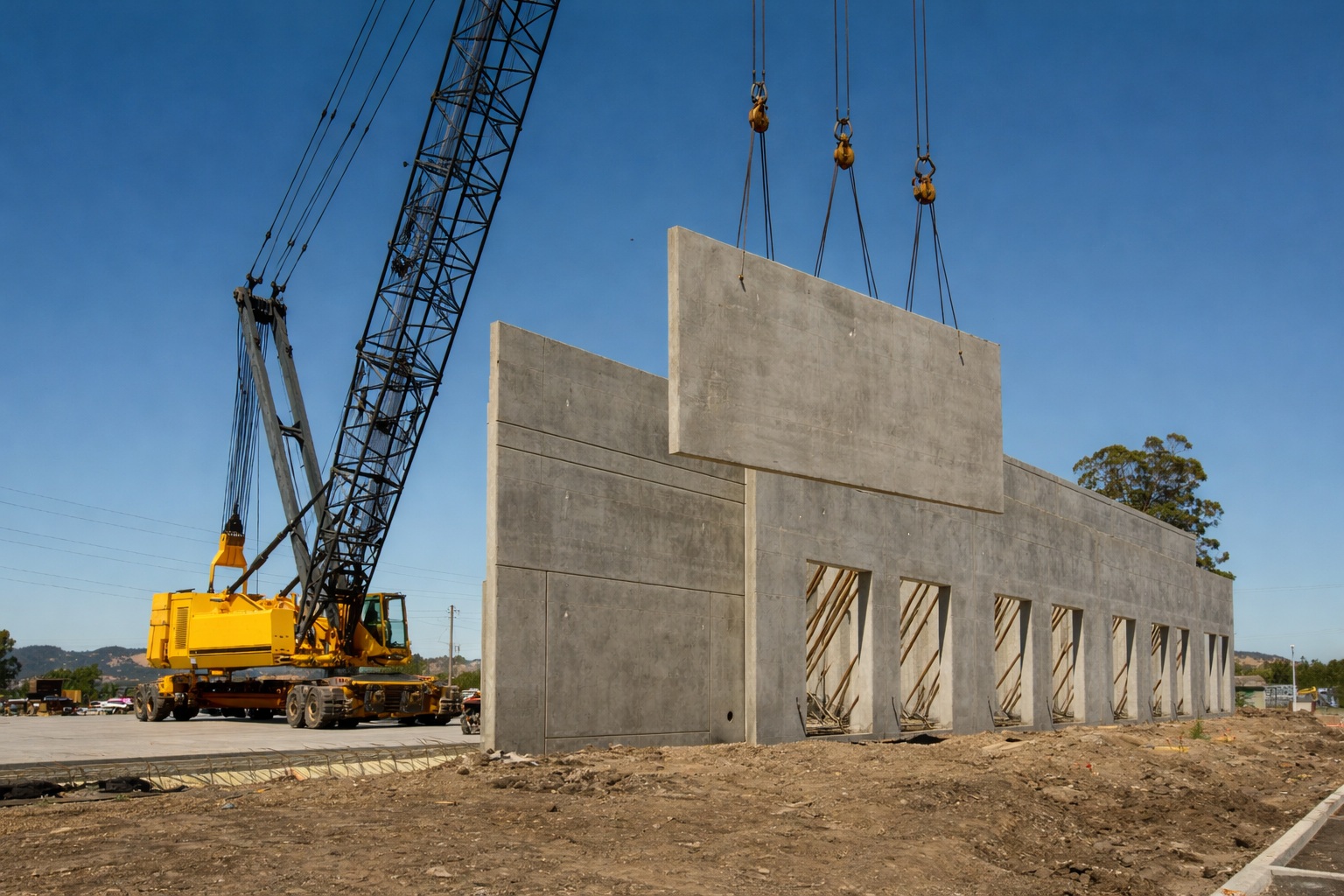
Tilt-up construction, also known as tilt-slab or panelized construction, has emerged as one of the most efficient and cost-effective methods for erecting large-scale commercial and industrial structures. This technique involves casting concrete panels horizontally on-site and then tilting them into a vertical position to form the walls of a building. Over the past few decades, tilt-up construction has become a preferred method for warehouses, distribution centers, retail spaces, and even residential complexes due to its speed, durability, and flexibility.
Understanding Tilt-Up Construction
Tilt-up construction is fundamentally a method of constructing concrete buildings by casting the structural walls on-site, usually on the building’s floor slab, and then lifting or “tilting” them into their final vertical positions. Unlike traditional concrete construction, where walls are poured in forms in their upright positions, tilt-up panels are created horizontally and then erected using cranes.
This approach allows for significant efficiency in terms of labor, materials, and time, particularly for large-scale projects with repetitive wall structures. The walls often include integrated architectural features, such as textures, colors, or embedded designs, making tilt-up construction not just functional but also aesthetically versatile.
History and Evolution
The tilt-up method dates back to the early 20th century in the United States, with its origins in California during the 1900s. Early applications were primarily for industrial buildings, warehouses, and agricultural structures. The method gained widespread attention in the 1950s and 1960s as concrete technology and crane equipment evolved, making it feasible to handle larger, heavier panels.
By the 1980s, tilt-up construction had expanded globally, particularly in countries like Australia, Canada, and parts of Europe. Innovations in formwork, concrete mix design, and lifting techniques have allowed architects and engineers to achieve taller, more complex structures with tilt-up panels.
The Tilt-Up Construction Process
Tilt-up construction involves several well-defined stages, each critical to the structural integrity and efficiency of the project. Here’s a step-by-step breakdown:
1. Site Preparation and Foundation Work
The first step in tilt-up construction is preparing the site. The building site is graded, leveled, and compacted to provide a stable foundation. A reinforced concrete slab, often called a “casting slab,” is poured on the building site. This slab serves as the formwork surface for casting the tilt-up panels.
Proper site preparation ensures that the panels are cast accurately, with minimal deviation, which is crucial when the walls are lifted into position.
2. Panel Design and Engineering
Tilt-up panels are designed based on structural and architectural requirements. Engineers calculate the panel thickness, reinforcement placement, weight, and lifting points. Panels may be solid, insulated, or incorporate windows and doors.
Modern computer-aided design (CAD) and Building Information Modeling (BIM) tools allow precise modeling of tilt-up panels, ensuring that every panel fits perfectly during erection.
3. Casting the Panels
Concrete panels are cast directly on the casting slab. Forms or molds define the edges and thickness of each panel. Reinforcing steel (rebar) is placed according to structural requirements. High-strength concrete is typically used, often with admixtures to improve curing time, workability, and durability.
Architectural finishes, such as textured patterns, colored concrete, or embedded materials, can be applied during casting. This step allows for significant aesthetic flexibility while maintaining structural efficiency.
4. Panel Curing
After casting, panels undergo a curing process to achieve the necessary strength before lifting. Proper curing ensures the concrete develops the required compressive strength and minimizes cracking. Depending on the mix and environmental conditions, curing can take from a few days to over a week.
5. Panel Lifting or “Tilting Up”
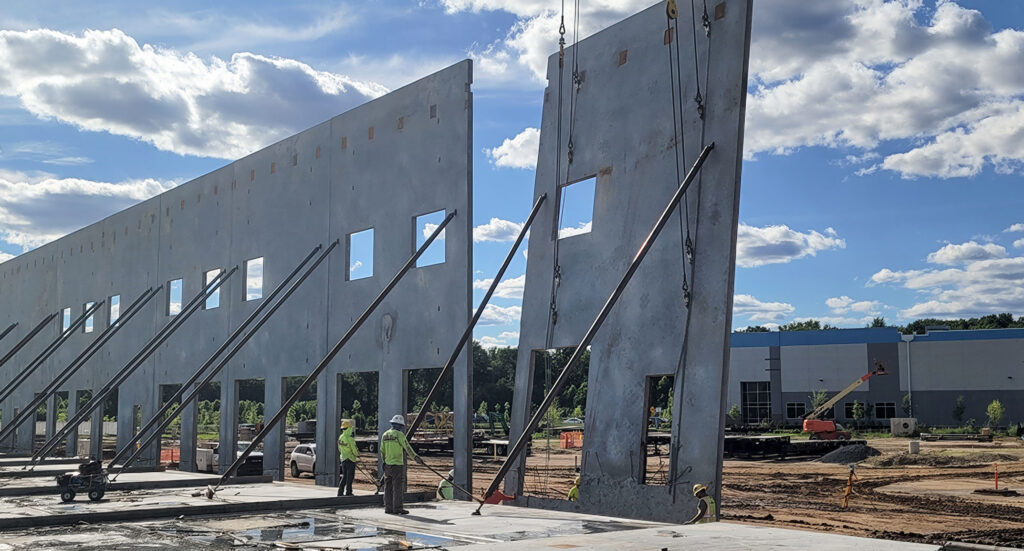
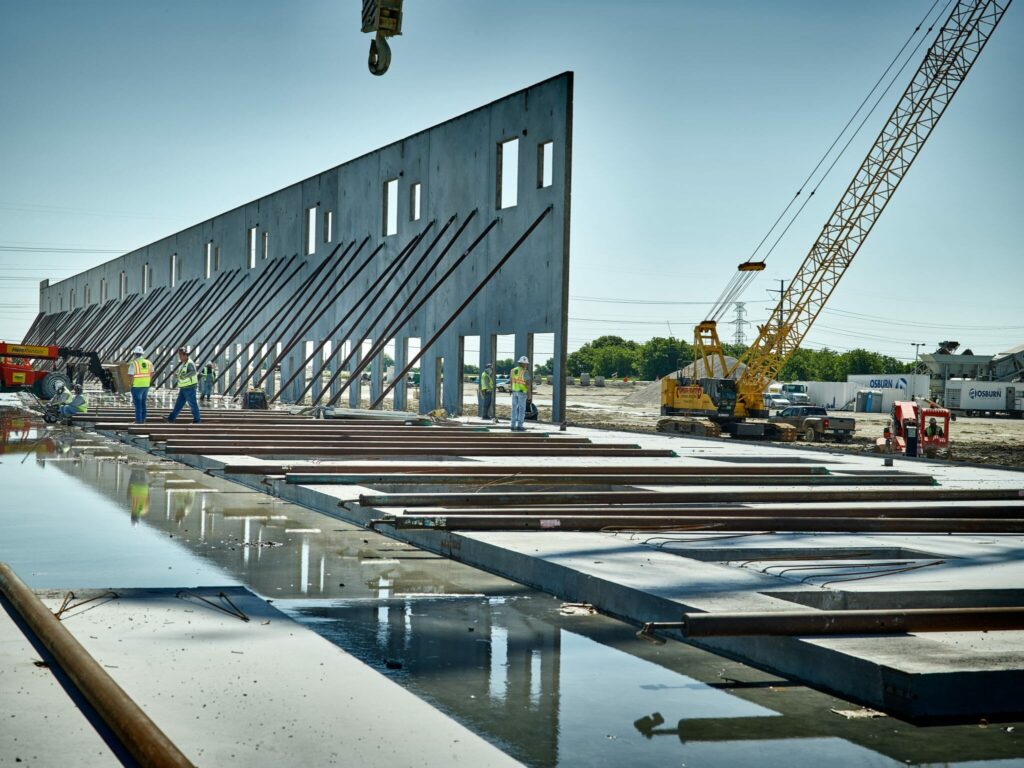
Once the panels reach adequate strength, cranes lift them from the horizontal casting slab to the vertical position. Temporary bracing supports the panels until they are permanently secured to the foundation or connected to adjoining panels.
Precision is critical during this stage; any misalignment can lead to structural issues. Advanced laser-guided positioning systems are often employed to ensure accurate placement.
6. Panel Connection and Structural Completion
After tilting, panels are anchored to the foundation and connected to each other, forming a rigid structural envelope. Steel embeds, welded connections, or concrete corbels are commonly used to ensure structural stability. Roof systems, flooring, and interior partitions are then installed, completing the building envelope.
7. Finishing and Detailing
Tilt-up panels can accommodate various finishes, including painting, stucco, cladding, or integrated insulation systems. Electrical and mechanical conduits can be embedded during casting, reducing post-construction work and improving overall efficiency.
Advantages of Tilt-Up Construction
Tilt-up construction offers several compelling advantages, making it increasingly popular in commercial, industrial, and institutional projects:
1. Cost Efficiency
Tilt-up construction significantly reduces labor and material costs compared to traditional masonry or pre-cast methods. Casting panels on-site eliminates transportation costs associated with precast panels, and the reduced need for complex scaffolding lowers labor expenses.
2. Speed of Construction
Because panels can be cast and cured simultaneously while foundation and other site work continue, project timelines are often shortened. Tilt-up projects can be completed in weeks rather than months, providing a faster return on investment.
3. Structural Durability
Concrete tilt-up panels are inherently strong, fire-resistant, and durable. Properly reinforced and cured, they can withstand seismic loads, high winds, and extreme weather conditions, making them ideal for industrial and commercial buildings.
4. Architectural Flexibility
Tilt-up panels are highly customizable. Architects can incorporate windows, doors, textured surfaces, and colored concrete during casting. This flexibility allows for creative designs without compromising efficiency or cost-effectiveness.
5. Sustainability
Tilt-up construction can be environmentally friendly. Using locally sourced materials, minimizing transportation, and reducing construction waste contribute to a lower carbon footprint. Additionally, concrete panels have high thermal mass, improving energy efficiency for heating and cooling.
Challenges and Considerations
While tilt-up construction is highly advantageous, it comes with challenges that must be carefully managed:
1. Site Requirements
Tilt-up construction requires ample space for casting slabs and maneuvering cranes. Urban sites with limited space may not be ideal for this method, necessitating alternative approaches or modifications.
2. Panel Cracking and Warping
Improper curing, shrinkage, or uneven loading can cause cracking or warping of panels. Engineers must consider these factors during design and curing to ensure long-term structural integrity.
3. Skilled Labor and Equipment
Despite its efficiency, tilt-up construction requires skilled labor for panel casting, lifting, and placement. Access to cranes and lifting equipment capable of handling large panels is essential.
4. Limited Height Without Special Techniques
Standard tilt-up panels are limited in height due to weight and lifting constraints. For taller structures, specialized lifting techniques or post-tensioned systems may be required.
Applications of Tilt-Up Construction
Tilt-up construction is versatile and increasingly popular across several sectors:
1. Industrial and Warehousing Facilities
Large warehouses, distribution centers, and logistics hubs benefit from tilt-up construction due to the method’s efficiency and ability to create expansive, unobstructed floor spaces.
2. Retail Buildings
Retail stores and shopping centers often use tilt-up panels for their structural walls, allowing for rapid construction while maintaining attractive exterior finishes.
3. Institutional Buildings
Schools, community centers, and government buildings have adopted tilt-up construction for its durability, cost-effectiveness, and ability to accommodate large, open interiors.
4. Residential and Multi-Family Housing
While less common, tilt-up techniques are being adapted for residential complexes, particularly where modular construction and fast-track schedules are desirable.
Innovations and Future Trends
The tilt-up construction industry continues to evolve with new technologies and materials:
- High-Performance Concrete: Advanced concrete mixes allow thinner panels without sacrificing strength, reducing material usage and weight.
- Precast-Tilt Hybrid Systems: Combining tilt-up with precast components offers flexibility in urban settings.
- Digital Engineering and BIM: Computer-aided design and simulation optimize panel layouts, lifting sequences, and structural performance.
- Sustainable Practices: Recycled aggregates, low-carbon concrete, and energy-efficient designs enhance the environmental sustainability of tilt-up projects.
These innovations are making tilt-up construction more versatile, attractive, and environmentally responsible.
Conclusion
Tilt-up construction represents a paradigm shift in building design and execution. By casting panels horizontally and lifting them into position, this method offers a unique combination of speed, cost-efficiency, durability, and architectural flexibility. From industrial warehouses to retail centers and beyond, tilt-up construction has proven its value across a wide spectrum of applications.
As technology advances, the potential for tilt-up construction continues to expand. Innovations in concrete technology, lifting methods, and digital modeling promise to make tilt-up an even more efficient and sustainable construction method in the coming years. For builders, architects, and developers seeking faster construction timelines, lower costs, and robust structures, tilt-up construction offers a compelling solution that bridges practicality with design versatility.
Image Credit: generalcontractor.com, peakconstruction.com