
Structural defects are more than surface-level imperfections. They often indicate deeper issues within a building’s load-bearing system, materials, or construction practices. If left unattended, these defects can compromise safety, accelerate deterioration, and significantly increase repair costs. Early identification and timely intervention are critical to preserving structural integrity and extending a building’s service life. Understanding the most common warning signs helps engineers, contractors, and facility managers take corrective action before minor issues escalate into major failures.
Major Structural Defects Requiring Immediate Attention
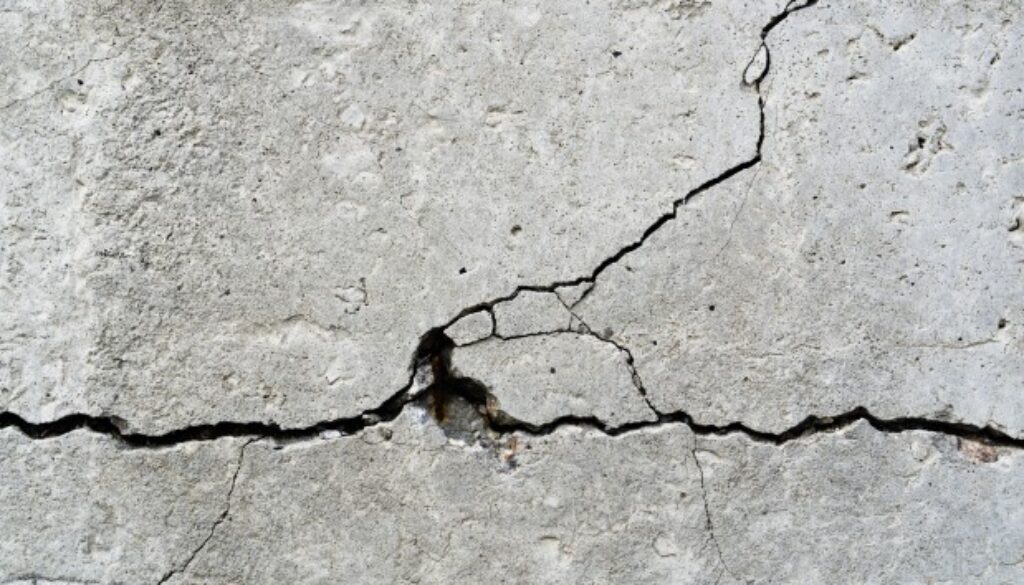
Structural Cracks
Cracks are among the earliest and most visible indicators of distress. While hairline cracks may result from shrinkage or temperature variation, wider or propagating cracks often signal structural movement or overloading. Diagonal cracks near openings, vertical cracks in load-bearing walls, or widening cracks in beams and slabs may indicate foundation settlement, differential movement, or inadequate reinforcement. Such cracks demand immediate structural assessment to prevent progressive failure.
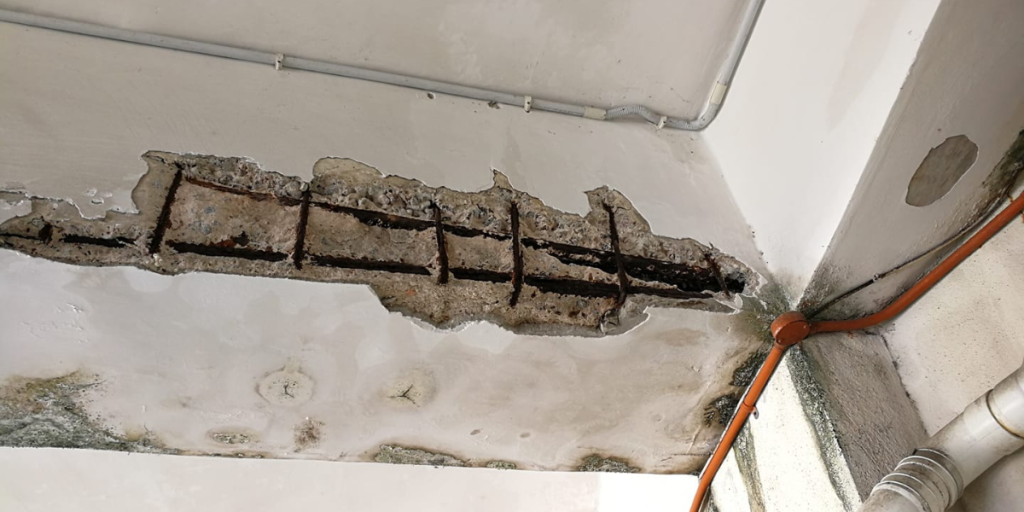
Concrete Spalling and Reinforcement Corrosion
Concrete spalling occurs when steel reinforcement corrodes and expands, causing the surrounding concrete cover to crack and detach. This defect is commonly found in coastal environments, basements, parking structures, and bridges exposed to moisture and chlorides. Spalling reduces the effective cross-section of structural members and exposes reinforcement to further corrosion, accelerating deterioration. Prompt repair is essential to restore load capacity and prevent cascading damage.
Excessive Deflection and Structural Deformation
Visible sagging of slabs, beams, or cantilevers indicates overstressing or long-term creep. Excessive deflection affects not only structural safety but also serviceability, leading to cracked finishes, misaligned doors, and uneven floors. Causes may include design errors, material fatigue, or unauthorized load additions. Immediate investigation is required to determine whether strengthening or load reduction is necessary.
Foundation Settlement and Differential Movement
Uneven settlement manifests as stepped cracks in masonry, sloping floors, or gaps between structural elements. It often results from weak soil conditions, poor compaction, water ingress, or changes in groundwater levels. Differential settlement can severely distort the structural framework, making early stabilization and underpinning critical to avoid irreversible damage.
Water Seepage and Damp-Induced Damage
Persistent water ingress weakens concrete, corrodes steel reinforcement, and degrades masonry. Damp patches, efflorescence, mold growth, or peeling finishes often indicate hidden moisture pathways. Over time, water-related defects reduce structural strength and durability. Immediate waterproofing and drainage correction are necessary to halt further deterioration.
Joint Failure and Loss of Structural Continuity
Expansion joints and construction joints accommodate movement and thermal expansion. Failure of these joints—through cracking, separation, or sealant breakdown—can transfer unintended stresses to structural members. This may lead to cracking or deformation in adjacent elements, requiring urgent joint rehabilitation and structural review.
Consequences of Delayed Intervention
Delaying corrective action on structural defects significantly increases the risk of accelerated deterioration and system-wide failure. What begins as a minor crack, localized corrosion, or slight settlement can progressively spread across interconnected structural components. Over time, stress redistribution caused by unresolved defects leads to secondary damage in beams, slabs, columns, and foundations, multiplying both the scope and cost of repairs.
Moisture-related defects are particularly damaging when ignored. Continued water ingress promotes reinforcement corrosion, concrete delamination, mold growth, and loss of material strength. In reinforced concrete structures, corrosion-induced expansion reduces bond strength between steel and concrete, weakening load transfer mechanisms and increasing the likelihood of sudden structural distress under normal service loads.
Delayed intervention also compromises building serviceability and occupant safety. Uneven floors, excessive deflections, misaligned doors and windows, and falling concrete fragments pose direct hazards to users. In commercial and public buildings, such conditions may lead to restricted access, regulatory non-compliance, and forced shutdowns, resulting in operational losses and reputational damage.
Advantages of Early Detection and Repair
- Preserves structural safety and load-bearing capacity
- Reduces long-term maintenance and rehabilitation costs
- Prevents progressive deterioration of materials
- Extends the service life of buildings and infrastructure
- Ensures compliance with safety and building regulations
- Minimizes disruption to occupants and operations
Common Repair and Intervention Strategies
- Crack Injection and Stitching – Restores continuity and strength in cracked members
- Concrete Repair and Recasting – Replaces damaged or spalled concrete sections
- Corrosion Protection Systems – Slows or halts reinforcement corrosion
- Structural Strengthening – Enhances capacity using jacketing, fiber reinforcement, or steel plates
- Foundation Stabilization – Addresses settlement through underpinning or ground improvement
- Waterproofing Systems – Prevents moisture ingress and associated deterioration
Conclusion
Structural defects are early warning signals that demand prompt attention. Cracks, spalling, deformation, settlement, and water ingress are not merely cosmetic issues but indicators of deeper structural distress. Immediate investigation and intervention help safeguard structural integrity, protect occupants, and optimize lifecycle costs. Proactive maintenance and timely repairs remain the most effective strategies for ensuring long-term performance and safety in buildings and infrastructure.
Info- concrete.org, fema.gov
