
What is Accelerated Concrete?
Accelerated concrete is a type of concrete in which the natural process of setting, hardening, and strength development is deliberately increased to achieve results within a reduced time frame. The acceleration is achieved through the use of chemical admixtures, controlled heat curing, optimized mix proportions, or a combination of these techniques. By promoting faster hydration reactions within the cement matrix, accelerated concrete provides the required structural performance more quickly, allowing construction processes to advance without extended waiting periods.
Why is Acceleration in Concrete Required?
The requirement for accelerated concrete arises from practical demands in the construction industry.
- Time-bound projects: Infrastructure projects such as bridges, highways, and metro works often follow strict timelines where delayed curing would disrupt schedules.
- Rapid repair works: Emergency repairs in pavements, airfields, or industrial floors demand materials that can be put to service quickly.
- Cold weather concreting: Acceleration counters the slower hydration rate at low temperatures, ensuring early strength gain.
- Precast industry: Accelerated curing allows faster turnover of molds, enhancing production efficiency.
- Early load application: In structures where scaffolding, traffic, or machinery needs to be placed early, accelerated strength development becomes necessary.
Applications of Accelerated Concrete
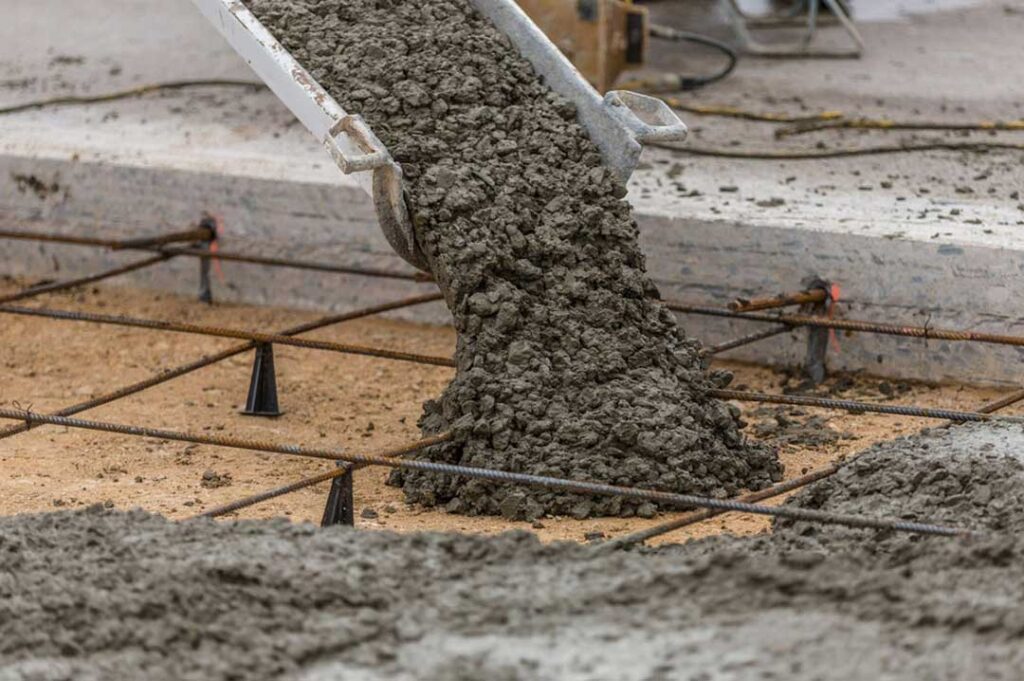
Accelerated concrete finds wide applications across construction sectors.
- Precast Components: Beams, slabs, pipes, poles, and wall panels benefit from early demolding and rapid turnover.
- Shotcrete Works: Tunnel linings, slope stabilization, and underground works often require accelerators to achieve immediate setting.
- Highway Repairs: Pavement slabs and expansion joints repaired with accelerated concrete can reopen to traffic within hours.
- Airfield Runways: Rapid construction and repair of airstrips depend on accelerated mixes to reduce downtime.
- Industrial Floors: Areas requiring minimal interruption to operations rely on fast-track concreting methods.
- Cold Weather Construction: Accelerated concrete ensures timely strength development despite low ambient temperatures.
- Bridge Decks and Metro Projects: Accelerated mixes reduce construction cycle time and improve project delivery.
Advantages of Accelerated Concrete
- Reduced formwork cycle time.
- Early application of loads.
- Faster repair and rehabilitation of structures.
- Useful for emergency construction.
- Supports precast industry productivity.
- Effective solution in cold climates.
Types of Accelerated Concrete
Accelerated-Setting Concrete
Accelerated-setting concrete is developed to shorten the initial and final setting times of cement. This type is particularly useful in cold weather conditions or where formwork must be removed early. The acceleration is achieved by incorporating setting admixtures such as calcium chloride, calcium nitrate, sodium thiocyanate, or alkanolamines, which speed up the hydration reaction of cement compounds. It is commonly applied in road repairs, precast elements, and construction projects that require rapid finishing and early structural continuity.
Accelerated-Hardening Concrete
Accelerated-hardening concrete is designed to achieve higher strength within a short duration compared to ordinary concrete. This is accomplished by using rapid-hardening Portland cement, steam curing, or chemical admixtures that promote faster hydration. It is widely used in the precast industry where production cycles need to be shortened, as well as in tunnel linings, bridge deck slabs, and situations that require structures to be put into service quickly. By gaining strength rapidly, it allows formwork turnover and construction scheduling to be optimized.
Accelerated-Strength Concrete
Accelerated-strength concrete targets the early development of compressive strength, sometimes achieving the seven-day strength of ordinary concrete within just one to three days. This is obtained through the use of high early-strength cement, low water–cement ratios, chemical accelerators, and controlled curing techniques such as steam treatment. It is often employed in fast-track projects, structures requiring early loading, and pavements or bridges that need to be opened to traffic within a short timeframe. Its role is pivotal in projects where early strength is more important than ultimate strength.
Heat-Cured Accelerated Concrete
Heat-cured accelerated concrete relies on the application of external heat to promote early hydration and strength gain. The curing can be performed using steam at atmospheric pressure, high-pressure steam curing in autoclaves, or in some cases infrared and microwave heating. These methods accelerate the chemical reaction of cement hydration, leading to rapid strength development. This approach is particularly useful in precast concrete plants where production speed and high turnover rates are important, enabling mass production of structural components without compromising strength.
Chemically Accelerated Concrete
Chemically accelerated concrete uses admixtures specifically designed to shorten setting and hardening times. Chloride-based accelerators are effective and economical but can lead to reinforcement corrosion, limiting their use in reinforced structures. For this reason, non-chloride accelerators such as calcium nitrate, thiocyanates, and alkanolamines are widely adopted. This type of accelerated concrete finds application in cold-weather concreting, emergency pavement repairs, and shotcrete operations, where rapid setting is essential to maintain stability and construction progress.
Shotcrete or Sprayed Accelerated Concrete
Shotcrete or sprayed accelerated concrete incorporates accelerators directly at the nozzle during the spraying process. This enables the mix to set rapidly upon application, making it suitable for overhead and vertical surfaces where quick adhesion is required. The technique is widely used in tunnel linings, mining works, and slope stabilization projects. The rapid setting and strength gain achieved through this method ensures structural stability in areas where conventional concreting methods are not practical or efficient.
Factors Affecting Acceleration
- Cement Composition: Higher C₃S and lower C₂S content improves acceleration potential.
- Temperature: Elevated curing temperatures enhance hydration but may cause thermal cracking if not controlled.
- Admixture Dosage: Overdosing accelerators can cause flash setting or long-term durability concerns.
- Moisture Availability: Adequate moisture is still required during curing for uniform strength development.
- Aggregate Type: Finer grading promotes dense packing and quicker hydration.
- Structural Element Size: Thin elements accelerate faster due to better heat dissipation, while massive structures require controlled curing.
Mitigation of Risks in Accelerated Concrete
- Avoid chloride accelerators in reinforced structures.
- Use blended cements with SCMs for balanced performance.
- Apply controlled steam curing cycles to prevent cracking.
- Adopt protective coatings in aggressive environments.
- Maintain adequate curing even for accelerated mixes.
Conclusion
Accelerated concrete plays a vital role in modern construction where time, productivity, and efficiency are important. With advancements in admixture chemistry and digital curing systems, accelerated concrete is set to become a standard practice in both precast and in-situ applications.
